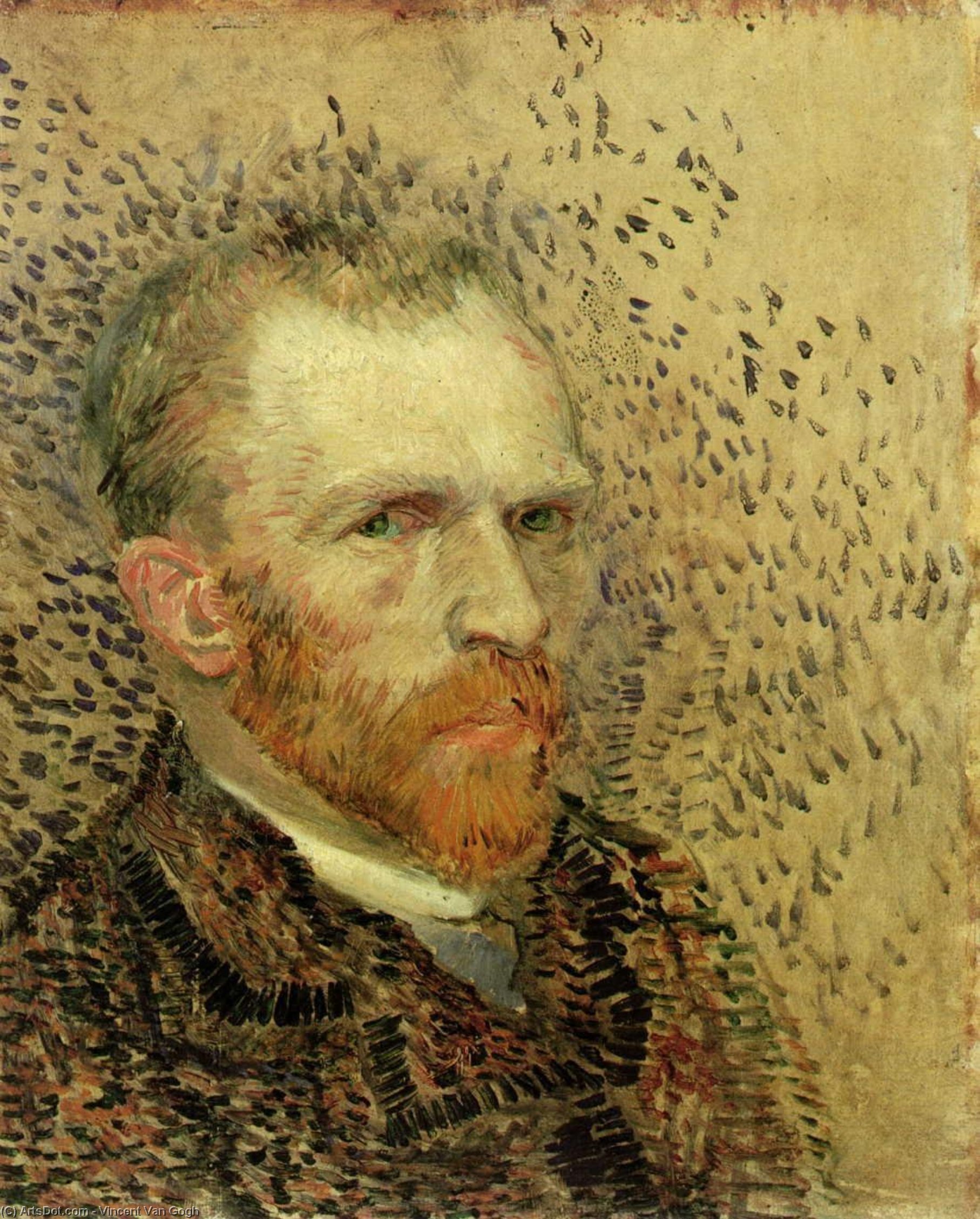
Self Portrait
Vincent van Gogh’s “Self Portrait,” painted in 1887 during his Parisian sojourn, stands as one of the most poignant emblems of artistic introspection and psychological vulnerability—a testament to the artist's relentless pursuit of self-understanding through visual representation. More than just a likeness of his face, this painting embodies a complex tapestry of emotions and stylistic innovations that define Van Gogh’s distinctive contribution to Post-Impressionism.
The Artistic Context
Van Gogh arrived in Paris armed with an unwavering conviction: “I prefer painting people’s eyes to cathedrals,” he confessed to Theo van Gogh—a declaration that encapsulates his artistic philosophy and reflects the broader intellectual currents of the era. Impressionism, championed by artists like Claude Monet and Pierre-Auguste Renoir, had begun to yield to Post-Impressionism, spearheaded by figures such as Cézanne and Gauguin, who sought to transcend mere optical observation and delve into subjective experience. Van Gogh’s approach mirrored this trend, prioritizing expressive brushwork and vibrant color palettes over meticulous realism—a deliberate rejection of academic conventions that prioritized technical accuracy above emotional resonance.
Key Elements
The painting's visual language is characterized by a masterful deployment of technique. Thick impasto—the application of paint in textured layers—dominates the canvas surface, creating palpable physicality and conveying an immediacy of feeling. Van Gogh’s palette leans heavily on warm hues—ochre yellows, fiery reds—contrasting sharply with cooler blues and greens that swirl around his face, generating a dynamic interplay of color and light. The artist meticulously rendered his gaze, capturing its intensity and unwavering focus—a gesture imbued with symbolic significance as an emblem of self-awareness and determination. Scattered birds in the background serve as visual metaphors for freedom and aspiration—elements that resonate deeply within Van Gogh’s broader artistic vision.
Historical Influences
Van Gogh's artistic sensibilities were profoundly shaped by encounters with Japanese woodblock prints—
Ukiyo-e—which captivated him with their flattened perspectives, bold compositions, and masterful use of color. These prints instilled in him a fascination for simplifying forms and prioritizing expressive visual impact—influences that are evident throughout his oeuvre. Furthermore, Van Gogh’s engagement with Cézanne's geometric explorations contributed to his own stylistic evolution, prompting him to investigate ways of representing volume and space through fractured planes and overlapping contours.
Museum Collections
“Self Portrait” resides prominently within the Vincent van Gogh Museum in Amsterdam—a repository of over 800 paintings and drawings that offer unparalleled insight into Van Gogh’s artistic development and creative spirit. Visitors can immerse themselves in an environment designed to evoke the atmosphere of his studio, fostering a deeper appreciation for the artist's profound engagement with color, texture, and emotion. The museum’s curators have meticulously reconstructed Van Gogh’s workspace, showcasing original materials—brushes, pigments, canvases—that illuminate the processes involved in creating these iconic artworks.
Legacy
Vincent van Gogh’s “Self Portrait” transcends its formal qualities to become an enduring symbol of artistic vulnerability and psychological exploration—a masterpiece that continues to inspire artists and art enthusiasts alike. Its haunting gaze compels contemplation on themes of identity, perception, and the artist's relationship with the external world—subjects that remain relevant across generations. The painting’s enduring appeal testifies to Van Gogh’s ability to distill complex emotions into a deceptively simple visual form—a testament to his mastery of technique and his unwavering commitment to conveying profound psychological truths.
- Artist: Vincent van Gogh
- Birth Year: 1853
- Death Year: 1890
- Birth City: Zundert
- Birth Country: Netherlands