A Glimpse of a Graying City: Walter Richard Sickert’s “Les Arcades de la Poissonnerie”
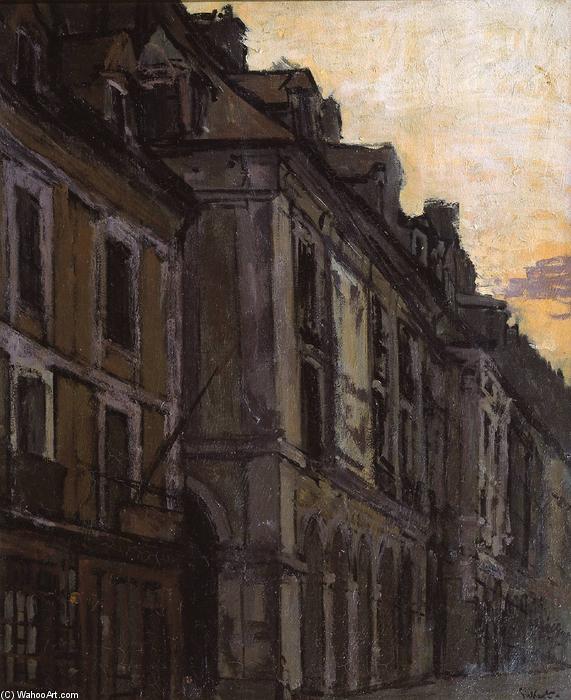
Walter Richard Sickert's "Les Arcades de la Poissonnerie," painted in 1900, isn’t merely a depiction of Dieppe; it’s an immersion into the city’s melancholic beauty. The canvas presents a carefully constructed urban landscape dominated by the imposing facades lining Quai Duquesne, the harbor street. Sickert masterfully captures the muted palette of a late afternoon or early evening – browns, grays, ochres, and subtle blues – creating an atmosphere thick with quiet contemplation. It’s a scene that speaks not of vibrant life, but rather of a dignified stillness, a moment suspended in time.
The composition itself is deliberately flattened, prioritizing form over strict realism. Sickert eschews the detailed perspective often favored by his contemporaries, instead employing strong vertical lines to emphasize the height and solidity of the buildings. This choice directs the viewer’s eye upwards, drawing attention to the interplay of light and shadow across the weathered stone surfaces. The architecture isn't idealized; it possesses a certain ruggedness, reflecting the working-class character of Dieppe at the turn of the century.
Impressionism in the Shadow of Modernity
Sickert’s style firmly resides within the realm of late 19th-century Impressionism, yet he subtly diverges from its more optimistic tendencies. He retains the loose brushwork and emphasis on capturing a fleeting sensation – the diffused light, the texture of the stone – but infuses it with a darker, more introspective mood. This is evident in his use of color; rather than bright highlights, Sickert favors subtle gradations and muted tones that contribute to the overall sense of somberness. Influenced by Whistler’s exploration of tonal relationships and Edgar Degas' focus on capturing movement and atmosphere, Sickert developed a unique visual language characterized by a fascination with urban life and its often-hidden complexities.
The painting’s historical context is crucial to understanding its emotional resonance. Sickert was deeply embedded in the Camden Town Group, a circle of artists who rejected academic traditions and sought to capture the gritty realities of London life. This group embraced a darker aesthetic, exploring themes of poverty, prostitution, and social alienation – subjects often overlooked by more conventional art movements. “Les Arcades de la Poissonnerie” reflects this sensibility, offering a glimpse into a world beyond the polished surfaces of Victorian society.
Technique and Symbolism: A Study in Texture and Light
Sickert’s technique is immediately apparent through his visible brushstrokes. The paint is applied with a deliberate roughness, creating a tactile surface that invites close inspection. He employed an alla prima approach – working directly onto the canvas without extensive underpainting – which further contributes to the immediacy of the scene. The layering of tones and the subtle shifts in value create a remarkable sense of depth, despite the flattened perspective.
Symbolically, the painting evokes a feeling of quiet contemplation and perhaps even melancholy. The graying city, shrouded in twilight, suggests a world on the cusp of change – a transition from the Victorian era to the modern age. The arcades themselves, reminiscent of Roman ruins, hint at a sense of timelessness and decay. Sickert’s choice of subject matter—a working-class harbor street—underscores his interest in portraying marginalized figures and overlooked corners of urban life. The painting is not simply a record of Dieppe; it's an exploration of the human condition within its specific setting.
This reproduction captures the essence of Sickert’s vision, offering a window into a world both familiar and strangely distant. It’s a piece that rewards repeated viewing, revealing new nuances with each encounter.