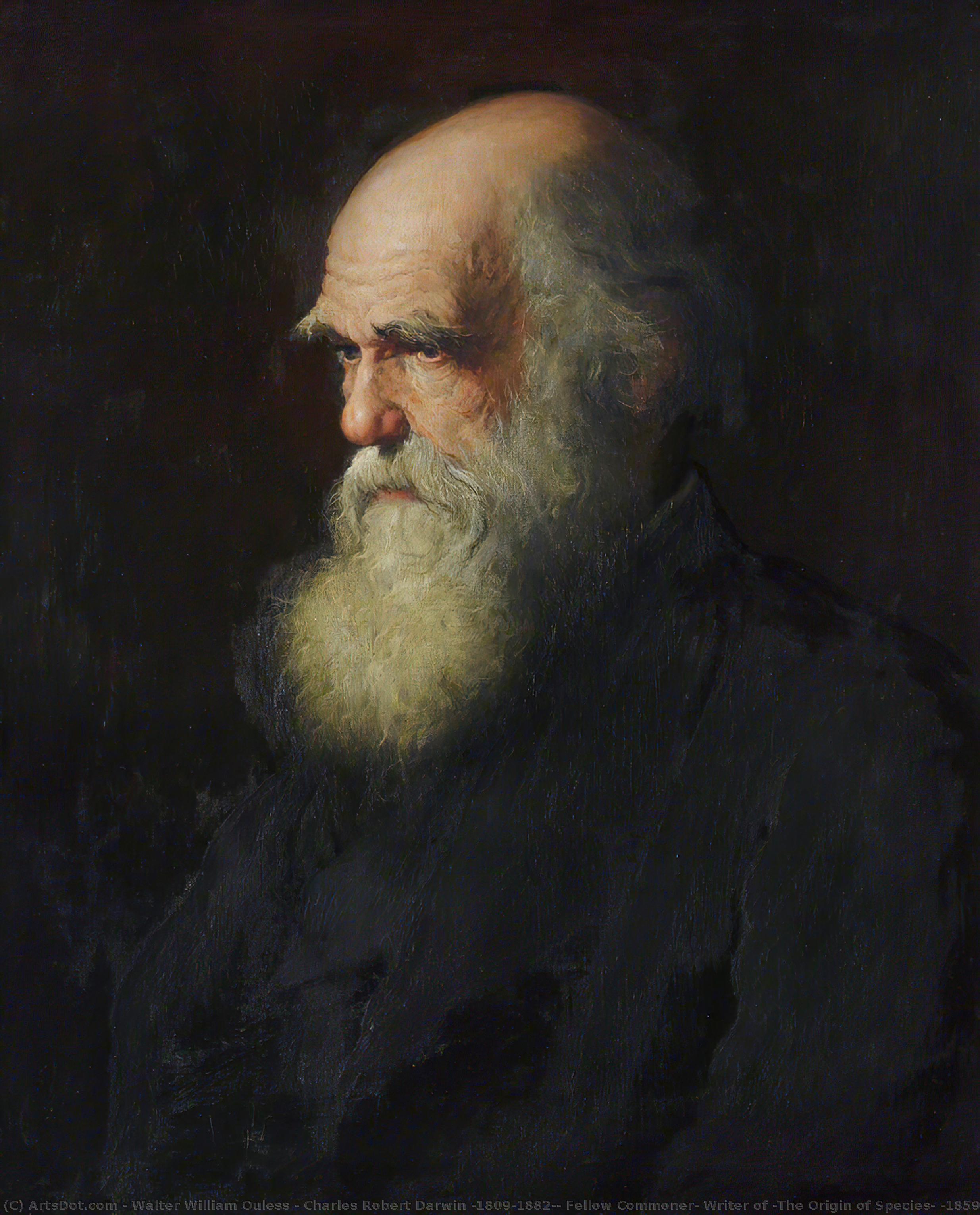
Admire Walter William Ouless’s 1883 portrait of Charles Darwin – a realistic oil painting capturing the scientist's intellect & legacy. Explore this significant piece at Christ's College, Cambridge.
ウォルター・ウィリアム・ウルス RA (1848-1933) は、写実的な人物研究や風景画で知られる著名なイギリスの肖像画家です。王立アカデミー会員として、19世紀の重要人物たちを描き残しました。彼の芸術と遺産をぜひご覧ください!
ケンブリッジのクリスト・カレッジを探索!1437年設立のこの歴史的な大学は、見事な建築、静穏な庭園、ダーウィンやミルトンといった著名な卒業生を誇ります。何世紀にもわたる学術的卓越性を発見してください!
A Portrait of Scientific Genius: Walter William Ouless’s Representation of Charles Darwin
Walter William Ouless's depiction of Charles Robert Darwin stands as a testament to the Victorian fascination with scientific inquiry and the burgeoning movement towards capturing intellectual portraits. Executed in 1883, this oil on canvas – measuring precisely 65 x 55 cm – resides at Christ’s College (Cambridge, United Kingdom), offering viewers an intimate glimpse into a pivotal figure of the nineteenth century. The painting transcends mere likeness; it embodies Ouless's commitment to academic realism and his masterful manipulation of chiaroscuro lighting to convey Darwin’s profound seriousness and contemplative spirit.
The Artist’s Vision: Gauguin’s Influence
Though Walter William Ouless himself wasn’t as globally celebrated as Paul Gauguin, he nonetheless operated within a milieu profoundly impacted by Gauguin's revolutionary approach to art – an artist who similarly sought refuge from societal conventions in pursuit of artistic authenticity. Like Gauguin, Ouless prioritized capturing the essence of his subject’s inner life rather than simply presenting a superficial exterior. This dedication to psychological depth is evident in the gaze of Darwin himself, which radiates intelligence and unwavering focus.
Subject Matter: Darwin – The Architect of Evolutionary Thought
Charles Robert Darwin, born in Shrewsbury in 1809, irrevocably altered our understanding of biology with his groundbreaking theories on natural selection and descent with modification. His magnum opus, ‘The Origin of Species,’ published in 1859, challenged prevailing dogma and established him as the father of modern evolutionary science. Ouless’s portrait skillfully captures this intellectual stature, portraying Darwin not merely as a scientist but as a man wrestling with complex ideas – a figure consumed by observation and driven by an unyielding desire to comprehend the natural world.
Technique and Style: Mastering Chiaroscuro
Ouless's technique exemplifies the stylistic conventions of his time—a deliberate embrace of academic realism characterized by meticulous anatomical accuracy and painstaking detail. The artist skillfully employs chiaroscuro lighting, a dramatic interplay between light and shadow, to sculpt Darwin’s form and imbue the canvas with palpable depth. Shadows drape across his face and clothing, highlighting wrinkles and emphasizing the contours of his features, creating an atmosphere of solemn contemplation. Brushstrokes are layered and textured, contributing to a rich surface finish that reflects the artist's meticulous attention to craftsmanship.
Symbolism and Emotional Resonance
Beyond its technical prowess, the portrait carries significant symbolic weight. The dark background serves as a visual anchor, drawing attention to Darwin’s face and reinforcing his intellectual dominance. Furthermore, Ouless’s portrayal speaks to the broader anxieties of Victorian society regarding scientific progress – capturing not only Darwin's physical appearance but also his unwavering conviction in the power of reason and observation. Ultimately, this artwork invites contemplation on the legacy of Darwinian thought and its enduring influence on our understanding of life itself.