A Prelude to Abstraction: Kandinsky’s Bavarian Landscape
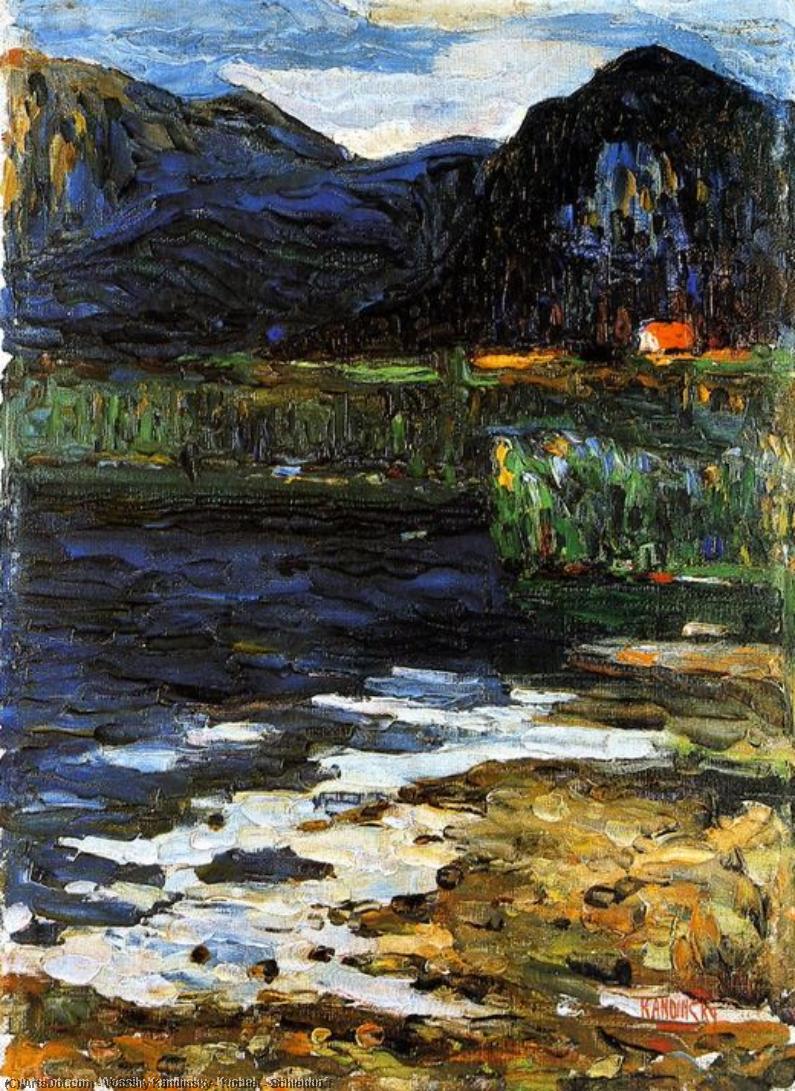
This evocative landscape, painted in 1902, marks a crucial juncture in Wassily Kandinsky's artistic evolution. Before his groundbreaking explorations into abstract art, Kandinsky was deeply invested in capturing the *feeling* of nature, not merely its appearance. “Kochel - Schlehdorf” beautifully exemplifies this transitional period, brimming with emotional resonance and hinting at the non-objective works to come.
Subject & Setting: The Allure of the Bavarian Alps
The painting depicts a dramatic view of the Bavarian Alps mirrored in the tranquil waters of a lake or pond. A humble cottage is nestled amongst lush vegetation, subtly acknowledging human presence within this grand landscape. However, this isn’t a straightforward depiction; Kandinsky prioritizes mood over topographical accuracy. The location itself – the Bavarian Alps – held significant appeal for artists seeking respite from burgeoning industrialization and inspiration in nature's majesty. It was a retreat, a source of spiritual renewal, and a canvas for emotional projection.
Expressionist Style & Technique: Impasto and Emotional Color
“Kochel - Schlehdorf” is firmly rooted in the emerging Expressionist style.
Kandinsky’s brushwork is vigorous and bold, prioritizing emotional impact over realistic representation. Forms are simplified and abstracted; mountains become powerful masses defined by color and texture rather than precise detail. The technique of *impasto* – applying paint thickly to the canvas – is central to the painting's effect, creating a richly textured surface where the physicality of the paint itself contributes to its dynamism and energy. Uneven lighting casts dramatic shadows, enhancing depth even as perspective remains deliberately flattened.
Historical Context: A Pivotal Year for Kandinsky
1902 was a transformative year for Kandinsky. Having abandoned a promising legal career, he had recently moved to Munich, actively seeking his artistic voice. He absorbed influences from Impressionism (particularly Monet’s *Haystacks*), Post-Impressionism, and folk art, but rapidly developed a unique approach. This landscape demonstrates that early synthesis – it's not imitation, but a translation of emotional response. It represents a vital step towards his eventual rejection of representational form altogether.
Symbolism & Emotional Impact: Solitude and the Sublime
The painting evokes a profound sense of solitude and contemplation. The imposing mountains symbolize strength, permanence,
and isolation. The water, reflecting both sky and landscape, suggests fluidity, introspection, and perhaps the subconscious mind. The small cottage, dwarfed by its surroundings, highlights humanity’s fragile place within nature's vastness. The overall tonality – leaning towards darker hues punctuated by bursts of color – contributes to a feeling of melancholy or wistful longing.
A Landscape That Resonates
“Kochel - Schlehdorf” is more than just a beautiful scene; it’s a testament to Kandinsky's artistic journey and a powerful expression of the human condition in relation to nature. It invites viewers to
feel a place, connecting with their own inner emotional landscapes. This painting would be a compelling addition to any collection or interior space seeking depth, emotional resonance, and a touch of early modern brilliance.
- Style: Expressionism, Early Modern
- Medium: Oil on Canvas
- Year: 1902
- Dimensions: Unknown