Layers: An Exploration of Geometric Abstraction
Wassily Kandinsky’s “Layers,” created around 1943, stands as a testament to the enduring power of abstraction and its ability to transcend representational imagery. This striking canvas embodies the culmination of Kandinsky's lifelong pursuit of spiritual expression through visual art—a journey that began with an unexpected fascination for Impressionism and solidified during his formative years in Munich.
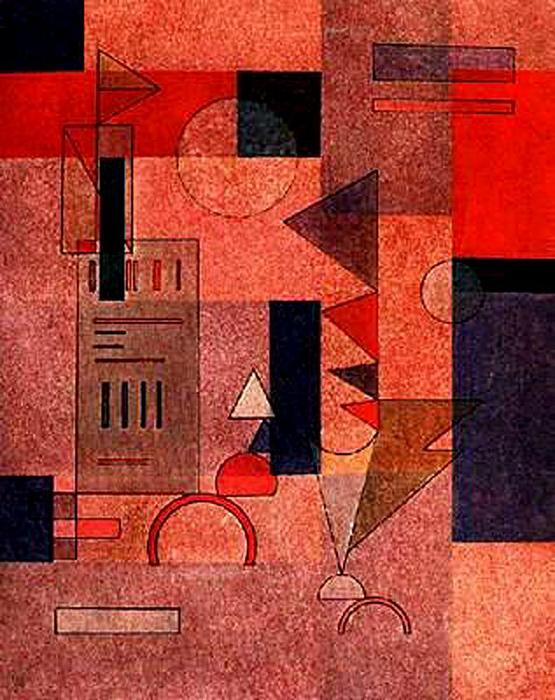
- Subject Matter: The artwork eschews recognizable figures or objects, opting instead for a purely geometric landscape. Dominating the composition is a rich reddish-brown hue punctuated by squares, rectangles, circles, and triangles arranged with deliberate asymmetry.
- Style & Technique: “Layers” firmly establishes Kandinsky within the realm of geometric abstraction, aligning closely with the influential Constructivist movement that emerged in Russia during the early 20th century. The painting utilizes oil paint on canvas—a technique characterized by visible brushstrokes and a textured surface—to achieve an effect of layered materiality.
- Historical Context: Kandinsky’s artistic evolution coincided with a period of profound intellectual and cultural upheaval. Influenced by thinkers like Nietzsche and Freud, he sought to liberate art from the constraints of traditional depiction, believing it could communicate directly with the subconscious mind and evoke spiritual sensations.
Symbolism & Emotional Impact: The geometric forms themselves are interpreted as representing structure and order against chaos—a recurring motif in Kandinsky’s oeuvre. While devoid of explicit narrative content, “Layers” communicates a palpable sense of dynamism and energy through its bold color palette and rhythmic arrangement of shapes. The reddish-brown hue evokes warmth and earthiness, grounding the composition while simultaneously conveying an underlying feeling of contemplation.
- Color Palette: Primarily composed of variations of red-brown, black, and creamy white, the color scheme contributes significantly to the artwork’s emotional resonance. Kandinsky deliberately employed color not merely for decorative purposes but as a vehicle for expressing inner states of mind—a cornerstone of his artistic philosophy.
- Texture & Brushwork: The rough texture achieved through Kandinsky's brushstrokes underscores the materiality of the painting and reinforces its expressive qualities. These visible marks serve as evidence of the artist’s process, inviting viewers to engage with the artwork on a tactile level.
“Layers” continues to captivate audiences today due to its masterful synthesis of formal innovation and spiritual aspiration. Its reproduction offers an opportunity to experience firsthand the profound beauty and intellectual depth of Kandinsky’s groundbreaking vision—a timeless masterpiece that embodies the spirit of modern art.