A Window Into Enlightenment London
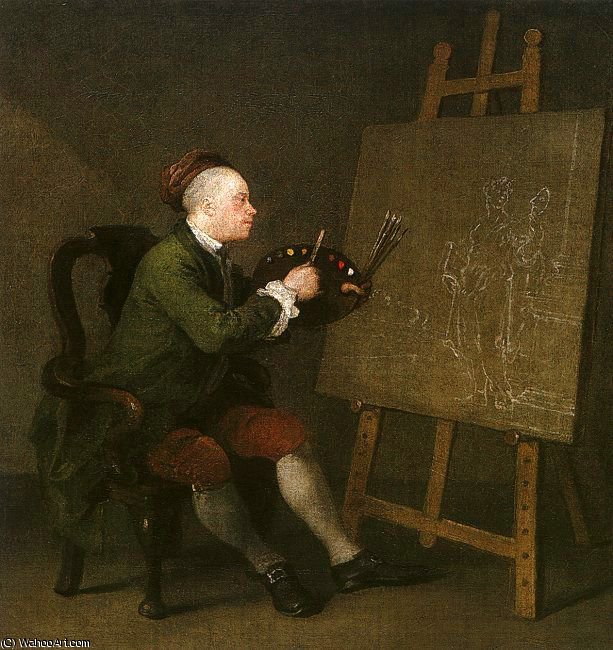
To gaze upon William Hogarth’s “Self Portrait at the Easel” is to step through a portal into the vibrant, often contradictory heart of 18th-century England. Completed around 1748, this masterpiece serves as much more than a simple record of an artist’s likeness; it is a meticulously crafted snapshot of intellectual and social life during the Age of Reason. In this era, characterized by a fervent belief in scientific inquiry and philosophical progress, Hogarth presents himself not merely as a craftsman, but as a profound thinker. The painting captures the very essence of Georgian England—a period where the light of Enlightenment was beginning to illuminate the shadows of long-standing social hierarchies.
The composition centers on the artist himself, seated with a deliberate and commanding presence at his easel. Surrounded by the humble yet essential tools of his trade—scatter of brushes, pigments, and a palette—Hogarth elevates the act of painting to an intellectual pursuit. His gaze is direct and unflinching, possessing a self-awareness that reflects the burgeoning humanist spirit of his time. Through a masterful blend of realism and the subtle, expressive qualities of the Rococo style, Hogarth achieves a texture of life that feels both immediate and eternal. The technique allows the viewer to sense the weight of the bristles and the richness of the oils, grounding the lofty intellectual themes in the tactile reality of the studio.
Symbolism and the Domestic Sphere
Beyond the central figure, the painting breathes with a quiet, domestic complexity. The background offers an intimate glimpse into Hogarth's world, where a dining table laden with tableware sits illuminated by the soft, flickering glow of candlelight. This setting suggests a life that is comfortable yet perhaps somewhat austere, reflecting the artist's grounded nature. The presence of figures in the periphery adds layers of narrative depth, hinting at familial connections and the social structures that defined the era. These secondary characters serve as vital foils to Hogarth’s solitary contemplation, prompting us to consider how the individual exists within the broader tapestry of society.
Every element within the frame is imbued with symbolic significance. The easel stands as a monument to creativity and the relentless pursuit of truth through artistic representation. The palette and brushes are not merely objects, but symbols of the meticulous observation required to capture the human experience. For the discerning collector or interior designer, this work offers a profound sense of narrative weight. It is a piece that invites conversation, acting as an anchor in any space by providing a window into a vanished world of intellectual rigor and social transformation.
An Enduring Legacy for the Modern Collector
For those seeking to adorn their homes or galleries with art that possesses both historical gravity and aesthetic beauty, a high-quality reproduction of this self-portrait offers unparalleled inspiration. The emotional impact of the work lies in its ability to bridge the gap between the 18th century and the present day, reminding us of the enduring power of the human gaze and the importance of documenting our place in history. Whether placed in a study, a library, or a sophisticated living space, Hogarth’s vision brings an air of scholarly elegance and timelessness.
Owning a piece that captures the "Hogarthian" spirit means embracing a legacy of social commentary and technical brilliance. This painting is not just a decoration; it is an invitation to reflect on the progress of civilization and the enduring importance of the artist as a witness to their time. It remains a cornerstone for any collection dedicated to the profound intersections of art, history, and the human soul.