A Whisper of Impressionism: Capturing a Moment with William Merritt Chase
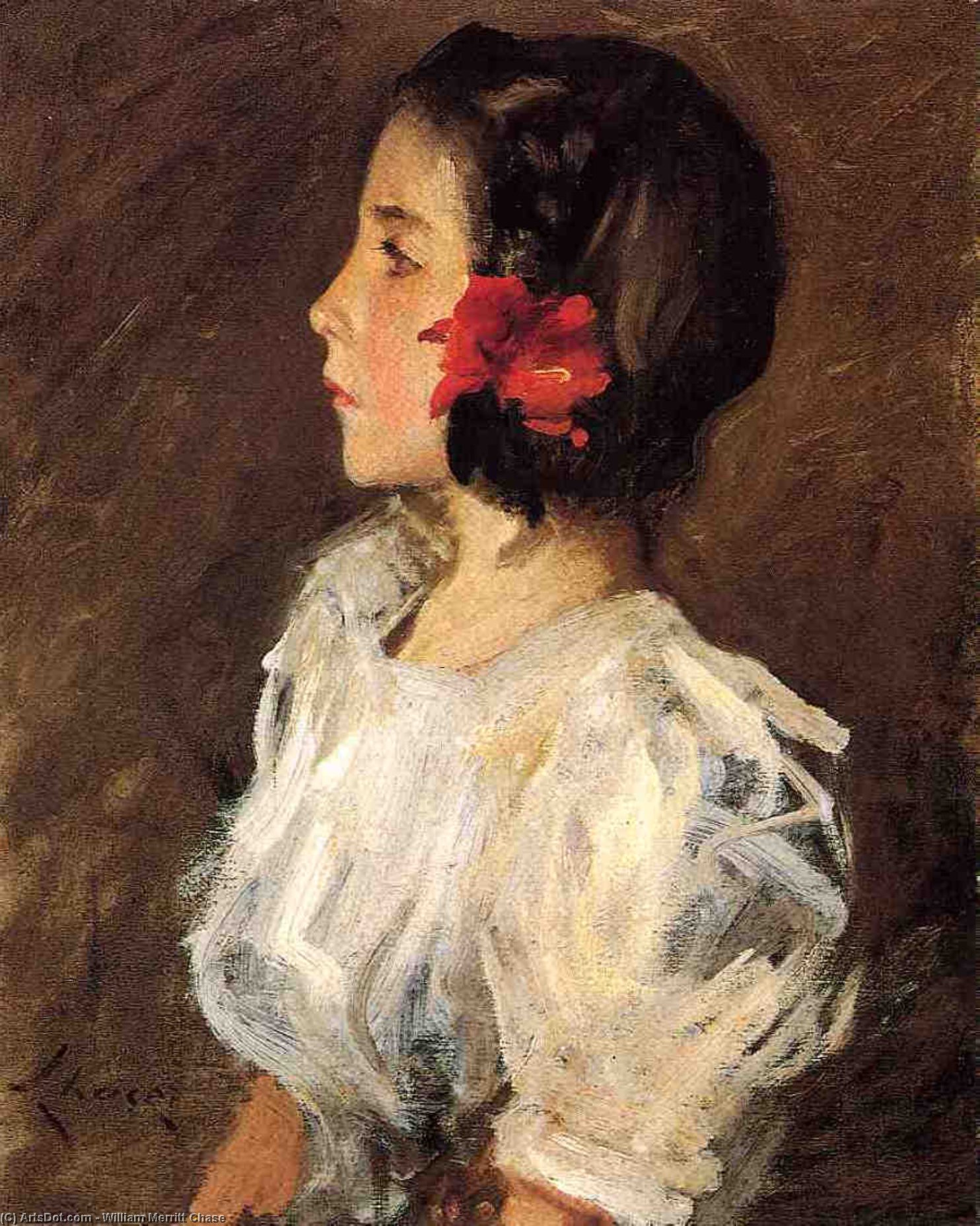
To stand before Dorothy is to step directly into the luminous haze of the early twentieth century. William Merritt Chase, a titan of American art, gifted us this exquisite pastel portrait in 1906, a work that transcends mere depiction to become an echo of contemplation itself. The painting immediately draws the eye to its central figure—a woman whose long hair seems woven from shadow and light, dressed in the pristine simplicity of white. Yet, it is the single, vibrant red flower nestled within her tresses that acts as an immediate focal point, a passionate punctuation mark against the soft palette surrounding her.
The Delicate Alchemy of Pastel Technique
Chase’s mastery is perhaps most evident in his choice of medium: pastel. This technique allows for a breathtaking softness, lending the entire scene a delicate, almost ephemeral quality, as if viewed through a veil of twilight. Unlike the sharp edges of oil paint, the pastel dust whispers across the surface, capturing not just light, but the very sensation of it playing upon skin and fabric. Chase was renowned for his innovative use of this medium, transforming what could be seen as fragile into something enduringly beautiful. The play of light here is palpable; one can almost feel the gentle glow illuminating her downward gaze.
Narrative Depth and Compositional Harmony
The subject’s posture—head bowed in apparent thought—invites the viewer into a private moment, suggesting a narrative that remains beautifully untold. She seems lost in reverie, contemplating something just beyond our sight. This intimacy is wonderfully framed by the presence of two other figures, subtly placed on either side. They are secondary notes to the main melody of Dorothy’s contemplation, grounding her within a social context while allowing her inner world to remain paramount. The composition balances this central solitude with peripheral human connection.
Historical Resonance and Enduring Appeal
As an Impressionist piece from 1906, Dorothy captures the very spirit of modern life—a moment suspended between grand societal movements and quiet personal reflection. For the collector or designer, this painting offers more than just decoration; it offers atmosphere. Reproducing this work allows one to infuse a space with the sophisticated elegance of American Impressionism. It speaks to an appreciation for masterful technique, historical depth, and the profound beauty found in fleeting human emotion.