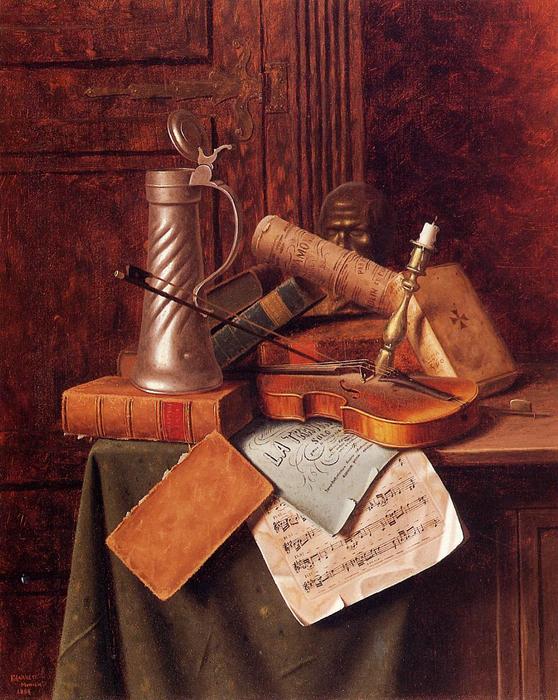
The
Munich Still Life is a remarkable painting by
William Michael Harnett, an American artist known for his exceptional skill in creating trompe l'oeil still lifes. This painting, dated 1884, is a prime example of Harnett's ability to deceive the viewer's eye with his meticulous attention to detail and masterful use of light and shadow.
Composition and Technique
The
Munich Still Life features a beautifully arranged still life composition, with a violin as the central focus. The painting showcases Harnett's expertise in rendering various textures and materials, from the smooth surface of the violin to the roughness of the books and the delicate patterns on the vases. The use of oil on panel allows for a level of detail and precision that is characteristic of Harnett's work.
Artistic Significance
The
Munich Still Life is not only a stunning example of Harnett's technical skill but also a reflection of his artistic vision. The painting is a testament to the artist's ability to transform everyday objects into a work of art, inviting the viewer to contemplate the beauty in the mundane. As seen in other works by
William Michael Harnett, such as
Still Life: Le Mot d'Or and
Old Models, available on
https://ArtsDot.com, the artist's attention to detail and commitment to realism are evident throughout his oeuvre.
Trompe l'oeil is a French term that translates to "deceives the eye," and Harnett's work is a prime example of this artistic technique. The
Munich Still Life is a painting that continues to fascinate audiences with its incredible level of detail and realism, making it a must-see for anyone interested in American art and the trompe l'oeil tradition.
The
Munich Still Life is a significant work in the oeuvre of
William Michael Harnett, demonstrating the artist's mastery of still life painting and his ability to create intricate, visually stunning compositions. As a testament to the enduring power of art to captivate and inspire, the
Munich Still Life remains an important work in the history of American art.