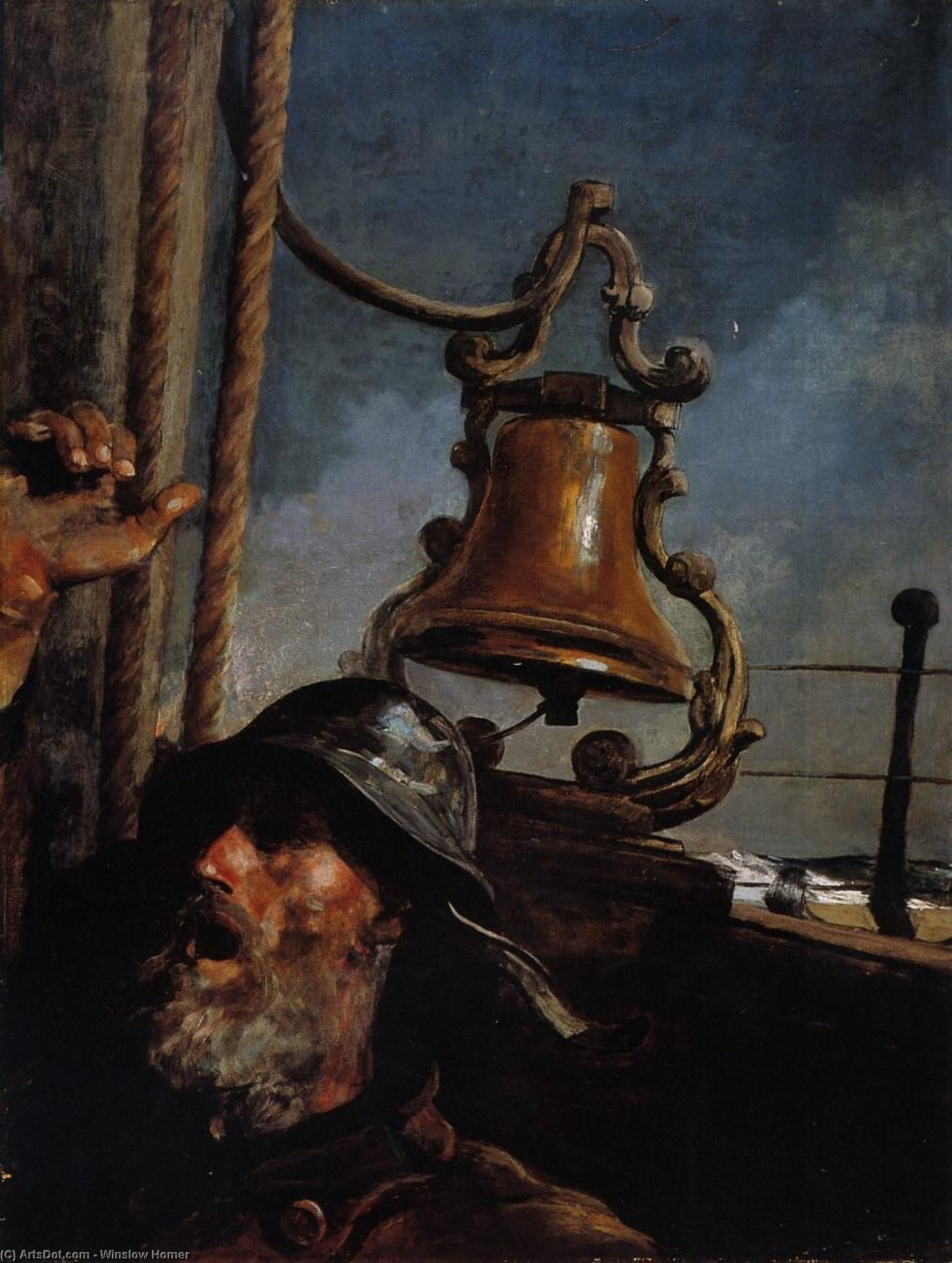
The Lookout - All's Well
Winslow Homer, one of the most celebrated American artists of his time, created a captivating oil on canvas painting titled
The Lookout - All's Well in 1896. This artwork is currently housed at the
Museum of Fine Arts in Boston, United States.
Composition and Storytelling
The painting depicts a man standing on a boat with his hands raised towards the sky, seemingly gazing at something above him. The man wears a hat, which adds to the overall atmosphere of the scene. A bell hangs from a rope, possibly indicating the presence of a ship's crew or signaling some form of communication. Additionally, a clock is visible on the boat, serving as a timekeeping device for the sailors. Homer’s masterful brushwork captures the essence of life at sea, incorporating various elements that contribute to a dynamic and engaging composition—a testament to his ability to tell stories through art. The stark black and white palette amplifies the drama, focusing attention on the central figure's gesture and conveying a profound sense of contemplation amidst the vast expanse of the ocean.
Artistic Elements
The painting’s execution is characterized by thick impasto texture—a technique where paint is applied in heavy layers—creating palpable physicality and enhancing visual depth. Homer skillfully utilizes light and shadow to sculpt form, emphasizing the contours of the man's body and the boat’s structure. The muted tonal range contributes to a mood of solemnity and introspection, mirroring the contemplative gaze of the protagonist. This deliberate stylistic choice underscores Homer’s commitment to realism while simultaneously imbuing the artwork with emotional resonance.
Context and Significance
Winslow Homer was renowned for his ability to portray everyday life with remarkable sensitivity—a skill evident in
The Lookout - All's Well. It reflects his fascination with maritime life and the human experience during a period marked by both industrial expansion and profound social change. The painting serves as an enduring symbol of resilience—a quiet defiance against the overwhelming forces of nature—and invites viewers to contemplate themes of solitude, faith, and connection to something larger than oneself. Homer’s work continues to inspire artists and audiences alike, cementing his place as a cornerstone of American art history.
Relevance and Availability
For those interested in exploring more of Winslow Homer's oeuvre,
The Lookout - All's Well is available for viewing at the Museum of Fine Arts in Boston. Furthermore,
The Morning Bell, another notable piece by Homer, can be found on ArtsDot. Explore reproductions crafted with meticulous attention to detail—bringing Homer’s vision into your home and enriching your appreciation for American art. Consider also
The Blue Church by Efa Prudence Heward, or
Luis Falero, a Spanish painter known for his female nudes and mythological settings.
Discover the Artworks of Rothesay Pavilion, Rothesay, United Kingdom Rothesay Pavilion houses numerous masterpieces from renowned artists.