プレビュー
プレビュー
 プリントを購入
 シェアする
シェアする シェアする
シェアする


 ダウンロード
 似ている作品
 X線調査
X線調査 スライドショー
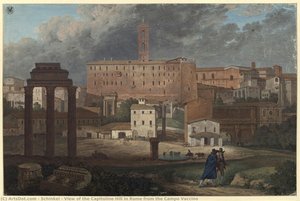
View of the Capitoline Hill in Rome from the Campo Vaccino
 Oil On Canvas
- WallArt
- Neoclassicism
 47.0 x 30.0 cm
 クーパーシュチッヒカビネット
Karl Friedrich Schinkel’s “View of the Capitoline Hill in Rome from the Campo Vaccino”: A NeoClassical Masterpiece Reflecting Roman Grandeur
The artwork, titled "View of the Capitoline Hill in Rome from the Campo Vaccino," stands as a testament to Karl Friedrich Schinkel's unparalleled ability to capture both architectural precision and atmospheric emotion. Executed around 1803/1804 during his formative years as an architect and artist, this oil painting on canvas embodies the ideals of Neoclassicism—a movement that sought inspiration from ancient Greece and Rome—while simultaneously demonstrating Schinkel’s mastery of tonal gradation and compositional balance. More than just a scenic depiction, it's a carefully crafted statement about order, beauty, and the enduring legacy of classical civilization.- Subject Matter: The painting focuses squarely on the Capitoline Hill in Rome, a prominent landmark steeped in Roman history and mythology. Schinkel meticulously portrays the Temple of Jupiter Optimus Maximus—a symbol of imperial power and religious devotion—alongside surrounding buildings, presenting a panoramic vista that aims to convey the grandeur of the city’s past.
- Style: The artwork adheres strictly to Neoclassical principles. Linear perspective dominates the composition, guiding the viewer's eye towards the central temple and establishing a sense of depth. Geometric shapes—primarily squares and rectangles—are utilized extensively in architectural forms and decorative elements, reflecting the movement’s emphasis on rationality and symmetry.
- Technique: Schinkel employed a technique characterized by subtle tonal variations achieved through meticulous layering of paint—a hallmark of his artistic style. Atmospheric perspective is skillfully rendered, diminishing the intensity of colors and blurring contours in distant structures to simulate the effects of air and distance. Brushstrokes are visible but restrained, contributing to a textured surface that enhances the realism of the scene without overwhelming its overall elegance.
- Historical Context: Created during Schinkel’s early career, “View of the Capitoline Hill” reflects the intellectual fervor of Prussia under Frederick William III—a period marked by ambitious architectural projects designed to elevate the nation's prestige and solidify its cultural identity. The painting aligns with broader artistic trends of the time, mirroring the fascination with classical antiquity that permeated European art and thought.
- Symbolism: Beyond its visual beauty, the artwork carries symbolic significance. The Temple of Jupiter Optimus Maximus represents divine authority and imperial patronage—themes central to Schinkel’s architectural vision. Furthermore, the depiction of Rome itself embodies ideals of civic virtue and artistic excellence, reflecting Schinkel's belief in the transformative power of art to shape society and inspire contemplation.
Additional Research & Resources
To delve deeper into Schinkel's artistic legacy, explore these valuable links:- View of the Capitoline Hill: Admire Schinkel’s ‘View of the Capiteline Hill.’ This detailed 18th-century oil painting showcases Roman grandeur & architectural precision. Explore its neoclassical style & historical significance.
- SCHINKEL SUPERSTAR - Google Arts & Culture: Discover Schinkel’s groundbreaking achievements and explore his influence on German architecture.
- Karl Friedrich Schinkel: Explore Schinkel’s life, artistic style and notable works.
- View of the Capitoline Hill: Order a copy of Schinkel’s masterpiece.
Artist Information
Karl Friedrich Schinkel (1781–1841), Germany: A Prussian Visionary: The Life and Legacy of Karl Friedrich Schinkel Schinkel’s life was a compelling narrative woven with threads of personal hardship and professional triumph, unfolding against the backdrop of shifting political landscapes and burgeoning artistic movements. The devastating fire that ravaged Neuruppin in 1787, tragically claiming his father’s life while Schinkel was still a young boy, cast a long shadow over his formative years. This early experience instilled within him a profound appreciation for order, permanence, and the enduring power of form—qualities that would later define his artistic vision. He received early mentorship under Friedrich Gilly and his father David Gilly, both influential architectカール・フリードリヒ・シンケル(1781 – 1841)
カール・フリードリヒ・シンケル(1781-1841)を発見!プロイセンを代表する建築家兼画家。新古典主義とゴシック・リバイバルの傑作、ベルリンの設計、そして影響力のある初期モダニズムのビジョンを探る。
クーパーシュチッヒカビネット(Berlin, Deutschland)
ベルリンのクプファシュティッヒカビネットで、ドゥーラーやレンブラントなどの名作を含む数世紀にわたる版画と素描の世界を探索!美術館島にある活気ある芸術博物館でドイツの文化遺産を発見しましょう。 ドイツ ベルリン クプファシュティッヒカビネット ルネサンス期の版画 50万点以上の版画 版画と素描 1831 古代ローマの彫刻 1 クプファシュティッヒカビネット博物館の主な焦点は何ですか?
作品詳細
- 作品名: View of the Capitoline Hill in Rome from the Campo Vaccino
- 作家: カール・フリードリヒ・シンケル
- 作品サイズ: 47.0 x 30.0 cm
- 技法: Landscape
- 著作権の状態: パブリックドメイン
- 展示場所: クーパーシュチッヒカビネット
- 動勢: Neoclassicism
- 技法・素材: Oil On Canvas
- 制作時期: Mature Period
- 主要な色: Gray
作品詳細
- Title: View of the Capitoline Hill in Rome from the Campo Vaccino
- Movement: Neoclassical
- Artistic style: Detailed landscape painting
- Influences:
- Greek architecture
- Caspar David Friedrich
- Location: Alte Nationalgalerie, Staatliche Museen zu Berlin
- Subject or theme: Roman antiquity; Urban panorama
- Artist: Karl Friedrich Schinkel
QRコード