Introduction
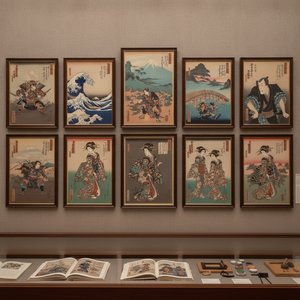
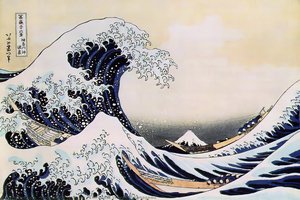
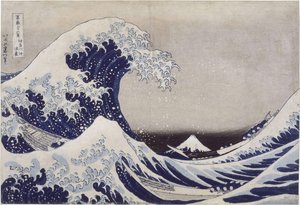
To step into the world of Ukiyo-e is to enter a realm of "floating worlds," where the ephemeral joys of life—the transient beauty of a falling cherry blossom, the rhythmic pulse of a crowded street, or the quiet dignity of a passing wave—are captured forever in ink and color. Emerging from the vibrant urban culture of Japan's Edo period, these woodblock prints were more than mere decorations; they were the heartbeat of a society finding its voice through art that celebrated the everyday, the sensual, and the spectacular.
Through delicate linework and a revolutionary use of flat color planes, the masters of this movement transformed simple mulberry paper into windows onto a lost era. These works did not just document history; they shaped the visual language of an entire nation, eventually traveling across oceans to ignite the fires of Impressionism in Europe. The mastery found in these prints lies in their ability to balance profound stillness with intense movement, inviting us to pause and find eternity within a single, fleeting moment.
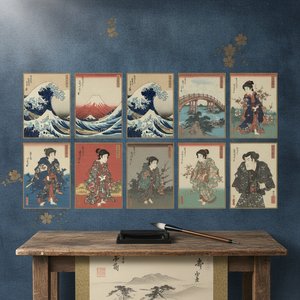
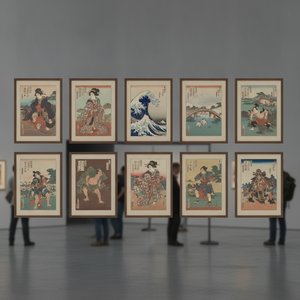
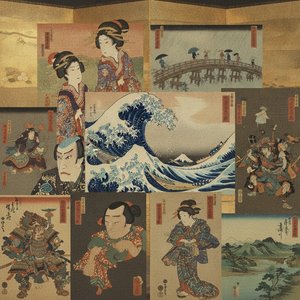
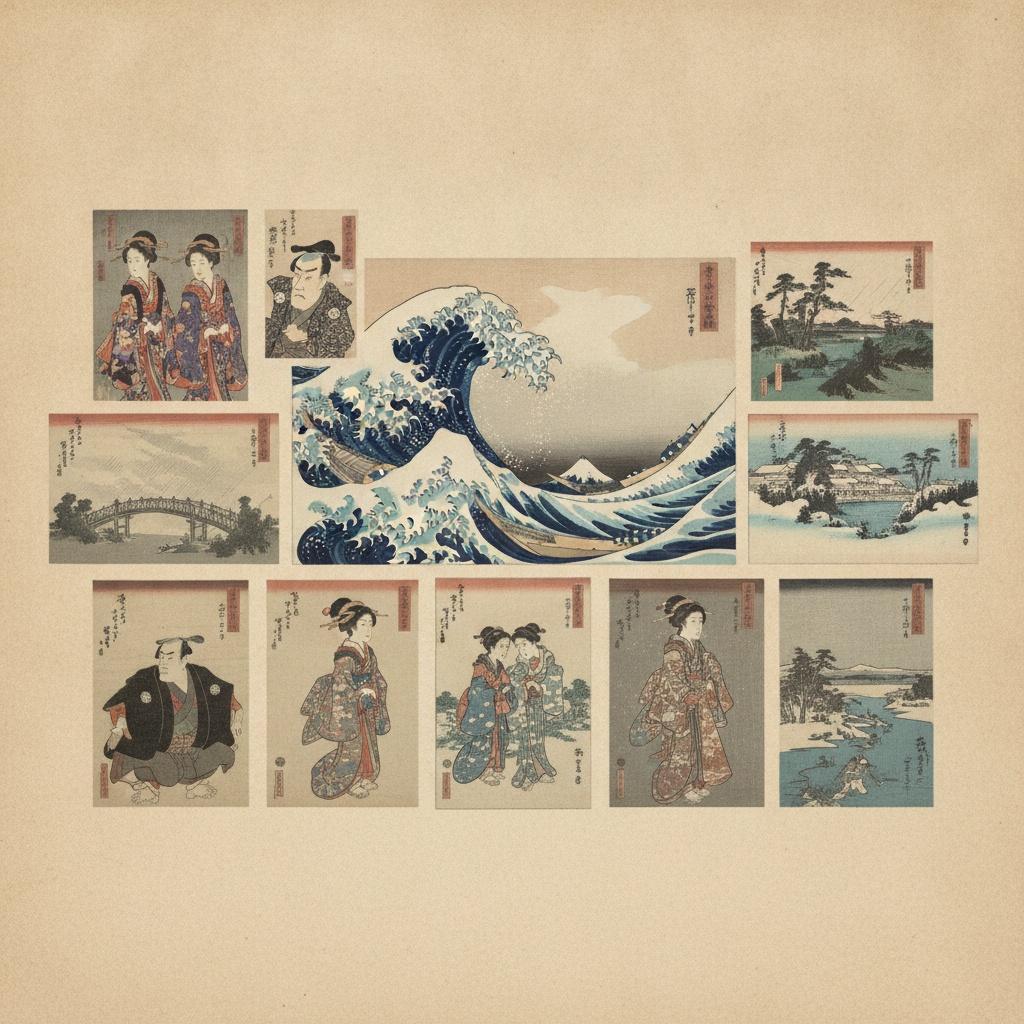
As we journey through this curated selection, we will explore ten definitive masterpieces that serve as the pillars of the Ukiyo-e tradition. Each piece presented here offers a unique glimpse into the craftsmanship and cultural spirit of an era, showcasing the technical precision and emotional depth that continue to resonate with collectors and art lovers across the globe today.
Phoenix - Katsushika Hokusai
 Phoenix - Katsushika Hokusai
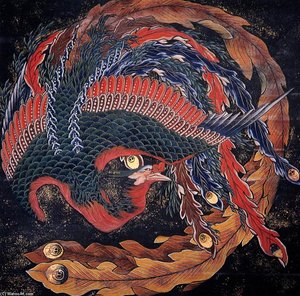
Imagine a moment of sudden, radiant warmth as the legendary Katsushika Hokusai brings the mythical Phoenix to life. This masterpiece serves as a profound meditation on rebirth and resilience, capturing the bird in a glorious arc of fiery reds, vibrant oranges, and soft golds. The composition is a symphony of movement; the central phoenix spreads its wings with dignified power, surrounded by a meticulous circle of foliage that symbolizes the eternal cosmos. Hokusai’s signature technique—blending the precision of Ukiyo-e woodblock traditions with the ethereal, layered washes of sumi-e ink painting—creates an atmosphere of deep, spiritual depth.
Beyond its historical significance in the Japanese Ukiyo-e movement, this work offers a transformative energy for the modern interior. The interplay of light and the symbolic triumph of life over adversity provide a focal point of inspiration and calm. Whether placed in a corporate lounge or a private study, the Phoenix introduces a sense of timelessness and sophisticated grace, inviting quiet reflection on the continuous cycle of growth and renewal.
Kinoe no komatsu - Katsushika Hokusai
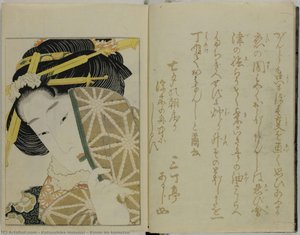 Kinoe no komatsu - Katsushika Hokusai
To understand the true breadth of the Ukiyo-e movement, one must look beyond the serene landscapes to the raw, pulsating energy of human intimacy and folklore. Kinoe no komatsu by Katsushika Hokusai serves as a profound testament to this duality. Published in 1814, this intricate trilogy transcends simple illustration, utilizing the meticulous mokuhanga woodblock technique to weave tales of passion and myth. The work begins with striking ōkubi-e portraits—large-head images of courtesans that capture nuanced psychological depth through delicate line work and expressive gazes.
As you move through the pages, the visual narrative shifts into complex, symbolic scenes where nature and desire intertwine, most famously seen in the surreal, tactile imagery of connection and abundance. Hokusai’s ability to balance the erotic with the allegorical makes this work a cornerstone of Japanese art history. Today, these masterworks continue to captivate, offering a window into the Edo period's cultural soul and reminding us how powerful imagery can transform a modern space with historical gravity and emotional depth.
The Dish Mansion - Katsushika Hokusai
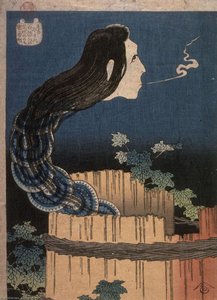 The Dish Mansion - Katsushika Hokusai
To gaze upon The Dish Mansion by Katsushika Hokusai is to step into a spectral realm where the boundaries between the human and the supernatural dissolve. There is a profound, melancholic beauty in the sight of the solitary figure perched upon jagged rocks, her upward gaze and quiet cigarette smoke evoking a universal sense of contemplative solitude. This masterpiece earns its place among the top 10 defining works of the Ukiyo-e movement through its masterful use of Prussian blue, a pigment that lends the ocean a deep, spiritual luminosity and connects the viewer to the folklore of the floating world.
Hokusai’s ability to weave motion—seen in the soaring bird and drifting boats—with such heavy, symbolic stillness is what makes this print an enduring icon of Japanese art history. At ArtsDot.com, we honor this legacy by offering hand-painted oil reproductions that capture every nuanced brushstroke and tonal depth of Hokusai’s original vision. Whether you are decorating a corporate space or a private collection, our museum-quality recreations allow you to bring the haunting elegance of the Edo period into your contemporary environment.
Battle Between Two Warriors - Katsushika Hokusai
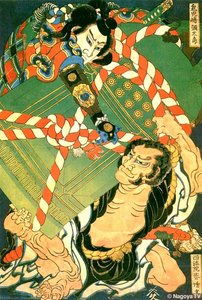 Battle Between Two Warriors - Katsushika Hokusai
In Battle Between Two Warriors by Katsushika Hokusai, the viewer is met with a profound geometric equilibrium that transcends the chaos of combat. The composition is anchored by a masterful use of intersecting lines and balanced shapes; the vertical tension of the swordsman on the left finds its counterweight in the fluid, rhythmic placement of decorative elements like the soaring bird and drifting fish. This structural harmony creates a sense of timeless perfection, making it a cornerstone of the Top 10 Masterpieces That Defined the Japanese Ukiyo-e Art Movement .
Hokusai utilizes a vibrant palette of reds, greens, and blues to frame the warriors, employing a flattened perspective that emphasizes symbolic weight over literal realism. This deliberate arrangement of form and color mirrors the principles of modern minimalist design, where every element serves a functional, aesthetic purpose. By stripping away unnecessary clutter and focusing on essential silhouettes, Hokusai provides a visual grounding that feels remarkably contemporary, allowing this Edo-period treasure to integrate seamlessly into a clean, sophisticated modern aesthetic.
The Phantom of Kohada Koheiji - Katsushika Hokusai
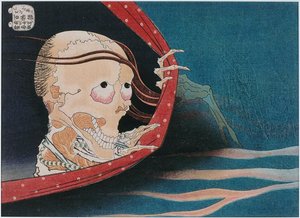 The Phantom of Kohada Koheiji - Katsushika Hokusai
Step into the shadows of 1831 with Katsushika Hokusai’s The Phantom of Kohada Koheiji , a work that breathes life into the chilling folklore of the Edo period. The scene unfolds with a cinematic tension; amidst a deep, melancholic blue background, a skeletal face emerges from beneath an unfolding umbrella, creating a haunting interplay of concealment and revelation. Hokusai utilizes meticulous woodblock techniques to weave a tapestry of dread and drama, where the starkness of death meets the vibrant textures of Kabuki tradition.
The composition is heavy with symbolic weight—the presence of crows as omens of misfortune and the skeletal features serving as a visceral reminder of mortality. This masterpiece does more than illustrate a ghost story; it captures a profound atmospheric depth that transcends time. For the modern collector, integrating such a powerful piece of the Japanese Ukiyo-e movement into a space offers an unparalleled sense of mystery and intellectual intrigue. Its cool tones and dramatic silhouette provide a sophisticated focal point, inviting quiet reflection and adding a layer of historical storytelling to any contemporary interior.
Cherry Blossoms - Katsushika Hokusai
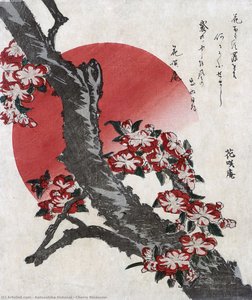 Cherry Blossoms - Katsushika Hokusai
Imagine standing in a quiet Edo-period garden, where the air is thick with the scent of spring and the world feels momentarily suspended in time. This sense of profound stillness is captured perfectly in Katsushika Hokusai’s Cherry Blossoms . The artwork presents a striking composition: delicate pink blossoms clinging to a branch, set against a bold, celestial red circle that evokes the rising sun. It is more than a landscape; it is a meditation on mono no aware —the pathos of things and the beauty of impermanence.
This piece earns its place among the top 10 masterpieces of the Ukiyo-e movement through its masterful use of flattened perspective and symbolic depth. Hokusai uses the ephemeral cherry blossom to remind us of life's fleeting nature, a theme that resonates across centuries. In our fast-paced modern era, bringing such a work into a professional or residential space offers a much-needed anchor of serenity. Much like the legendary woodblock prints that defined an era, this painting serves as a timeless window into a world of balance, grace, and emotional resonance.
Raiko tormented by the earth spider - Utagawa Kuniyoshi
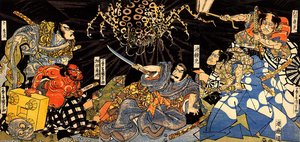 Raiko tormented by the earth spider - Utagawa Kuniyoshi
In Raiko tormented by the earth spider , Utagawa Kuniyoshi achieves a breathtaking level of visual tension through his mastery of line and texture. The viewer is immediately drawn to the intricate, almost tactile detail of the spider’s segmented body and the sharp, decisive strokes that define Raiko’s traditional samurai armor. This work stands as a pillar of the Japanese Ukiyo-e movement because it transcends mere illustration; Kuniyoshi utilizes bold, dynamic compositions and a dramatic, dark color palette to transform folklore into a visceral psychological experience. The way the light catches the swirling patterns of the demonic siege creates a sense of movement that is rare in woodblock printing.
At ArtsDot.com, we recognize that the true power of such masterpieces lies in their physical presence. Our high-end reproductions are meticulously crafted to preserve this tactile, three-dimensional quality , ensuring that the deep tonal ranges and the energetic spirit of Kuniyoshi’s brushwork are brought into your space with museum-grade precision, allowing the drama of the Edo period to live on in a modern setting.
Station 36, Goyu; Kyoka Tokaido Series - Utagawa Hiroshige
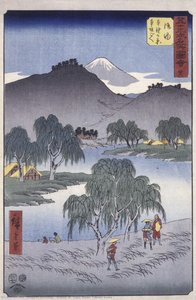 Station 36, Goyu; Kyoka Tokaido Series - Utagawa Hiroshige
Step into the quietude of 1855 with Utagawa Hiroshige’s Station 36, Goyu , a masterpiece from the Kyoka Tokaido Series that captures the very breath of Edo-period Japan. The scene unfolds like a soft memory: a winding path traces alongside tranquil waters, leading the eye toward the majestic, snow-capped silhouette of Mount Fuji. Hiroshige employs a masterful use of atmospheric perspective, where cool blues and muted greens dissolve into a misty distance, creating an ethereal sense of depth that feels almost cinematic.
The print is a triumph of ukiyo-e technique, utilizing the bokashi method to achieve delicate color gradients that mimic the soft light of an overcast day. There is a profound, rhythmic stillness in the way travelers move through the landscape, symbolizing the human journey amidst nature's permanence. For the modern collector, bringing this work into a space offers more than mere decoration; it introduces a focal point of meditative calm. Its harmonious palette and structural elegance serve to anchor contemporary interiors, inspiring moments of reflection and a deep connection to the timeless beauty of the natural world.
Sakai-chô - Katsushika Hokusai
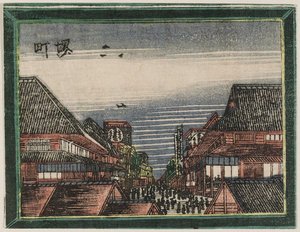 Sakai-chô - Katsushika Hokusai
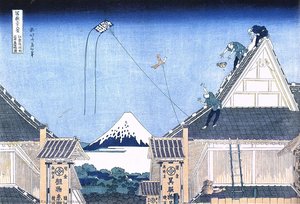
In Sakai-chô , Katsushika Hokusai captures the rhythmic pulse of Edo-period life with an unparalleled sense of movement and urban vitality. As a cornerstone of the Japanese Ukiyo-e movement, this masterpiece transcends simple documentation; it is a sensory immersion into a bustling district where merchants, pedestrians, and even a solitary circling bird converge in a perfectly balanced composition. Hokusai’s innovative use of perspective and the striking application of Prussian blue create a depth that feels remarkably modern, pulling the viewer directly onto the crowded sidewalks of 19th-century Japan.
This work remains essential to our selection of the top 10 masterpieces because it exemplifies the technical precision and storytelling prowess that defined an era. Today, the print’s clean lines and dynamic energy resonate deeply with contemporary design sensibilities. Its ability to introduce a sophisticated, historical ambiance makes it a timeless choice for modern interiors, offering a window into a lost world that continues to inspire fashion, graphic arts, and high-end architectural decor.
Two Carp In A Cascade - Katsushika Hokusai
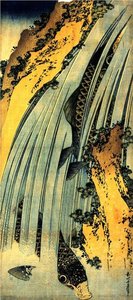 Two Carp In A Cascade - Katsushika Hokusai
In Two Carp In A Cascade , Katsushika Hokusai captures a profound meditation on resilience that transcends the boundaries of the Edo period. This masterpiece does not merely depict fish in motion; it embodies the philosophical struggle for harmony amidst life's turbulence. The cascading waterfall serves as a powerful metaphor for the ceaseless flow of existence, while the two carp, navigating the white foam with grace, symbolize the strength and perseverance required to overcome adversity.
Hokusai’s technical mastery is on full display through his use of vibrant Prussian blue pigments and delicate, layered washes that create an immersive atmospheric depth. The interplay between the rhythmic movement of the water and the tranquil presence of the fish creates a sensory experience that remains strikingly relevant in today's fast-paced world. As a cornerstone of the Japanese Ukiyo-e art movement , this work continues to inspire modern aesthetics, offering a timeless visual language of balance and endurance that resonates deeply within contemporary curated spaces and collectors of fine Japanese landscapes.
Conclusion
To wander through the world of Ukiyo-e is to traverse the "floating world" itself—a realm where the ephemeral beauty of a falling blossom, the crest of a wave, and the quiet grace of a passing shadow are captured in eternal stillness. These ten masterpieces are far more than mere relics of Edo-period Japan; they are living presance, breathing with a vitality that transcends centuries. They remind us that even in the most fleeting moments of human existence, there is a profound, enduring dignity waiting to be recognized.
As the light fades on our journey through these woodblock treasures, we invite you to consider how such profound beauty might inhabit your own surroundings. These works were never meant to be confined to the silent halls of museums; they were born from the pulse of daily life and are destined to enrich it. By bringing the delicate linework and evocative colors of Ukiyo-e into your home or workspace, you do more than decorate a wall—you invite a sense of historical wonder and rhythmic tranquility into your daily rituals. Let these textures and tones serve as constant, gentle reminders of the creativity and grace that define our shared human experience.
We invite you to explore the depth and breadth of this storied tradition within our full collection , where the spirit of the floating world awaits your discovery.