From Cave Walls to Sarcophagi: The Primordial Roots of Animal Imagery
 Animalia: Exploring the Enduring Presence of Animals in Art & Interior Design
The Ancient Bond: Animals as Symbols in Early Art From the ochre handprints alongside depictions of bison in the caves of Lascaux to the meticulously rendered creatures adorning Egyptian sarcophagi, the presence of animals in art is not merely repres...
The human fascination with the animal kingdom is perhaps our oldest narrative, predating the very development of complex language. Long before the first brush touched canvas, it was etched into the limestone walls of caves like Lascaux. In these prehistoric sanctuaries, ochre handprints accompanied powerful depictions of bison and horses, serving not merely as records of a hunt, but as profound spiritual connections to the vitality and mystery of the wild. This ancient bond evolved with breathtaking sophistication in the Nile Valley. To the ancient Egyptians, animals were far more than creatures of the earth; they were divine conduits. The jackal-headed Anubis guided souls through the mysteries of death, while the feline Bastet embodied the protective warmth of domesticity and fertility. In these early eras, the animal was never just a subject; it was a symbol of the cosmic order itself, a testament to a worldview where the boundaries between the human and the divine were perpetually blurred.
Divine Beasts and Moral Lessons: Animals as Allegory in Medieval and Renaissance Art
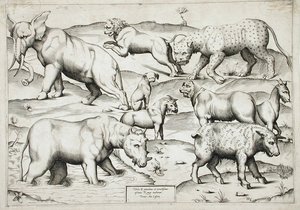 Sheet of Animals
Discover 'Sheet of Animals' by Enea Vico (1523-1567), a captivating Renaissance artwork. Explore his mythological scenes & animal studies – a unique hand-painted reproduction.
As history progressed into the Middle Ages, the representation of animals shifted from the totemic to the allegorical. The intricate bestiaries that illuminated medieval manuscripts transformed the natural world into a complex moral landscape. Here, every creature carried a weight of spiritual meaning: the lamb stood as a silent emblem of innocence, while the serpent whispered of temptation and fallibility. This tradition of using animals to communicate profound truths continued into the Renaissance, where artists began to blend mythological wonder with anatomical curiosity. Consider the captivating studies of Enea Vico, whose work captured both mythological scenes and detailed animal studies with a unique, classical grace. During this era, the artist’s eye began to move between the symbolic and the observational, laying the groundwork for a more naturalistic approach to the living world.
The Baroque Spectacle: Scientific Precision and the Flourishing of Zoological Detail
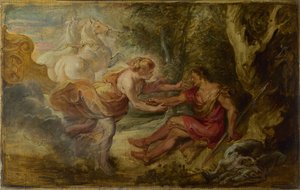
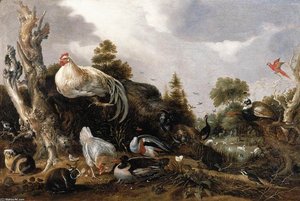 Orpheus Charming The Animals
Discover 'Orpheus Charming The Animals' by Gillis Claesz d’Hondecoeter – a stunning Dutch Baroque painting of wildlife. Explore this captivating artwork and its artist's legacy.
The Baroque period ushered in an era of unparalleled splendor and scientific inquiry. As the Enlightenment began to reshape our understanding of nature, animal painting flourished, often as a showcase for technical virtuosity and meticulous detail. In the Dutch Baroque tradition, artists like Gillis Claesz d’Hondecoeter mastered the art of the wildlife spectacle. His work, such as
Orpheus Charming The Animals, presents a breathtaking panorama of movement and texture, where every feather and fur is rendered with startling clarity. This period saw a magnificent convergence of art and science; painters were no longer just creating allegories but were documenting the intricate mechanics of life. This era of collaboration and observation allowed for a level of zoological realism that celebrated the sheer abundance and complexity of the natural world, often through the lens of grand, dramatic compositions.
< <
Romanticism and the Soul of the Wild: Capturing Emotion through Naturalistic Mastery
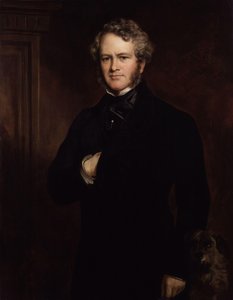 Edwin Henry Landseer
A Life Immersed in the Natural World: Edwin Henry Landseer Edwin Henry Landseer, born in London on March 7, 1802, was destined for a life inextricably linked to the animal kingdom. His father, Samuel Landseer, was an engraver and portrait painter, bu...
With the rise of Romanticism, the focus shifted once more, this time toward the emotional resonance and the untamed spirit of the animal subject. Artists sought to move beyond mere depiction to capture the very essence, or soul, of their subjects. Edwin Henry Landseer stands as a titan of this movement; his life was inextricably linked to the natural world, and his works moved from simple sporting scenes to deeply moving narratives set against the rugged Scottish Highlands. Landseer did not merely paint animals; he imbued them with psychological depth and emotional complexity. This dedication to character was echoed in the work of 19th and 20th-century masters like Arthur Wardle, whose meticulous portrayaries of dogs and domestic animals captured a spirited energy and individual personality that resonated deeply with collectors. For these artists, the animal was a vessel for exploring themes of loyalty, solitude, and the sublime power of nature.
Light, Texture, and Life: The Evolution of Animal Portraiture in Impressionism
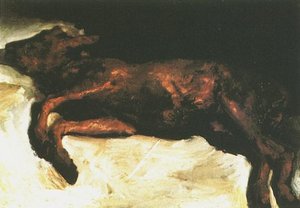 New-Born Calf Lying on Straw
Captivating Subject and Naturalistic Composition This evocative artwork captures a serene, resting animal—most likely a dog—reclining peacefully on a bed of straw. The subject exudes a sense of vulnerability and calm, inviting viewers into a quiet mo...
The evolution of animal art reached a transformative peak with the advent of Impressionism and Expressionism, where the emphasis moved from precise anatomical detail to the capture of light, atmosphere, and raw emotion. In the hands of Vincent van Gogh, the subject matter became an opportunity for expressive texture and vibrant energy. His evocative works, such as
New-Born Calf Lying on Straw, utilize vigorous, spontaneous brushstrokes and a rich, earthy palette to evoke a sense of vulnerability and quiet repose. The focus shifted to the tactile quality of the paint itself—the way light dances across the textured softness of fur or the ruggedness of straw. This movement prioritized the artist's personal emotional response to the scene, using color and light to create an intimate connection between the viewer and the tranquil, fleeting moments of the natural world.
Preserving the Legacy: Curating Masterpiece Reproductions for the Modern Collector
To possess such profound historical narratives within a contemporary home is to hold a living fragment of art history. At
ArtsDot.com, we specialize in bridging the gap between the museum gallery and the private residence through our exquisite, hand-painted oil reproductions. We do not offer mere prints; we offer the soul of the original. Our artists, holders of prestigious Fine Arts degrees, work meticulously on 100% cotton canvas to recreate the visible brushstrokes and deep tonal ranges that define true masterpieces.
Our process is designed for the discerning collector who values both tradition and transparency:
- The Commission: Following your order, you receive an immediate confirmation and a digital mockup for complex or custom orders, allowing for color adjustments before the first stroke is laid.
- The Artistry: Over a period of 2 to 4 weeks, our specialists hand-paint your chosen work, ensuring each layer of oil paint contributes to a lasting legacy.
- The Approval: We provide a pre-shipment photograph for your personal approval, ensuring the final piece meets our exacting museum standards.
- The Delivery: Once approved, your artwork is professionally framed and shipped via DHL or FedEx with full tracking to over 70 countries worldwide.
For those looking to expand their collection beyond the canonical, we offer the unique ability to "remix" history. You may request a personal photograph to be reimagined in the impasto style of Van Gogh, or even undergo a "Period Shift," transforming a modern portrait into a 17th-century masterpiece in the style of Rembrandt. Every painting is finished with a protective coat of Damar varnish, safeguarding the pigments against dust and moisture for generations. Whether you are seeking a faithful reproduction of a Dutch Baroque treasure or a custom pet portrait that captures the spirit of your own companion, we invite you to explore the enduring beauty of the world's greatest animal masterpieces.