The Alchemical Revolution: How Oil Painting Transformed the Northern Canvas
 Mastering Detail: A Guide to the Timeless Beauty and Technical Brilliance of Flemish Painting
The Alchemy of Oil: Pioneering Techniques of the Early Netherlandish Masters To step into the world of fifteenth-century Flemish art is to witness a profound revolution in the very chemistry of light. Before the masters of the North, the visual langu...
To step into the world of fifteenth-century Flemish art is to witness a profound revolution in the very chemistry of light. Before the masters of the North achieved their legendary status, the visual language of Europe was largely defined by the matte, opaque, and somewhat rigid qualities of egg tempera. This older medium, while beautiful, lacked the capacity for the slow, luminous transitions that would eventually define the Northern Renaissance. The true transformation occurred through what can only be described as an alchemical mastery over transparency and depth. By refining the technique of layering thin, translucent glazes of pigment suspended in drying oils—such as walnut or poppy seed—artists unlocked a new dimension of artistic expression.
This period, often referred to as the Franco-Flemish 15th Century, was not merely about a change in medium; it was an era of technical discovery. As artists learned to manipulate these oil layers, they achieved a jewel-like brilliance where light would penetrate the surface, catch within the pigment, and refract back to the viewer’s eye. This created a sense of internal radiance that seemed to emanate from within the canvas itself. While the origins of oil painting can be traced much further back to ancient traditions in places like Afghanistan, it was the Northern European masters who breathed life into the medium, using its forgiving nature and rich color density to move art away from the symbolic flatness of the Middle Ages toward a breathtakingly tactile reality.
Microscopic Realism: The Art of Texture, Light, and Materiality
 Oil on Canvas: A Historical & Technical Exploration of a Timeless Artistic Medium
The Origins of Oil Painting: From Ancient Murals to Early European Masters The allure of oil painting—its capacity for luminous depth, its forgiving nature, and the sheer richness of color it allows—has captivated artists for millennia. Yet, tracing ...
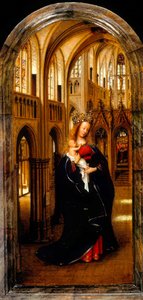
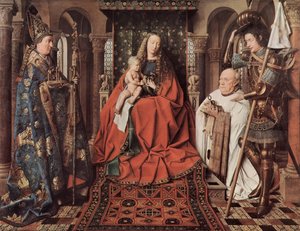
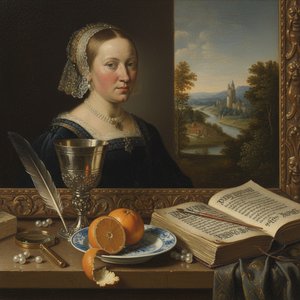
The true hallmark of Flemish mastery lies in an almost obsessive devotion to detail—a microscopic realism that invites the viewer to linger indefinitely. When one examines the works of this era, the eye is immediately drawn to a staggering precision of texture. There is a palpable weight to the heavy velvets and brocades depicted; one can almost feel the subtle sheen of a gemstone or the soft, organic pores of human skin. This was not merely a display of technical skill, but a profound way to honor the physical world through meticulous observation. The ability to capture the fleeting subtlety of light on a metallic surface or the cold dampness of a stone floor allowed these artists to create a window into a world that felt entirely tangible.
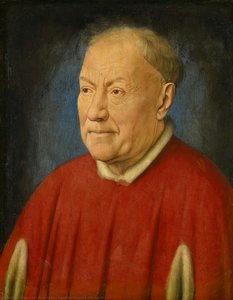
This mastery extends far beyond the human form, reaching into the very atmosphere of the paintings. Through the careful application of oil, masters like Jan van Eyck could manipulate light to suggest volume and presence. The precision was so great that even the smallest inanimate object—a brass basin, a single flower, or a reflected image in a mirror—was imbued with its own dignity and life. This level of detail served a dual purpose: it showcased the artist's academic excellence and reinforced the idea that every fragment of the physical world was worthy of intense, spiritual contemplation. It is this very texture and depth that makes a high-quality oil reproduction so much more compelling than a mere print; the visible brushstrokes and layered pigments provide a soul that digital printing simply cannot replicate.
Symbolic Landscapes: Decoding Allegory and Devotion in Flemish Art
 Allegory of Christianity
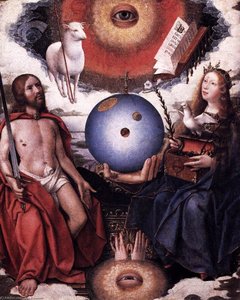
The Northern Renaissance art movement, which emerged in Europe during the 15th century, is renowned for its captivating and symbolic paintings. One such masterpiece is the Allegory of Christianity by Jan Provoost , a prominent artist of this era. Cre...
In the Northern Renaissance, beauty was rarely just aesthetic; it was deeply encoded with meaning. The paintings of this era are renowned for their captivating and symbolic compositions, where every object serves as a vessel for a larger theological or moral truth. Consider, for instance, works like Jan Provoost’s Allegory of Christianity. In such masterpieces, the composition is a complex tapestry of symbols requiring careful interpretation. A man holding a book or a woman grasping a box might represent the sacred scriptures and the treasures of faith, while a blue sphere could symbolize the heavenly realm or the unity of Christian doctrine. The presence of animals and birds often serves to represent various virtues or vices, turning a single panel into a profound sermon.
This tradition of using visual metaphors allowed artists to communicate complex religious and philosophical ideas to both the literate and the illiterate. Even in more secular landscapes, the natural world was often imbued with a sense of divine order. The landscape was not merely a backdrop but a stage for spiritual drama. This marriage of intense realism and deep allegory created a tension that is uniquely Northern: the viewer is grounded in a recognizable, physical reality, yet simultaneously pulled toward a higher, metaphysical plane. To study these works is to engage in a silent dialogue with the past, decoding the whispers of history hidden within every petal and shadow.
Beyond the Borders: The German Renaissance and the Power of Printmaking
 German Renaissance
The German Renaissance, part of the Northern Renaissance, was a cultural and artistic movement that spread among German thinkers in the 15th and 16th centuries, which developed from the Italian Renaissance. Many areas of the arts and sciences were in...
While the Low Countries flourished with oil innovation, the German Renaissance brought its own distinct energy to the movement, driven by the spread of Renaissance humanism and the monumental shifts of the Protestant Reformation. This era in Germany was marked by incredible advances in both the arts and sciences, fueled by a culture of intellectual inquiry. Perhaps the most significant contribution from this region was the mastery of printmaking—specifically woodcut and engraving. Artists like Albrecht Dürer transformed the medium, using the precision of line to spread Renaissance ideals across the entire continent. Unlike the singular, precious oil panels of Flanders, prints could be reproduced and distributed, making art a more democratic force in European society.
The German tradition emphasized a different kind of rigor—one of graphic clarity and structural strength. The influence of humanism led to a renewed interest in classical learning, yet it remained rooted in the local landscape and the pressing social changes of the 16th century. This period saw the rise of influential thinkers and scientists whose work would eventually reshape the modern world. In art, this manifested as a fascination with anatomy, perspective, and the dramatic potential of black and white contrast. The interplay between the meticulous detail of the North and the structural innovations of the German masters created a rich, multifaceted artistic landscape that defined the era.
From Bosch to Bruegel: Exploring the Enigmatic and the Human Condition
 northern netherlandish painter
The Enigmatic Vision of Pieter Bruegel the Elder Pieter Bruegel the Elder, a name synonymous with the late Northern Renaissance, remains one of the most profoundly enigmatic and enduring figures in Western art history. Born around 1525 in what is now...
As the Northern Renaissance progressed toward its later stages, the focus shifted from the purely devotional toward more complex, often enigmatic reflections on human existence. Hieronymus Bosch stands as one of the most compelling figures of this transition. Born into a family of painters, Bosch transcended his foundations to create a unique visual language populated by hybrid creatures, grotesque figures, and unsettling landscapes. His work was not an observation of reality, but a deeply personal and symbolic realm that utilized the imagery of folk tales, proverbs, and even alchemy to explore themes of morality and sin. His triptychs offer a window into a world where the fantastical and the terrifying coexist.
Following in this lineage of profound observation was Pieter Bruegel the Elder, whose work offers a remarkably layered reflection on social dynamics and the capricious nature of fortune. While often associated with "peasant" scenes, Bruegel was a sophisticated artist who integrated Italian Renaissance perspective with a distinctly Northern sensibility. His landscapes are vast and teeming with life, capturing the rhythms of human labor and the overwhelming scale of nature. From the surreal nightmares of Bosch to the panoramic human dramas of Bruegel, the late Northern Renaissance remains an enduring testament to the power of art to explore the deepest recesses of the human soul. For those seeking to bring this historical grandeur into a modern space, ArtsDot.com offers exquisite, hand-painted oil reproductions that preserve the very essence, texture, and spirit of these timeless masterpieces.