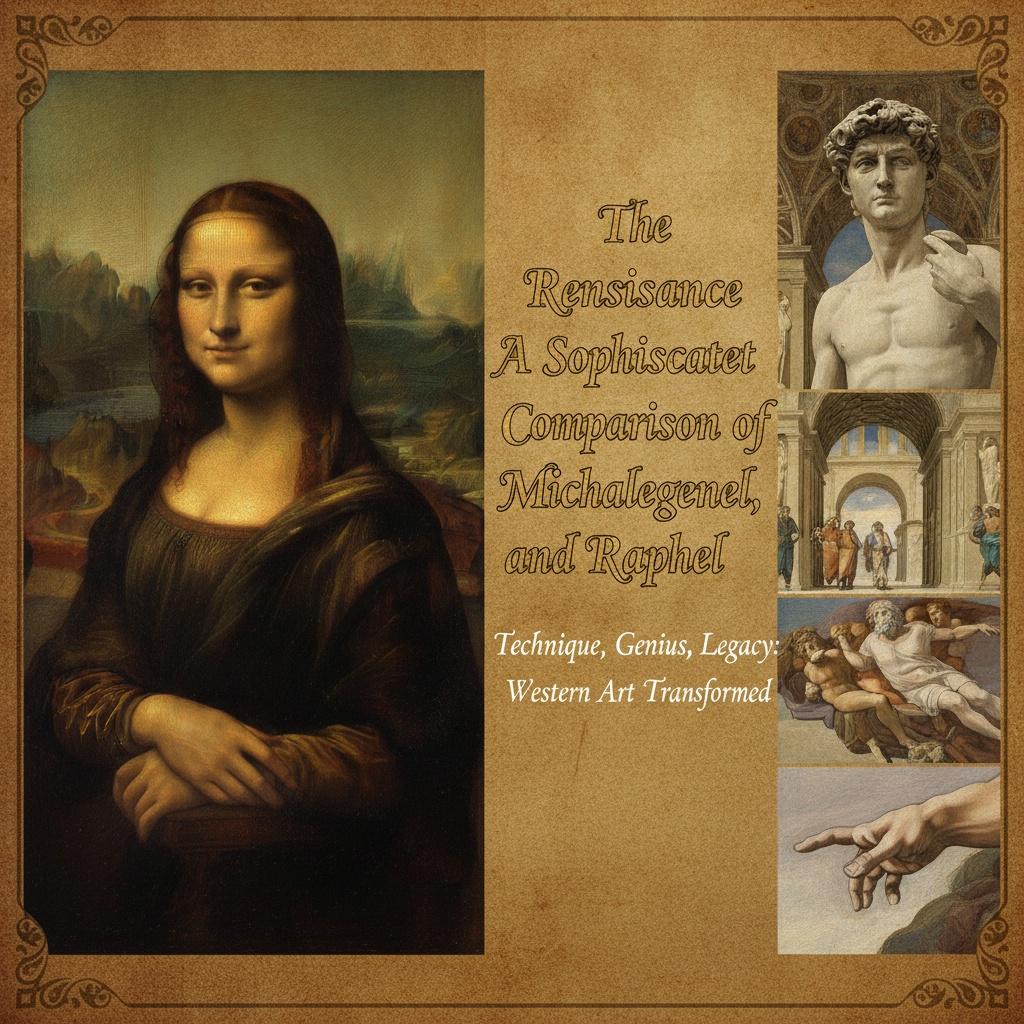
The Dawn of Genius: Understanding the High Renaissance Context
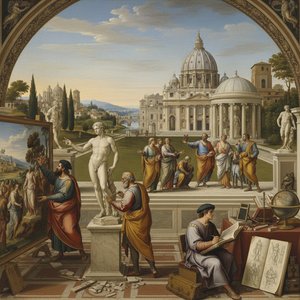 The High Renaissance: A Flourishing of Artistic Innovation & Humanist Ideals
Introduction: The Dawn of a New Artistic Era Wikipedia: High Renaissance In art history, the High Renaissance was a short period of the most exceptional artistic production in the Italian states, particularly Rome, capital of the Papal States, and in...
To step into the era of the High Renaissance is to witness a moment when the human spirit seemed to expand, touching the very edges of the infinite. It was a brief, incandescent period—roughly spanning from 1490 to 1527—where the foundations laid by the Early Renaissance in Florence blossomed into an unprecedented apex of European achievement. This was not merely a stylistic evolution but a profound cultural rebirth, fueled by the intellectual currents of Humanism. As scholars rediscovered the lost wisdom of classical antiquity, the focus of the universe shifted; man was no longer a mere subject of divine decree, but the very measure of all things.
In the vibrant centers of Florence and the papal splendor of Rome, art became the visual language of this new dignity. Under the patronage of ambitious popes like Julius II, the boundaries between science, philosophy, and aesthetics dissolved. The air was thick with the scent of discovery—from the anatomical precision born of scientific inquiry to the mathematical elegance of linear perspective. It was a time when the artist transitioned from a humble craftsman to a celebrated intellectual, a creator capable of capturing not just the likeness of the world, but its very soul. This era provided the fertile soil in which three distinct geniuses would grow, each interpreting the light of human potential through their own unique lens.
Leonardo da Vinci: The Enigma of Sfumato and Scientific Vision
 Sfumato
Sfumato (English: sfoo-MAH-toh, Italian: [sfuˈmaːto]; lit. 'smoked off', i.e. 'blurred') is a painting technique for softening the transition between colours, mimicking an area beyond what the human eye is focusing on, or the out-of-focus plane. It i...
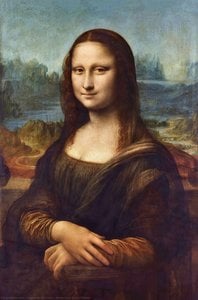
If the Renaissance was a search for truth, Leonardo da Vinci was its most profound investigator. He did not merely paint; he observed, dissected, and understood. For Leonardo, the canvas was an extension of his scientific notebooks, a place where the mysteries of optics and human vision could be rendered tangible. His approach was defined by a rejection of harsh boundaries, favoring instead the subtle, atmospheric transitions that mimic the way our eyes truly perceive the world. This revolutionary technique, known as
sfumato—literally meaning "smoky" or "blurred"—allowed him to dissolve the edges of form into shadow and light.
In masterpieces such as the
Mona Lisa and the
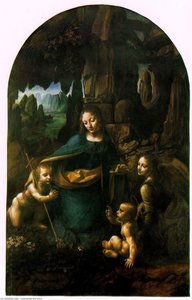
Virgin of the Rocks, one finds no rigid outlines, only a soft, seamless gradation of tones that creates an illusion of depth and life so profound it feels almost supernatural. Leonardo’s mastery of
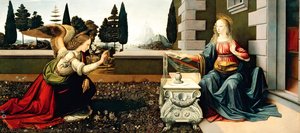
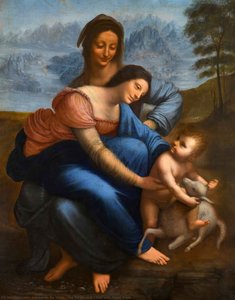
sfumato was rooted in his deep research into how light interacts with matter and how the human eye focuses on planes of existence. His work invites us into a world of mystery, where a smile or a glance remains perpetually elusive, shrouded in the delicate haze of a dream. He brought to art a sense of psychological depth and atmospheric realism that forever altered our understanding of what a painting could achieve, blending the empirical with the ethereal.
Michelangelo: The Divine Sculptor and the Power of Form
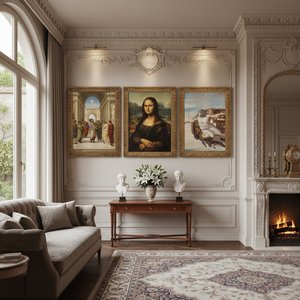 High Renaissance Masterpieces: Iconic Art for Your Home |
Introduction To gaze upon the masterpieces of the High Renaissance is to encounter a moment in time where human potential seemed limitless, and artistic expression reached unprecedented heights. This wasn’t merely a stylistic shift; it was a cultural...
Where Leonardo sought the subtle mist, Michelangelo Buonarroti sought the monumental strength of the human form. To him, the artist’s task was not to invent beauty, but to liberate it from the stone. He viewed the body as a vessel for divine struggle, an anatomical landscape capable of expressing the most intense spiritual and emotional states. His work is characterized by
terribilità—a sense of awe-inspiring power and emotional intensity that can overwhelm the viewer. Whether working in marble or fresco, Michelangelo’s focus remained on the muscularity, the tension, and the heroic scale of his subjects.
The Sistine Chapel ceiling stands as the ultimate testament to this vision, a sprawling narrative of creation and human destiny rendered with breathtaking anatomical complexity. In his sculptures, such as the
David, every vein and sinew is imbued with a latent energy, as if the marble itself were breathing. His approach to painting was inherently sculptural; he used color and light to define mass and volume, creating figures that possess a weight and presence far beyond the flat surface of the wall. For Michelangelo, art was a profound struggle between the earthly and the divine, a pursuit of perfection through the sheer force of will and the mastery of physical form.
Raphael: The Harmony of Grace and Classical Perfection
 Italian Renaissance painting
Italian Renaissance painting is the painting of the period beginning in the late 13th century and flourishing from the early 15th to late 16th centuries, occurring in the Italian Peninsula, which was at that time divided into many political states, s...
In the shadow of Leonardo’s mystery and Michelangelo’s intensity, Raphael Sanzio emerged as the great synthesizer of the High Renaissance. If Leonardo provided the soul and Michelangelo the body, Raphael provided the perfect balance. His work represents the ultimate achievement of classical harmony, characterized by clarity, grace, and an exquisite sense of proportion. He possessed a unique ability to take the innovations of his contemporaries—the soft light of Leonardo and the structural grandeur of Michelangelo—and weave them into a cohesive aesthetic of serene beauty.
Raphael’s compositions, such as the iconic
School of Athens, are marvels of spatial organization and intellectual depth. He utilized linear perspective not just to create depth, but to guide the eye through a choreographed dance of figures, each placed with intentionality and poise. His Madonnas possess a sweetness and a gentle humanity that resonate with an enduring tenderness, achieved through balanced color palettes and fluid, rhythmic lines. In Raphael’s hands, the complexities of the human experience were distilled into moments of perfect equilibrium, creating an ideal of beauty that would serve as the standard for Western academic art for centuries to come.
A Comparative Study: Divergent Paths to Artistic Immortality
 Renaissance art
Renaissance art (1350 – 1620) is the painting, sculpture, and decorative arts of the period of European history known as the Renaissance, which emerged as a distinct style in Italy in about AD 1400, in parallel with developments which occurred in phi...
To compare these three masters is to observe three distinct philosophies of existence converging in a single historical moment. They represent a trinity of approaches: the scientific, the heroic, and the harmonious. Leonardo’s path was one of endless inquiry, where the artist acts as a philosopher-scientist, using the brush to probe the secrets of nature and the mechanics of perception. His art is an invitation to wonder, a soft-focus exploration of the unknown.
Michelangelo, conversely, represents the path of the spiritual combatant. His art is a testament to the struggle of the human condition, utilizing the monumental and the muscular to express the weight of mortality and the yearning for transcendence. There is no softness in his truth, only the raw, unyielding power of form. Raphael offers the third path: the path of the idealist. He sought to capture the perfection of the classical world, creating an art of such balance and grace that it feels as though it were plucked from a higher plane of existence. While their techniques diverged—from the smoky
sfutato to the sculptural fresco—their shared commitment to the dignity of man remains the golden thread that binds them.
The Enduring Legacy: How the Trinity Shaped Western Aesthetics
 Renaissance
The Renaissance (UK: rin-AY-sənss, US: REN-ə-sahnss) was a European period of history and cultural movement taking place at the end of the Late Middle Ages and the beginning of the early modern era. It is variously defined as covering the 15th and 16...
The influence of this Renaissance trinity cannot be overstated; they did not merely create art, they established the very vocabulary of Western aesthetics. The technical innovations they pioneered—the mastery of perspective, the nuance of light and shadow, and the anatomical precision—became the foundational pillars of artistic education for generations. Their work moved art away from the symbolic rigidity of the Middle Ages toward a profound engagement with reality, emotion, and the human intellect.
Even as later movements like Mannerism and the Baroque sought to challenge or expand upon these ideals, they did so by reacting to the standard set by Leonardo, Michelangelo, and Raphael. Today, when we gaze upon their works—whether in the halls of the Vatican or through a meticulously crafted reproduction in our own homes—we are not just looking at historical artifacts. We are encountering the enduring power of human potential. Their legacy lives on in every brushstroke that seeks to capture beauty, in every sculpture that strives for truth, and in every heart that finds inspiration in the timeless harmony of the Renaissance spirit.
For those who wish to bring a piece of this eternal beauty into their own lives, ArtsDot.com offers exquisite, hand-painted oil reproductions that honor the profound techniques of these masters, ensuring that the light of the Renaissance continues to shine in the modern world.