The Pulse of the Street: Defining Neo-Expressionism's Raw Rebellion
To understand the seismic shift that occurred in the late twentieth century, one must look past the polished galleries and listen to the rhythmic, chaotic heartbeat of the city streets. While the art world had long been enamored with the cool, detached intellectualism of Minimalism, a new, visceral movement began to surge through the veins of New York. This was Neo-Expressionism—a movement that rejected the sterile and embraced the primal. It was an era where the boundaries between high culture and street rebellion dissolved, replaced by a frantic, emotive energy that sought to reclaim the human experience from the grip of abstraction.
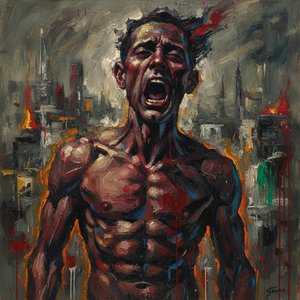
This period was characterized by a return to figurative imagery, but not in any traditional sense. The brushstrokes were no longer delicate or controlled; they were aggressive, thick with impasto, and laden with an almost desperate urgency. It was as if the artists were attempting to scrape the very essence of urban life onto the canvas, capturing the grit, the noise, and the unvarnished truth of a world in transition. This movement did not merely observe reality; it collided with it, creating a visual language that felt both ancient and urgently modern.
Basquiat’s Visual Language: Symbols, Text, and the Deconstruction of Power
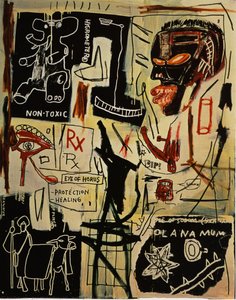
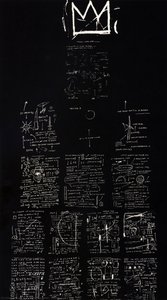
At the epicenter of this electric storm stood Jean-Michel Basquiat, a figure whose work functioned as a complex, layered manuscript of identity. To gaze upon a piece like Tuxedo is to enter a labyrinth of meaning where text and symbol dance in a state of perpetual tension. Basquiat did not simply paint; he inscribed. His canvases are populated by a cryptic lexicon of crowns, anatomical sketches, and crossed-out words that demand the viewer’s active participation. The act of crossing out a word, as seen in many of his works, was a deliberate strategy to draw even more attention to it, forcing an encounter with themes of race, class, and authority.
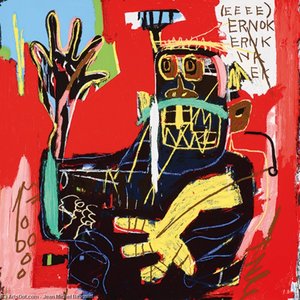
In masterpieces such as Untitled (ernok), we witness the seamless blending of urban energy and profound social commentary. He utilized symbols not as mere decoration, but as tools for deconstructing power structures. The crown, perhaps his most iconic motif, serves as a reclamation of dignity and royalty for the Black figure, asserting presence in a world designed to render them invisible. Through this layered approach, Basquiat transformed the canvas into a site of political struggle, where every frantic line and cryptic glyph contributed to a larger narrative about the complexities of existence and the weight of history.
Beyond the Canvas: The Intersection of Graffiti Aesthetics and Fine Art History
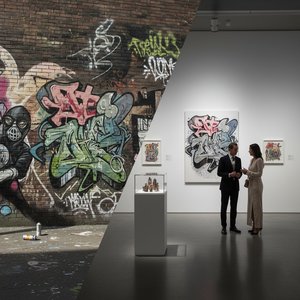
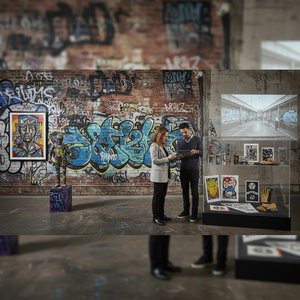
The evolution of Basquiat’s work represents one of the most fascinating dialogues in art history: the bridge between the ephemeral graffiti of the subway car and the enduring permanence of the museum. This was not a simple migration of style, but a profound synthesis. By bringing the aesthetics of street art—the drips, the spray-like textures, and the spontaneous markings—into the realm of fine art, Basquative challenged the very definition of what constitutes "valuable" art. He proved that the raw, unmediated energy of the street possessed a depth and a historical weight capable of standing alongside the masters.
This intersection created a new genre often referred to as Raw Pop, where the accessibility of pop culture meets the emotional intensity of expressionism. Works like Hollywood Africans demonstrate this beautifully, blending surrealist imagery with a graffiti-inflected boldness that confronts themes of identity through striking, fragmented portraits. This movement forced the art establishment to acknowledge that the pulse of culture often beats strongest in the margins, and that the most profound truths are frequently found in the most unexpected, unrefined places.
The Electric Palette: Analyzing Color and Chaos in Basquiat’s Masterpieces
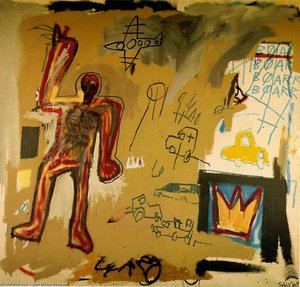
To experience a Basquiat is to be overwhelmed by color. His palette was never subtle; it was an assault of vibrant primaries and jarring contrasts that mirrored the sensory overload of New York City. In works such as Snakeman, layers of aggressive reds and yellows create a sense of heat and movement, while the chaotic arrangement of symbols suggests a world in a state of constant flux. There is no resting place for the eye; instead, one is propelled through the composition by the sheer kinetic force of his application.
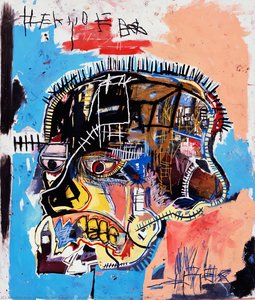
<_p>This use of color serves a dual purpose: it provides the emotional landscape for his narratives and acts as a structural element within the chaos. The vibrant hues often clash with dark, heavy outlines, creating a sense of fragmentation that is central to the Neo-Expressionist aesthetic. Even in more somber works like Untitled - Skull, the interplay of light and shadow through bold, saturated tones creates a powerful, haunting presence. It is a mastery of controlled chaos, where the artist uses the most basic elements of painting to evoke the most complex of human emotions.A Lasting Legacy: How Raw Pop Reshaped Contemporary Identity and Culture
The legacy of Basquiat and the Neo-Expressionist movement extends far beyond the era of their peak influence. They fundamentally altered the DNA of contemporary art, paving the way for future generations of artists to explore identity through a multi-disciplinary lens. The movement’s emphasis on social commentary, the use of found imagery, and the blurring of high and low culture can be seen in everything from modern street art to the digital aesthetics of today's visual landscape. Basquiat taught us that art could be both a personal diary and a public manifesto.
Today, we see his influence in the way contemporary collectors approach the concept of "the edge." The energy he captured—that raw, unpolished, and deeply human spirit—continues to resonate in an increasingly digital and curated world. He remains a beacon for those who seek art that does not merely decorate a room but challenges the soul. As we reflect on his contribution, we recognize that the electric energy of Neo-Expressionism was not just a moment in time, but a permanent expansion of the boundaries of human expression.