The Language of the Unseen: Defining Symbolic Expressionism
To gaze upon a masterpiece is often to embark on a journey through the labyrinth of the human psyche. While classical realism seeks to mirror the tangible world with anatomical precision, Symbolic Expressionism invites us to look beneath the skin of reality. It is an art movement that does not merely depict a subject, but rather translates the intangible—the tremors of anxiety, the heat of passion, and the shadows of despair—into a visual vocabulary of form and color. In this realm, the brushstroke becomes a pulse, and the canvas serves as a mirror to the soul's most private recesses.
At its core, this movement functions through a sophisticated interplay between symbolism and expression. Where a traditionalist might paint a wilting rose to signify mortality, the Symbolic Expressionist distorts the very essence of the flower, using jagged lines and clashing hues to evoke the visceral sensation of decay and loss. It is a departure from the objective; it is an embrace of the subjective truth. For the discerning collector, understanding this movement requires more than an eye for beauty—it requires an ear for the silent screams and whispered longings embedded within the pigment.
Visceral Landscapes: The Psychological Turmoil of Edvard Munch
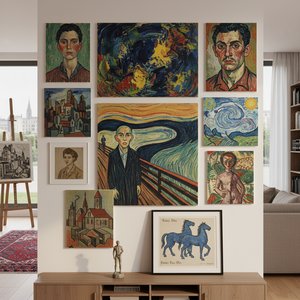
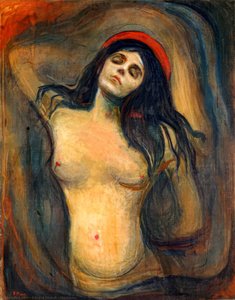
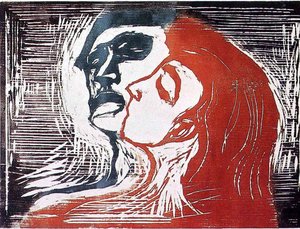
No artist has navigated the turbulent waters of the subconscious with greater mastery than Edvard Munch. His works serve as the definitive canon for those seeking to understand how art can capture psychological turmoil. In his seminal works, such as 'Passion', we encounter a visceral intensity that transcends mere depiction. The figures are not merely bodies in space; they are vessels of intense emotion, caught in a state of profound existential tension. Munch’s ability to utilize the landscape as an extension of the mind allows the viewer to feel the weight of the atmosphere itself.
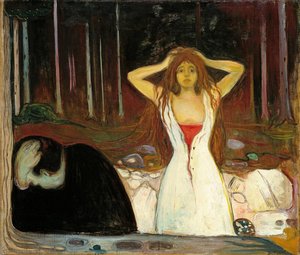
Consider the haunting depths found in 'In the Human Brain'. Here, the boundaries between the internal thought process and the external world dissolve. The painting becomes a window into fear and despair, utilizing a raw, almost primitive application of paint to mirror the fragmentation of a mind under duress. To study Munch is to witness the birth of a modern visual language where the environment reacts to the protagonist's inner state, creating a cinematic sense of dread and longing that remains as potent today as it was in the late 19 and early 20th centuries.
Distorted Forms and Raw Desires: The Emotional Weight of Symbolism
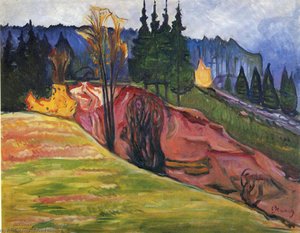
The power of Symbolic Expressionism lies in its refusal to adhere to the constraints of anatomical or perspectival perfection. Instead, it utilizes distortion as a deliberate tool of communication. When we examine works like Munch’s 'Lovers on the Beach II', we see how the manipulation of form can heighten the sense of longing and intimacy. The figures are shaped by their emotions; the very light that falls upon them seems heavy with the weight of unfulfilled desire.
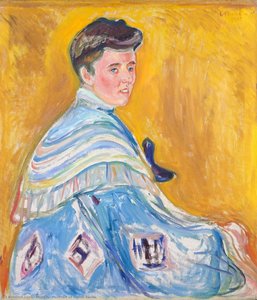
This distortion is not a lack of skill, but a profound expansion of it. By bending the physical world, artists like Wilfred Gabriel de Glehn were able to weave together elements of surrealism and symbolism to explore complex philosophical themes. The movement teaches us that truth is often found in the exaggeration of a curve or the unsettling elongation of a limb. For the art enthusiast, these distortions provide a gateway to experiencing the raw, unadulterated essence of human desire and the profound psychological depth that lies just beneath our composed exteriors.
Beyond the Surface: Analyzing Color and Texture as Emotional Vessels
In the realm of expressionism, color is never merely decorative; it is an emotional protagonist. The palette functions as a direct conduit to the viewer's nervous system. Deep, bruised purples and somber blues may evoke the depths of melancholy, while sudden, violent strikes of crimson can simulate the heat of rage or the sting of heartbreak. This use of color is often paired with a highly tactile approach to texture, where the impasto technique—the thick, heavy application of paint—adds a three-dimensional dimension to the emotional narrative.
The physical presence of the paint itself contributes to the work's communicative power. A thick, rugged layer of oil can represent the scarring of experience, while smooth, flowing transitions might suggest the fluidity of dreams. When analyzing these works, one must look past the subject matter and observe how the very chemistry of the medium—the way light catches a raised ridge of pigment or disappears into a dark glaze—servates the underlying theme. It is in this tactile interaction between the eye and the canvas that the true spirit of the artwork is revealed.
The Modern Legacy: How Symbolic Expressionism Resonates in Contemporary Collecting
Though the height of the movement belongs to a specific historical era, its echoes are vibrantly present in the contemporary art world. The modern collector finds a profound connection to these works because the human condition—our anxieties, our passions, and our search for meaning—remains unchanged. The ability to bring a piece of this emotional intensity into a personal space allows for a continuous dialogue between history and the present moment.
Today, the appreciation for such depth is reflected in the growing demand for high-quality, museum-grade reproductions that preserve the integrity of these original brushstrokes. Whether through the meticulous layering of oil on canvas or the precision of modern Giclée printing, the goal remains the same: to ensure that the visceral energy of the masters continues to breathe within our homes and galleries. As we continue to explore the hidden emotions of art, we find that the shadows cast by the Expressionists still illuminate the most complex corners of our own humanity.
Discover the profound beauty of history with ArtsDot.com. From exquisite handmade oil reproductions to museum-quality prints, we specialize in bringing the world's most emotive masterpieces into your collection. Whether you seek a custom commission or an expert consultation to find the perfect piece for your space, our dedication to academic excellence and artisanal craftsmanship ensures that every work we provide is a testament to the enduring power of art.