The Architect of Glamour: The Life and Legacy of Arnold Isaacs
In the shimmering tapestry of twentieth-century fashion, few names evoke the sheer opulence and structural brilliance of Arnold Isaacs, known to the world by his more melodic pseudonym, Arnold Scaasi. Born in Montreal, Canada, in 1930, Isaacs’ journey into the heart of haute couture was deeply rooted in the tactile world of his father, a furrier. This early immersion in the luxurious textures of pelt and fiber instilled in him a lifelong reverence for craftsmanship and an intuitive understanding of how fabric could be manipulated to sculpt the human form. His path from the modest beginnings of Montreal to the pinnacle of New York high society was paved with rigorous training, beginning at the Cotnoir-Capponi School of Design and culminating in the prestigious halls of the Chambre Syndicale de la Haute Couture Parisienne in Paris. It was here that he absorbed the sacred traditions of French elegance, a foundation that would later allow him to blend Parisian sophistication with a distinctly American sense of drama.
The evolution of Isaacs’ artistry was profoundly shaped by his encounter with the legendary Charles James. Working alongside the master of sculptural tailoring, Isaacs learned the secrets of architectural construction—how a seam could create a silhouette and how weight could be balanced to achieve effortless grace. This period of apprenticeship was transformative, teaching him that a garment was not merely clothing, but a structural feat of engineering. As he transitioned into his own career, he famously adopted the name Scaasi to lend an air of Italian flair to his burgeoning brand, a move that coincided with his rise as a formidable force in the American fashion scene. By 1953, his ready-to-wear line had already begun to capture the imagination of critics, and by 1962, he was honored with the prestigious Coty American Fashion Critics' Award, a milestone that signaled his arrival as a titan of the industry.
A Symphony of Sequins and Silk
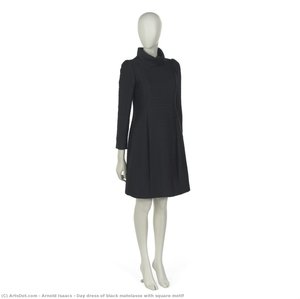
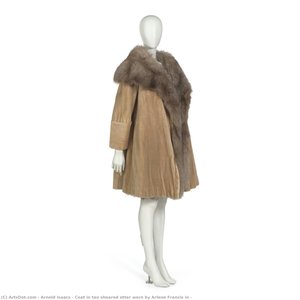
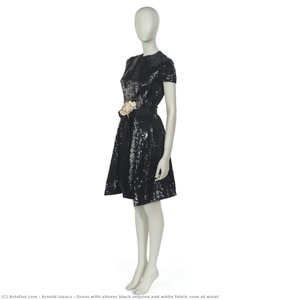
To examine the work of Arnold Scaasi is to witness a masterclass in the use of light, texture, and movement. His design philosophy was often a captivating duality: he could pivot from the minimalist elegance of a structured day dress to the breathtaking extravagance of an evening gown encrusted with thousands of hand-sewn sequins. One might look upon his 1969 creation, a day dress of black matelasse with a square motif, and see a rejection of ostentation in favor of geometric precision and subtle tactile complexity. Yet, in his couture salon, he was equally capable of conjuring pure magic through the use of feathers, fur, and fine embroidery, creating pieces that seemed to vibrate with energy under the ballroom lights.
His technical prowess was most famously displayed during moments of global cultural significance. The world watched in awe when Barbra Streisand appeared at the 41st Academy Awards wearing his sheer overblouse and pants ensemble—a daring, modern silhouette that instantly transformed him into a household name. This ability to marry the avant-garde with the wearable allowed him to become the preferred couturier for an extraordinary roster of women who defined an era:
- The First Ladies: He possessed a unique gift for dressing the most influential women in America, creating dignified yet glamorous ensembles for Mamie Eisenhower, Barbara Bush, Hillary Clinton, and Laura Bush.
- Hollywood Icons: His designs provided the cinematic glamour required by legends such as Elizabeth Taylor, Joan Crawford, Lauren Bacall, and Catherine Deneuve.
- Socialites and Celebrities: From the high-society elegance of Brooke Astor to the contemporary edge of Ivana Trump, his work bridged the gap between old-world prestige and modern celebrity culture.
Historical Significance and Enduring Influence
The historical importance of Arnold Isaacs lies in his role as a bridge between the rigid traditions of mid-century couture and the more liberated, expressive fashion of the late twentieth century. He did not merely follow trends; he constructed them through a meticulous attention to detail that honored the heritage of the House of Paquin while embracing the bold, often theatrical demands of the jet-set era. His work remains a testament to the idea that fashion is a form of wearable art—a medium capable of conveying status, personality, and even political grace.
Even as the fashion landscape shifted toward more casual aesthetics, the legacy of Scaasi’s craftsmanship endured. He remained a steadfast believer in the power of the "total look," where every element, from the weight of a silk sash to the placement of a fabric rose, contributed to a cohesive narrative of luxury. Though he passed away in 2015, his influence persists in the way we perceive the intersection of sculpture and textile. He taught the world that true elegance is never accidental; it is meticulously planned, expertly tailored, and executed with an unwavering commitment to the sublime.