The Enigma of the Golden Page: The Boucicaut Master
In the twilight of the Middle Ages, amidst the flickering candlelight of Parisian scriptoriums, an anonymous hand emerged to redefine the boundaries of visual storytelling. Known to history as the Boucicaut Master, or more formally as the Master of the Hours for Marshal Boucicaut, this artist remains one of the most captivating enigmas of Northern European art. Though his true name has been lost to the corridors of time, his presence is felt through the luminous brilliance of his surviving works. Active between 1400 and 1430, he operated at the height of the International Gothic style, a period where the rigid symbolism of the past began to melt into a new, breathtaking naturalism.
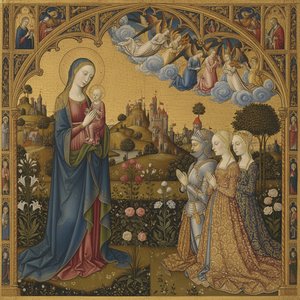
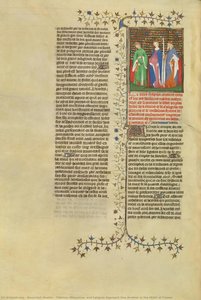
The Master’s identity is inextricably linked to his most famous commission: the magnificent Book of Hours for Jean II le Meingre Boucicaut. This lavish manuscript, now preserved in the Musée Jacquemont-André, serves as a window into a world of aristocratic splendor and profound religious devotion. Through these miniature masterpieces, we glimpse an artist who was not merely a decorator of texts but a pioneer of spatial depth. While his contemporaries often focused on flat, iconographic arrangements, the Boucicaut Master experimented with aerial perspective and the subtle interplay of light and shadow, creating atmospheres that felt remarkably breathable and alive.
A Synthesis of Tradition and Innovation
The artistic evolution of the Boucicaut Master represents a pivotal moment in the transition from medieval mysticism to Renaissance observation. His workshop in Paris likely served as a crucible where various European influences converged. While his roots are deeply embedded in the International Gothic tradition—sharing the courtly elegance and meticulous detail found in the works of the Limbourg Brothers—he was also an artist looking toward the horizon. There is a palpable sense that he was absorbing the burgeoning innovations emerging from Italy, particularly the early developments in linear perspective and the realistic rendering of landscapes.
This stylistic synthesis allowed him to achieve something truly unique: the ability to depict sacred narratives with a sense of historical weight and physical reality. In his hands, biblical scenes were no longer just symbols; they became events occurring within structured, believable environments. His mastery is particularly evident in:
- The Manipulation of Light: He utilized light not just to illuminate figures, but to define the very texture of the air and the distance of far-off mountains.
- Narrative Complexity: His compositions often feature a dramatic tension, where characters are locked in profound emotional or moral confrontations.
- Opulent Detail: The use of gold leaf and rich pigments reflects the high status of his patrons, lending an imperial gravity to every miniature.
Legacy of an Anonymous Visionary
The historical significance of the Boucicaut Master lies in his role as a bridge between eras. He stood at the threshold where the decorative beauty of the Gothic era met the scientific curiosity of the Renaissance. By pushing the limits of what could be achieved on the surface of vellum, he paved the way for future generations of painters to explore the depths of human emotion and physical space. Even without a biography written in ink, his legacy is etched in the gold and pigment of the manuscripts he left behind.
To study the works of the Boucicaut Master is to witness the birth of a new way of seeing. He transformed the act of reading a prayer book into an immersive experience of divine and earthly beauty. Though he remains a shadow in the historical record, his light continues to shine through the exquisite, enduring perfection of his illuminated visions, reminding us that true genius requires no name to be immortal.