The Master of Bremen’s Maritime Soul
In the heart of Germany's maritime history, few names resonate with as much precision and evocative power as Carl Justus Harmen Fedeler. Born in Bremen in 1799, Fedeler emerged from a lineage of craftsmanship, the son of a sign painter, a background that undoubtedly instilled in him a profound respect for line, detail, and the structural integrity of his subjects. His journey from the meticulous world of sign painting to the grand stage of Romantic marine art is a testament to a singular vision: the desire to immortalize the vessels that defined an era of global exploration and commerce. As Bremen and Bremerhaven flourished as vital port cities, Fedeler became their visual chronicler, capturing not just the wood and canvas of ships, but the very spirit of the North Sea.
Fedeler’s life was deeply intertwined with the maritime culture of his homeland. Following his marriage to Marie Wilhelmine Voigt in 1824, he established a legacy that extended into the next generation, as his son would also pursue the path of the marine painter. This familial dedication to the sea ensured that his artistic sensibilities were nurtured by the rhythms of the tides and the bustling activity of the harbors. His career reached its zenith during the Romantic era, a period when artists sought to find the sublime in the struggle between man and nature. Between 1833 and 1856, Fedeler’s works graced the walls of the Kunsthalle Bremen, where his ability to portray ships with unparalleled realism and emotional depth earned him widespread acclaim among the artistic elite.
Technique and the Drama of the Deep
To observe a Fedeler painting is to witness a masterclass in observation. His technique was rooted in a painstaking devotion to accuracy, a trait likely inherited from his early training. He did not merely paint ships; he documented them. Every contour of a hull, every tension in a shroud, and the specific nuances of atmospheric conditions were rendered with meticulous brushwork. Using oil on canvas, Fedeler employed a sophisticated layering of textures and hues to breathe life into his compositions. This approach allowed him to convey the raw, kinetic power of turbulent seas, where the white foam of a breaking wave meets the dark, heavy weight of an ocean in turmoil.
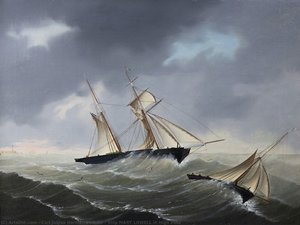
His subject matter focused heavily on the genre of ship portraits, a choice that reflected the economic and cultural heartbeat of 19th-century Bremen. These were not merely static portraits but dynamic narratives of voyage and survival. In works such as his depiction of the topsail schooner MARY LOWELL in High Seas, one can feel the palpable tension of the vessel battling heavy seas. Through his lens, the ship becomes a protagonist in an epic struggle against the elements. The artist’s ability to balance the technical precision of the vessel's construction with the atmospheric drama of the sky and sea creates a sense of immersion that remains captivating over a century later.
A Lasting Maritime Legacy
The historical significance of Carl Justus Fedeler lies in his role as a bridge between maritime documentation and fine art. While his works serve as invaluable records of 19th-century naval architecture and the bustling life of German ports, they transcend mere illustration through their emotional resonance. He captured the essence of the Romantic movement—the awe, the terror, and the majesty of the sea—within the framework of a highly disciplined, realistic style.
Today, Fedeler’s contributions to the maritime art canon are recognized for several key reasons:
- Historical Documentation: His precise renderings provide a window into the design and operation of vessels like the schooners and merchant ships that drove 19th-century trade.
- Artistic Mastery: He elevated the ship portrait from a commercial craft to a sophisticated form of Romantic expression.
- Cultural Identity: His work remains an essential part of the artistic heritage of Bremen, embodying the maritime identity of the region.
Through his dedication to capturing the grandeur and drama of seafaring life, Fedeler ensured that the fleeting moments of maritime struggle and triumph would be preserved in the enduring medium of oil and canvas, leaving an indelible mark on the history of German marine painting.