The Architect of Space and Time: The Life of Enrique Timoteo González de Careaga y Bishop
Enrique Timoteo González de Careaga y Bishop stands as a fascinating testament to the multifaceted talents of early 20th-century Spain. Born in Madrid in 1872, he was a man who seamlessly blended seemingly disparate disciplines—a rare convergence that profoundly shaped his artistic output and cemented his legacy within the annals of Spanish art history. His life began amidst the burgeoning industrial landscape of Europe, an environment that equipped him with technical engineering skills that would later inform his precise approach to visual representation. Yet, beyond the blueprints and calculations, he was a man driven by a profound passion for movement and competition, most notably through his influential role in the world of football.
His involvement with Athletic Bilbao extended far beyond mere participation; he spearheaded the club's transformation into a legendary powerhouse. Serving as the third president between 1903 and 1906, he oversaw a pivotal moment in Basque football history—the merger of Athletic Bilbao and Bilbao FC. This strategic unification created one of Spain’s most enduring athletic institutions. Under his visionary leadership, the club secured its first two Copa del Rey titles, establishing itself as a dominant force on the national stage. This dedication to fostering excellence on the pitch mirrored his later commitment to exploring the boundaries of visual perception through the canvas.
A Visionary Approach to Abstract Geometry
As his artistic journey unfolded, González de Careaga y Bishop moved away from conventional representation toward a highly distinctive and innovative conceptual framework. He sought to capture what he termed “spatial-temporal structures,” a daring ambition that anticipated the developments of abstract art decades before they became mainstream. Rejecting the static nature of traditional portraiture or landscape, he focused on the elusive interplay between space and time, attempting to freeze the very essence of movement within a geometric plane.
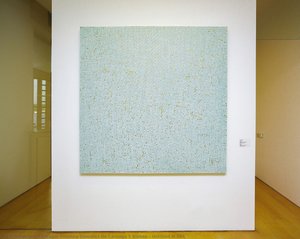
His work often functions as a bridge between the physical and the metaphysical. In pieces such as Sphère Spatio/Temporelle, the viewer is invited into a mesmerizing realm of Op Art, where geometric forms and vibrant blues create a sense of profound depth. His technique utilized rhythmic patterns and optical illusions to challenge the eye, making the canvas feel less like a flat surface and more like a window into a multidimensional reality. This mastery over visual perception allowed him to explore how color and form could evoke a sense of weightlessness or intense vibration.
Legacy and Artistic Significance
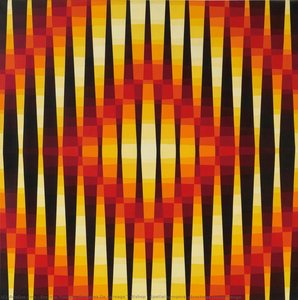
The historical significance of González de Careaga y Bishop lies in his ability to synthesize the technical precision of an engineer with the rhythmic soul of an athlete. His later explorations, characterized by energetic interplays of warm hues like reds, oranges, and yellows, demonstrate a profound mastery over pigment and light. Works such as Spatial-temporal structures jaune-orange showcase a dense, intricate tapestry of verticality, where varying widths of stripes create a grid-like pattern that feels both meticulously structured and wildly alive.
Though his life was cut short in 1936, the echoes of his "spatial-temporal" theories continue to resonate within the study of modern abstraction. His ability to anticipate the complexities of mid-century modernism through a much earlier lens marks him as a true pioneer. Today, his captivating works are recognized in prestigious collections such as MACBA and Borusan Contemporary, serving as enduring reminders of a man who saw the world not just as a collection of objects, but as a dynamic dance of intersecting planes, time, and light.