The Genesis of a Collective Vision
In the vibrant, transformative landscape of post-war Paris, a new artistic consciousness began to coalesce. The year 1957 marked the birth of Equipo 57, a collective that would swiftly emerge as one of the most profound voices within the concrete art movement. This was not merely a gathering of individual talents, but a deliberate union of architects, sculptors, and painters—including Ángel Duarte, José Duarte, Juan Serrano, Juan Cułenca, and Agustín Ibarrola—who were bound by a shared conviction to redefine the boundaries of visual language. Their arrival signaled a decisive departure from the subjective emotionalism of Surrealism and Expressionism, seeking instead a path paved with clarity, precision, and a rigorous rationalism.
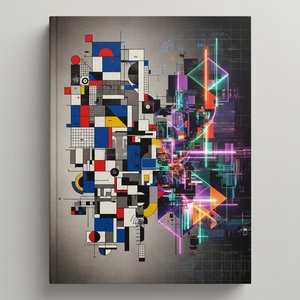
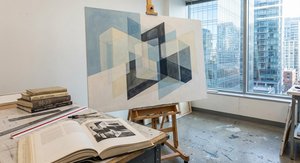
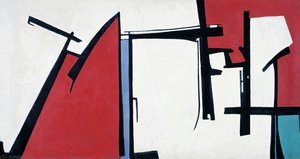
The group’s philosophical foundation was deeply rooted in the seminal concept of concrete art, as articulated by Theo van Doesburg. Embracing this ideology, Equipo 57 rejected superfluous ornamentation and the heavy hand of personal sentiment. Instead, they turned their gaze toward the fundamental building blocks of reality: the square, the rectangle, the circle, and the line. To them, these geometric forms were not mere decorative motifs but essential elements capable of conveying profound meaning through their spatial relationships and compositional arrangements. Their work sought to strip away the unnecessary, exposing a pure, structural truth that resonated with the scientific and analytical tendencies of the era.
A Unified Approach to the Plastic Arts
What truly distinguished Equipo 57 was their radical pursuit of a unified artistic practice, reminiscent of the Bauhaus ideal. They did not view painting, sculpture, and architecture as isolated disciplines but as interconnected facets of a single, cohesive creative endeavor. This holistic approach meant that their influence extended far beyond the canvas; it permeated the very fabric of lived space, encompassing interior decoration, furniture design, and large-scale architectural projects. Their ambition was to integrate art into the social fabric, transforming the environment through a disciplined application of geometric principles.
As their research progressed, the group faced the formidable challenge of translating two-dimensional abstractions into three-dimensional realities. This transition into sculpture represented a pivotal moment in their development. By applying theories of interactivity and mass to physical space, they began to explore how geometric shapes could interact with light, shadow, and volume. The works of Agustín Ibarrola, such as the iconic “La Gran Pirámide,” became monumental embodiments of this struggle, capturing a sense of permanence and solidity while simultaneously projecting a dynamic energy through meticulously calibrated proportions.
Social Commitment and Historical Legacy
Beyond the technical mastery of form and space, Equipo 57 was driven by a profound social mission. Through their manifestos, they voiced a powerful critique of the prevailing production and market mechanisms of the art world. They sought to renew the artistic situation by searching for a new social function for art—one that would reintegrate the artist into society as an active participant in the construction of a modern, rational world. This activist attitude, characterized by a defense of new artistic behaviors, allowed them to bridge the gap between pure abstraction and social responsibility.
Though their most intense period of activity was relatively brief, spanning roughly from 1957 to 1962, the historical significance of Equipo 57 remains undeniable. Their legacy is etched into the trajectory of modern art, having left an indelible mark on both European and Latin American abstract movements. They proved that through the reduction of form and the pursuit of essence, art could achieve a universal language—a language of structure, clarity, and enduring strength that continues to inspire those who seek beauty in the fundamental truths of geometry.