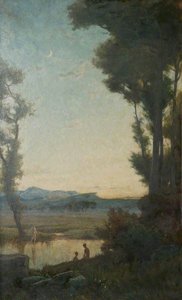
The Luminous Legacy of George Faulkner Wetherbee
In the golden twilight of the Victorian era, few artists captured the ephemeral dance of light and shadow as poignantly as George Faulkner Wetherbee. Born in Cincinnati, Ohio, in late 1850, Wetherbee’s life was a grand journey that bridged the rugged landscapes of America with the refined artistic circles of Europe. Though his roots were firmly planted in the American Midwest, his soul belonged to the rolling hills and atmospheric mysteries of the Old World. His early talent, evident from a young age, propelled him across the Atlantic to undergo rigorous training at the prestigious art schools of Antwerp and London. This cosmopolitan upbringing allowed him to absorb the diverse textures of European landscape traditions, ultimately shaping him into a painter who could translate the sublime beauty of nature into a universal visual language.
Wetherbee’s artistic evolution was marked by a profound mastery of both oil and watercolor, mediums through which he explored the delicate balance between serenity and melancholy. As his career matured, he gained significant recognition from distinguished London art societies, achieving true success in his forties. His work often centered on idyllic landscapes, frequently populated by small, graceful figures that lent a sense of human narrative to the vastness of the natural world. Whether painting the sun-drenched vistas of the West Indies or the misty, pastoral scenes of the English countryside, Wetherbee possessed an uncanny ability to manipulate color and light to evoke deep emotional responses in his viewers.
Technique, Texture, and the Romantic Spirit
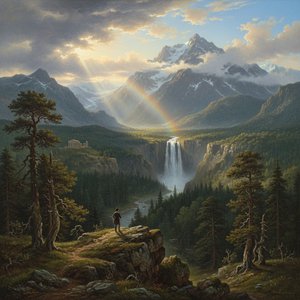
To stand before a Wetherbee canvas is to experience the tactile richness of the Romantic tradition. He was a master of impasto, applying paint with a deliberate thickness that gave his landscapes a sculptural quality. This technique allowed him to create surfaces that caught the light, lending a shimmering luminosity to his depictions of dawn and dusk. His palette was often characterized by warm ochre hues and muted, earthy tones, which he used to build atmospheric perspective—a method that draws the eye through layers of mist and light toward a distant, hazy horizon.
His stylistic influences were deeply rooted in the giants of British landscape painting. The sweeping, emotive power of J.M.W. Turner and the grounded, pastoral sincerity of John Constable served as the foundational pillars of his approach. From Turner, he inherited a fascination with the elemental forces of nature; from Constable, he drew a reverence for the quiet, rhythmic beauty of rural life. This synthesis of influences allowed him to create works that were both grand in scale and intimate in feeling, capturing the "sublime"—that specific aesthetic tension between awe and terror found in the natural world.
Masterworks and Historical Significance
The breadth of Wetherbee’s contribution to 19th-century art is best understood through his most celebrated compositions. Each piece serves as a window into his unique perception of the world:
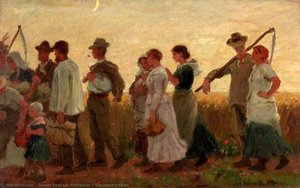
- The Harvest Moon: A breathtaking representation of late 19th-century rural life, where warm colors and gentle brushstrokes evoke a profound sense of tranquility and communal harmony.
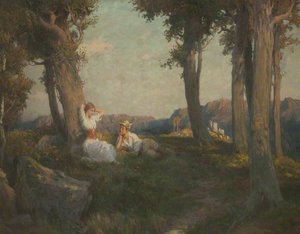
- Oenone Forsaken: A poignant example of his ability to use texture and tone to convey deep emotion, utilizing expressive strokes to weave a narrative of melancholy amidst a serene landscape.
- Dawn at the Gate: An evocative oil painting that demonstrates his command over light, capturing the precise moment when the first rays of morning break through the darkness.
Beyond his individual paintings, Wetherbee’s life reflected the interconnectedness of the Victorian art world. His residence in Belsize Park and Hampstead placed him at the heart of London's creative pulse. Though he passed away in 1920 and was laid to rest in Highgate Cemetery, his impact remains etched in the textures of his canvases. He remains a significant figure for collectors and historians alike, representing a period when art sought to find the divine within the natural landscape, leaving behind a legacy of light, color, and enduring beauty.