The Shadow and Splendor of the Prussian Court: The Life of Johann Christof Merck
In the twilight of the seventeenth century, as the Baroque era reached its zenith of grandeur across Europe, a painter of singular focus emerged from the Swabian traditions to leave an indelible mark on the Prussian court. Johann Christof Merck, often referred simply as Merk, remains one of the more enigmatic yet vital figures of the German Baroque. While much of his early life remains shrouded in the mists of history—with biographical details largely obscured by time—his presence in the artistic annals of Brandenburg Prussia is unmistakable. Moving from the industrious atmosphere of Schwäbisch Hall to the burgeoning political epicenter of Berlin, Merck brought with him a technical prowess that would soon catch the eyes of royalty.
His arrival in Berlin after 1695 coincided with a period of immense transformation under Elector Frederick III, who would later ascend the throne as King Frederick I of Prussia. It was within this atmosphere of burgeoning monarchical prestige that Merck found his calling. Rather than focusing solely on the sweeping landscapes that characterized much of the era's decorative art, Merck carved out a niche in the intimate and the imposing: uniformed portraits and the soulful depiction of animals. His ability to capture the rigid dignity of military attire alongside the organic vitality of living creatures allowed him to become a preferred chronicler of the court’s most cherished subjects.
Mastery of Form: From Animal Portraits to Royal Commissions
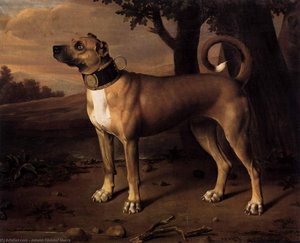
The true brilliance of Merck’s technique lies in his capacity for meticulous observation. He possessed an uncanny ability to render texture, whether it was the coarse fur of a hunting hound or the stiff, embroidered silk of a high-ranking officer's uniform. One of his most celebrated achievements remains the Ulmer Dogge (1705), a painting of an Ulm Mastiff that serves as a testament to his skill in animal portraiture. This work, which captured the affection of the King himself, demonstrates how Merck could elevate a simple subject into a masterpiece of character and presence.
As his reputation flourished, so did the scale and importance of his commissions. His career reached new heights when he moved to the court of King Frederick William I in Potsdam. Under the reign of the "Soldier King," Merck’s work took on a more monumental quality. He was tasked with the daunting yet prestigious duty of painting life-size portraits of the members of the Prussian Infantry Regiment #6, famously known as the Langen Kerls or the Potsdam Giants. This undertaking required not only immense technical stamina but also an artist capable of capturing the sheer physical imposition and disciplined spirit of these legendary soldiers.
Legacy and Artistic Significance
Beyond his role as a court painter, Merck contributed to the formalization of artistic education in Prussia, serving as a Professor at the Prussian Academy of Arts. This position allowed him to influence the next generation of painters, ensuring that the precision and classical foundations he championed would endure. His oeuvre, though relatively small in number, represents a crucial bridge between the rugged naturalism of earlier German traditions and the polished, ceremonial grandeur required by the rising Prussian state.
Today, the works of Johann Christof Merck stand as vital historical documents. They are more than mere aesthetic objects; they are windows into the social hierarchy, military pride, and personal passions of the Baroque age. Through his brush, we see the intersection of nature and nobility, a world where the loyalty of a hunting dog and the discipline of a giant soldier were rendered with equal reverence and profound artistic truth.