The Quiet Precision of John F. O'Connell
In the vast tapestry of American landscape and still life painting, few artists capture the profound stillness of a moment as delicately as John F. O'Connell. Born in Londonderry, Northern Ireland, O’Connell brought with him a heritage of rigorous European training that would eventually blossom into a uniquely American sensibility. His journey from the storied traditions of Irish art education to the vibrant, diverse studios of New York City allowed him to bridge two worlds, blending a disciplined, classical approach to form with an intimate, observational eye for the quiet rhythms of domestic and natural life.
O’Connell’s artistic foundation was laid at St Mary’s College Belfast, where he first mastered the essential mechanics of light, shadow, and composition. This early immersion in the disciplined traditions of Irish painting instilled in him a lifelong reverence for accuracy and texture. However, it was his subsequent move to the United States and his studies at the prestigious Pratt Institute in New York City that truly expanded his horizons. At Pratt, O’Connell moved beyond mere technical proficiency, learning to infuse his work with a sense of atmosphere that transformed simple subjects into evocative meditations on existence.
A Mastery of Tone and Texture
To encounter an O’Connell painting is to enter a world defined by tonal subtlety and remarkable detail. While the Impressionist movement often sought to capture the fleeting, ephemeral dance of light through broken brushstrokes, O’Connell took a different path. He prioritized the tangible reality of his subjects, rendering textures with such painstaking precision that one can almost feel the cool surface of a ceramic vase or the rough grain of a wooden tabletop. His palette was intentionally restrained, favoring a sophisticated arrangement of earth tones—ochres, siennas, and deep umbers—which lent his landscapes an ethereal, timeless quality.
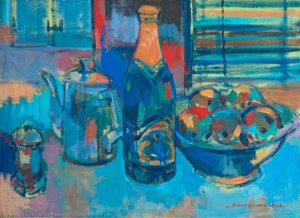
This meticulous technique is perhaps most evident in his celebrated still lifes. O’Connell possessed a singular ability to find grandeur in the mundane. He frequently returned to recurring motifs that spoke of domestic tranquility and the slow passage of time:
- The Coffee Percolator: Rendered with metallic luster and weight, these objects served as anchors for his compositions, representing the steady, comforting rituals of daily life.
- Floral Arrangements: Delicate blooms were often paired with utilitarian objects, creating a poignant contrast between the ephemeral beauty of nature and the enduring presence of man-made items.
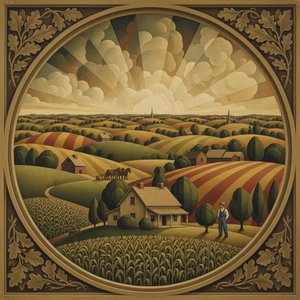
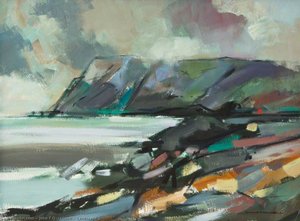
- Atmospheric Landscapes: His depictions of rolling hills and misty valleys utilized soft light to create depth, making the viewer feel as though they are peering through a morning fog into a serene, untouched world.
Legacy and Artistic Significance
Beyond his personal output, O’Connell’s influence extended to the next generation of American painters through his long-standing tenure as an instructor at the Pratt Institute. As a teacher, he passed on his devotion to meticulous technique and his belief in the importance of observational truth. His ability to nurture talent while maintaining his own distinct artistic voice solidified his place within the academic and artistic community of the Kennedy Era and beyond.
Though he may not occupy the spotlight of mainstream art history textbooks, the significance of John F. O'Connell lies in his ability to command attention through subtlety rather than spectacle. His work remains a testament to the power of the understated, offering collectors and scholars alike a window into a period of American art characterized by a deep respect for craft, a love for the natural world, and an unwavering commitment to the beauty found in the quietest corners of life.