The Luminous Silence: The Life and Legacy of John Fabian Carlson
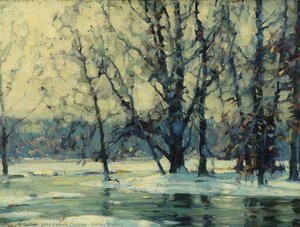
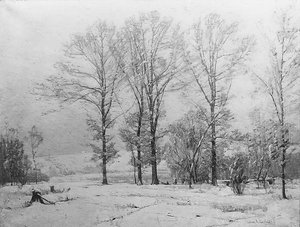
In the quietude of a frozen landscape, where the world seems to hold its breath beneath a heavy blanket of white, one finds the true essence of John Fabian Carlson. A Swedish-born American Impressionist, Carlson possessed a rare, meditative ability to translate the biting chill of winter into a visual symphony of light and texture. Born on May 5, 1874, in the pastoral landscapes of Kolsebo, Sweden, his early years were steeped in the folklore and rugged natural beauty of his homeland. This foundational connection to the earth would later manifest in his American works as a profound sensitivity to the atmospheric shifts of the seasons, particularly the ethereal, crystalline moments that define the winter solstice.
After emigrating to the United States in 1884 and settling in Buffalo, New York, Carlson began a rigorous artistic journey that would bridge European tradition with American innovation. His education at the Art Students League of Buffalo under Lucius Wolcott Hitchcock—a student of the great masters Renoir and Degas—provided him with a meticulous foundation in observation. This training instilled in him a lifelong dedication to capturing the fleeting nuances of light. As his talent blossomed, Carlson sought further refinement, eventually securing a scholarship to the Byrdcliffe Colony in Woodstock, New and York. It was within this vibrant artistic community, alongside luminaries such as Robert Henri, that Carlson’s fascination with the grandeur of nature solidified, setting the stage for his emergence as a master of the landscape.
A Mastery of Light and Texture
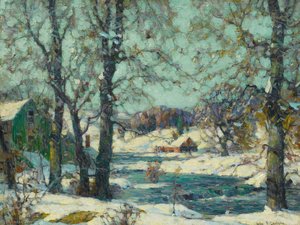
Carlson’s technical prowess lay in his ability to manipulate medium and movement to evoke the tactile reality of snow and ice. Whether working in the fluid, translucent layers of watercolor or the robust, impasto textures of oil, his work remained anchored in the Tonalist tradition. He did not merely paint a scene; he built an atmosphere. His technique often involved layering thin washes of color to create depth, followed by vigorous, textured brushstrokes that mimicked the uneven crust of a snow-covered mountainside or the delicate frost clinging to a woodland branch.
His repertoire was as diverse as the landscapes he traversed. While most celebrated for his serene, snow-laden vistas, Carlson also explored the rugged majesty of the Canadian Rockies and the sweeping expanses of the American Far West. His ability to balance fine detail with broad, emotive washes allowed him to capture both the microscopic beauty of a frozen leaf and the overwhelming scale of a mountain range. This duality made his work deeply engaging, inviting viewers to wander through his compositions, discovering quiet details hidden within the vast, white silence.
The Educator and the Historical Witness
Beyond the canvas, Carlson was a pivotal figure in the American art landscape as a teacher and author. He was a co-founder of the Woodstock School of Landscape Painting and established his own namesake school, leaving an indelible mark on generations of aspiring artists. His 1928 publication, Elementary Principles of Landscape Painting (later known as Carlson's Guide to Landscape Painting), remains a testament to his deep understanding of the mechanics of light, color, and composition.
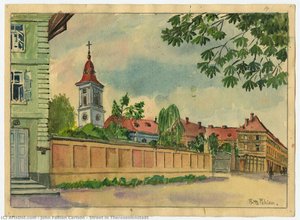
Yet, there is a poignant depth to Carlson’s legacy that extends beyond the tranquil beauty of his winter scenes. In the twilight of his life, his work took on a somber, historical weight. His 1944 watercolor, Street in Theresesienstadt, serves as a haunting departure from his usual pastoral themes. In this piece, the artist’s mastery of light is used to expose the stark reality of a concentration camp street, where the architectural permanence of brick walls meets the fragile movement of human life. This ability to pivot from the sublime beauty of nature to the profound gravity of human history cements John Fabian Carlson not just as a painter of landscapes, but as a profound witness to the enduring complexity of the human experience.