A Visionary of Hutsul Folklore and Young Poland
Kazimierz Sichulski (1879 – 1942) stands as a profound figure in the landscape of Polish art, a painter whose brush captured not just the physical reality of his subjects, but the very soul of a culture. Born in Lviv during the era of the Austro-Hungarian Empire, Sichulski’s life was shaped by the shifting political tides of Galicia and the subsequent Polish Partition. This backdrop of historical turbulence instilled in him a deep fascination with themes of national identity and spiritual reflection, driving him to seek beauty in the enduring traditions of the people. As a painter, lithographer, and caricaturist, his work became a vital bridge between the ethnographic reality of rural life and the sophisticated aesthetic movements of the early 20th century.
His artistic foundation was laid within the prestigious halls of Kraków’s Academy of Fine Arts, where he studied under legendary masters such as Leon Wyczółkowski, Józef Mehoffer, and Stanisław Wyspiański. These mentors provided him with a meticulous technical command that would later allow him to translate complex cultural textures onto canvas and lithograph stone. To further refine his craft, he sought training at the Vienna Kunstgewerbeschule alongside Anton von Kenner, an experience that equipped him with a sophisticated understanding of design and composition. This rigorous education allowed him to move seamlessly between the delicate precision of lithography and the expressive, emotive power of painting.
The Carpathian Soul and the Hutsul Legacy
The true heartbeat of Sichulski’s oeuvre can be found in his immersive engagement with the Hutsul region of the Carpathian Mountains. A transformative moment occurred between 1904 and 1905, when he embarked on a collaborative expedition into these rugged highlands alongside Fryderyk Pautsch and Władysław Jarocki. This encounter was far more than a mere study trip; it was a spiritual awakening. The vibrant rituals, intricate folk costumes, and deep-seated religious customs of the Hutsul people became his primary muse. Through works such as “Hutsul Wedding” (1906) and “Hutsuls in Moonlight,” Sichulski achieved a rare feat: he documented a vanishing way of life with an artist's sensitivity, elevating ethnographic observation to the level of high art.
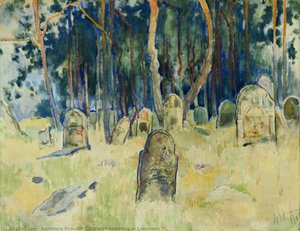
His fascination with the ephemeral and the eternal is perhaps most poignantly realized in his later works. In pieces like “A Jewish cemetery in Czerniawy,” painted in the 1930s, he explores the delicate boundary between memory and nature. Using gouache to create a luminous, ethereal atmosphere, he depicts traditional matzevahs not as somber markers of death, but as rhythmic elements of a living landscape. Through a masterful use of light and color, Sichulski invites viewers into a space where the passage of time is felt through the interplay of weathered stone and the organic, twisting growth of the forest, proving his ability to find universal symbolism within specific historical fragments.
Cultural Influence and Artistic Legacy
Beyond the canvas, Sichulski was a central figure in the bohemian intellectual life of Poland. He was deeply embedded in the Young Poland movement, a period of intense cultural renewal. His wit and social commentary found expression in his role as a drawer for the satirical magazine Liberum Veto, and he played an instrumental role in establishing the legendary Zielony Balonik (Green Balloon) cabaret. This involvement in the literary and satirical spheres demonstrates that his artistry was not isolated to the studio but was an active participant in the cultural dialogues of his time.
The historical significance of Kazimierz Sichulski lies in his ability to synthesize the local with the universal. His achievements include:
- Preservation of Heritage: His meticulous documentation of Hutsul culture serves as a vital visual record of Eastern European folk traditions.
- Technical Versatility: Mastery across diverse media, including lithography, caricature, and gouache, allowing for varied emotional textures.
- Olympic Recognition: His work was featured in the painting competition at the 1928 Summer Olympics, bringing Polish artistic excellence to a global stage.
- Symbolic Depth: The ability to transform ethnographic subjects into profound meditations on life, death, and national identity.
Ultimately, Sichulski’s legacy is one of profound empathy. Whether capturing the vibrant energy of a mountain wedding or the quiet stillness of a cemetery, his work remains a testament to the enduring power of cultural memory and the transformative beauty of the human spirit.