The Soul of the Canvas: The Life and Legacy of Khariton Platonov
In the vast tapestry of late 19th-century realism, few threads are as delicately woven as those left by Khariton Platonovich Platonov. A master of capturing the quiet, unvarnished beauty of human existence, Platonov’s work serves as a poignant window into an era defined by both profound social shifts and a romanticized reverence for innocence. Born in 1842 to a peasant family in the Upper Volga region of Russia, his journey from humble beginnings to the prestigious halls of the Imperial Academy of Arts in St. Petersburg is a testament to a singular, driving talent. His early years of formal training, spanning from 1859 to 1870, were marked by an extraordinary discipline; he earned multiple silver medals for his prowess in drawing, honing a technical precision that would later allow him to imbue his subjects with a lifelike, breathing quality.
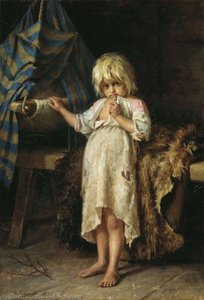
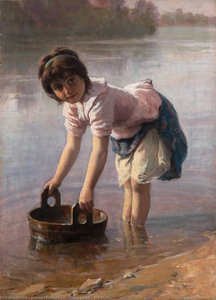
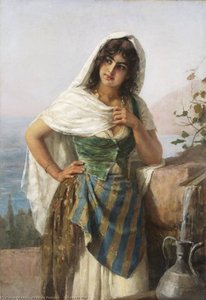
As his artistry matured, Platonov moved beyond mere academic exercise to find a voice that resonated with the emotional landscape of his time. While his training was rooted in the rigorous traditions of the Academy, his heart found its home in the genre painting of everyday life. He possessed a rare ability to elevate the mundane—a young girl by a well, a child tending to a task, or a quiet moment of reflection—into something transcendent. This skill was most famously recognized in 1878 when he was awarded a gold medal for his masterpiece, “Bulgarian Boy.” This work did more than just showcase his command over color and light; it solidified his reputation as an artist capable of capturing the very essence of human vulnerability and spirit through subtle nuances of expression.
A Bridge Between Nations: From St. Petersburg to Kiev
The trajectory of Platonov’s life took a transformative turn in 1877 when he relocated to Kiev, a move that would redefine his historical significance. While his roots were Russian, his legacy became inextricably linked with the cultural flourishing of Ukraine. In Kiev, he did not merely exist as a painter but became a cornerstone of the region's burgeoning art scene. He took up a position at the Kiev Drawing School, founded by the influential Nikolay Murashko, where he transitioned from a student of the Academy to a mentor of the next generation. His pedagogical influence was profound, shaping the hands and minds of prominent Ukrainian painters such as Mykola Pymonenko and Mykhailo Zhuk, thereby helping to lay the foundation for the Kiev Art School.
Beyond the classroom, Platonov’s artistic reach extended into the sacred and the monumental. He participated in the grand restoration project of St. Cyril’s Church, working under the direction of the legendary Mikhail Vrubel. This immersion in Orthodox iconography allowed him to engage with a different dimension of art—one of symbolism, grandeur, and spiritual depth. This period of his life represents a beautiful duality: while he was celebrated for his realistic, often tender portraits of young women and peasants, he was simultaneously contributing to the preservation of much older, more ethereal traditions of religious art.
The Enduring Resonance of Platonov’s Vision
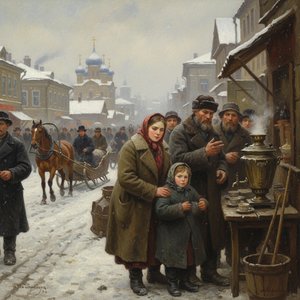
The works of Khariton Platonov remain deeply moving because they refuse to look away from the simple truths of life. Whether through the melancholic beauty found in “Girl by the Well” or the gentle, rustic charm of “Little Nurse,” his paintings offer a sense of peace and a celebration of purity. His approach to genre painting often presented the peasantry with a certain dignity; even in scenes of poverty, there is a cleanliness of spirit and a brightness of character that avoids the harshness of pure social critique, opting instead for a romanticized realism that speaks to the universal human condition.
As we reflect on his contributions, several key elements define his historical importance:
- Mastery of Portraiture: His ability to capture the psychological depth and innocence of young subjects.
- Educational Legacy: His pivotal role in reshaping art education in Kiev and nurturing Ukrainian talent.
- Technical Excellence: The seamless blend of academic precision with an emotive, painterly touch.
- Cultural Synthesis: The unique intersection of his Russian training with his profound impact on Ukrainian art history.
Though he passed away in 1907, the light captured in Platonov’s canvases continues to glow. He remains a vital figure for anyone seeking to understand the transition from classical academicism to the soulful, observant realism that would come to define much of the late 19th-century European tradition.