A Tapestry of Earth and Spirit: The Legacy of Lucy Yukenbarri Napanangka
In the vast, sun-drenched expanse of the Great Sandy Desert, where the Canning Stock Route traces ancient paths toward Jupiter Well, the life of Lucy Yukenbarri Napanangka was deeply etched into the very fabric of the landscape. Born near Kiwirrkurra around 1934, Lucy was a senior custodian of profound knowledge, a woman whose spirit was inextricably linked to the waterholes and ancestral tracks of her country. As a member of the Napaltjarra skin group, her existence was shaped by the rhythms of the desert—the seasonal arrival of bush foods and the sacred ceremonies that maintained the balance of the world. Her early years were marked by a nomadic connection to sites such as Marpa, Piyulpa, and Wirtjinti, experiences that would later manifest on canvas not merely as scenery, but as living, breathing narratives of survival and spirituality.
Though she lived much of her life through traditional customs, Lucy’s emergence as a visual storyteller in the late 1980s marked a transformative moment for Aboriginal art. Beginning her painting journey around 1989 with the Warlayirti Artists, she did not merely adopt existing traditions; she interrogated them. Her initial works adhered to the established Balgo methods, utilizing rows of dots to form lines and outlines. Yet, beneath this conventional surface lay a restless, creative intellect. She moved through phases of experimentation, transitioning from linear patterns to single-color fields of dotting, always searching for a way to translate the immense density and spiritual weight of her country into a new visual language.
The Revolution of Kinti-Kinti
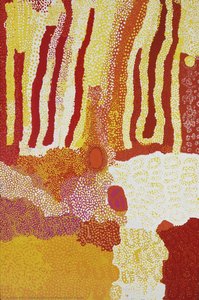
The true brilliance of Lucy Yukenbarri Napanangka lies in her revolutionary invention of the kinti-kinti style. Meaning “close-close,” this technique represented a radical departure from the more spaced, rhythmic dotting common in Western Desert art. In an act of profound technical courage, Lucy began to paint her dots with such extreme proximity that they ceased to be individual points and instead converged into dense, vibrating masses of pigment. This method created a mesmerizing, almost sculptural texture on the canvas, where the heavy application of paint caught the light and gave the surface a luminous, tactile quality.
This innovation was not merely an aesthetic choice but a symbolic one. By compressing the dots, she captured the concentrated essence of the desert—the way life clusters around a vital soakage or how the heat of the sun presses down upon the earth. Her palette was equally distinctive; while many artists utilized bright, contrasting colors, Lucy explored the profound depths of dark greens, blues, and blacks. These hues allowed her to masterfully depict the visual mystery of waterholes and rock soaks, creating deep, obsidian-like icons that anchored her compositions. Through this technique, she achieved a sense of depth and atmosphere that was entirely unique within the Balgo artistic community.
A Lasting Cultural Impression
Beyond the technical mastery of her brushwork, Lucy’s art served as a vital repository for the ecological and cultural wisdom of her people. Her canvases are rich with the presence of kantilli (bush raisins) and pura (bush tomato), alongside the structural beauty of the kurkapi (desert oak). Every painting was an act of mapping—not just the physical locations of food and water, but the spiritual geography of her ancestors. Her work celebrated the resilience of women and the enduring strength of the Marpa country, ensuring that the stories of these sacred sites would resonate far beyond the borders of the Western Desert.
As a pioneer, Lucy Yukenbarri Napanangka left behind a legacy that continues to influence generations of Warlayirti artists. Her ability to push the boundaries of the medium while remaining deeply rooted in her cultural responsibilities serves as a testament to the power of individual vision within a collective tradition. Though she passed away in 2003, her "close-close" technique remains a landmark in Australian art history, a shimmering reminder of a life lived in profound harmony with the ancient, enduring pulse of the desert.