The Quiet Master of Nuance: The Life and Legacy of Pieter Christoffel Wonder
In the grand, often boisterous tapestry of nineteenth-century art, where many painters sought the spotlight through sweeping historical dramas and theatrical grandeur, Pieter Christoffel Wonder carved a path defined by a much more intimate devotion. Born in Utrecht in January 1777, Wonder emerged not as a seeker of fame, but as a meticulous observer of the human condition. His journey was one of profound quietude, a lifelong pursuit of capturing the subtle flickers of emotion and the soft play of light that define our most personal moments. While his name may not resonate with the immediate thunder of the era's most famous titans, his work possesses an enduring, whispered beauty that speaks to the very heart of psychological realism.
Wonder’s artistic foundation was built upon a deeply personal and rigorous apprenticeship with the past. Largely self-taught in his formative years, he found his greatest teachers not in living masters, but in the silent canvases of the Old Masters. Through the painstaking process of copying works by legends such as Rembrandt and Rubens, he internalized their mastery of light, shadow, and the profound ability to imbue a portrait with an inner life. This period of intense study allowed him to develop a technical vocabulary rooted in observation rather than artifice. His formal education was later refined at the Kunstakademie Düsseldorf between 1802 and 1804, where he expanded his understanding of compositional structure, blending his self-taught intuition with the academic rigor of the German school.
A Spirit of Collaboration and Innovation
Beyond his solitary studies, Wonder was a vital participant in the burgeoning artistic community of Utrecht. In 1807, demonstrating a profound love for the collective advancement of art, he co-founded the Genootschap Kunstliefde (Love of Art Society) alongside Jan Kobell and Johann Wilhelm Tischbein III. This society was far more than a mere club; it served as a vital crucible for experimentation and intellectual exchange. As a director of this group, Wonder helped foster an environment where innovation could flourish within the local landscape, encouraging his peers to push the boundaries of genre painting and portraiture. This collaborative spirit reflected his belief that art was not merely an individual achievement but a shared cultural endeavor.
His influence also extended through mentorship, shaping the next generation of Dutch talent. Most notably, he served as a mentor to Willem Pieter Hoevenaar, a significant figure in nineteenth-century Dutch painting. Through this lineage, Wonder’s dedication to technical precision and his appreciation for the rich visual heritage of the Netherlands were passed down, ensuring that his stylistic sensibilities continued to ripple through the decades.
The English Years and the Art of Intimacy
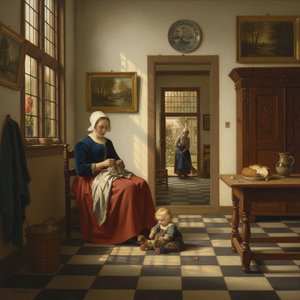
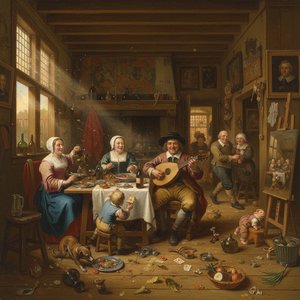
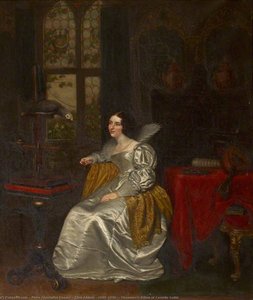
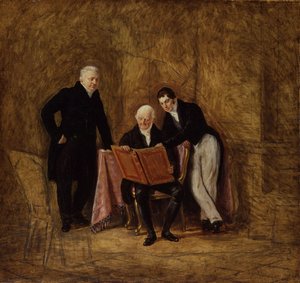
A transformative chapter in Wonder’s life began in 1823, when he traveled across the Channel to England. It was during this period, lasting until 1831, that his reputation as a premier portrait painter truly solidified. In the English landscape, he found a clientele of aristocrats, scholars, and businessmen who were drawn to his unique ability to convey dignity without ostentation. Unlike the stiff, formal portraits common to the era, Wonder’s subjects often appeared in intimate domestic settings, bathed in a soft, naturalistic light that suggested a moment caught in time.
His English works are characterized by several defining elements:
- Psychological Depth: A focus on subtle gestures and facial expressions that reveal the character's inner world.
- Luminous Atmosphere: The use of soft, diffused light to create a sense of warmth and domestic tranquility.
- Genre Elements: An ability to blend portraiture with interior scenes that tell a story of everyday life.
- Technical Refinement: A seamless execution derived from his early studies of the Dutch masters.
Ultimately, the historical significance of Pieter Christoffel Wonder lies in his refusal to participate in the era's trend toward spectacle. He remained a humanist painter, dedicated to the truth of the individual. His legacy is found in the quiet dignity of his canvases—works that do not shout for attention but instead invite the viewer into a silent, profound conversation with the subjects of the past.