The Poignant Echoes of Isolation: The Art of Wang Shugang
Born in the vibrant yet turbulent landscape of Beijing in 1960, Wang Shugang has emerged as a pivotal figure in contemporary Chinese art, crafting a sculptural language that speaks to the profound depths of human solitude. His artistic journey is one of deep contemplation, beginning with his rigorous training at the prestigious Central Academy of Fine Arts (CAFA). This foundational period allowed him to master the technical complexities of sculpture before he embarked on an international trajectory that included a transformative residency in Germany. Upon returning to Beijing, Shugang brought with him a synthesized perspective, blending Western sculptural traditions with the foundational aesthetics of his Chinese heritage to create works that resonate far beyond geographical borders.
The essence of Shugang’s oeuvre lies in its striking stylistic consistency and a masterful manipulation of color. His monumental bronze sculptures are often defined by a deliberate use of three primary tones—red, white, and black. These colors serve as more than mere visual anchors; they act as conceptual drivers that ground his work in a sense of symbolic resonance. Through these hues, he explores the tension between presence and absence, creating a visual dialogue that is both stark and deeply emotive.
A Synthesis of History and Spirit
To understand the soul of Shugang’s work, one must look toward the socio-political landscape of his formative years. Growing up amidst the upheaval of the Cultural Revolution, he developed an acute awareness of historical narratives and a critical engagement with ideological forces. This period of instability instilled in him a lifelong preoccupation with how individual identity persists within larger, often overwhelming, historical currents. His sculptures do not merely depict forms; they embody the weight of memory and the resilience of the human spirit.
This historical gravity is balanced by a profound spiritual lightness, heavily influenced by the principles of Zen Buddhism. In pieces such as his celebrated monk series, one can sense a palpable serenity and a deliberate simplicity. The stillness found in his bronze figures reflects a preoccupation with introspection and spiritual contemplation, inviting the viewer into a space of quietude. This duality—the heavy weight of history meeting the ethereal peace of Zen—is what gives his work its unique, haunting beauty.
Cynical Realism and the Human Condition
During the mid-1990s, Shugang emerged as a prominent voice within the Cynical Realism movement, a stylistic era in Chinese art characterized by an unsettling juxtaposition of idealized forms with unflinching depictions of everyday life. While many artists used this movement to critique prevailing utopian narratives, Shugang utilized it to present a nuanced portrayal of the human experience marked by isolation and introspection. His work avoids the purely political, opting instead for a more universal exploration of existence.
His achievements are best witnessed in his ability to transform cold bronze into living, breathing narratives. Notable works include:
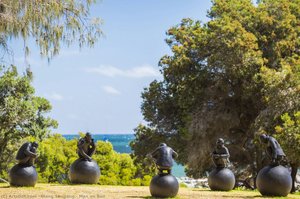
- Man on Ball: A serene sculpture series that depicts bronze figures set against evocative autumnal landscapes, capturing a sense of peaceful solitude.
- Sweeping Monks: Works that utilize rhythmic movement and minimalist form to evoke the meditative nature of repetitive labor.
- Squatting Monks: Sculptures that ground the spiritual in the physical, using posture to communicate a deep, earthbound contemplation.
Through these explorations, Wang Shugang has secured his historical significance not just as a sculptor of form, but as a sculptor of emotion. His ability to capture the poignant echoes of isolation ensures that his work remains a vital part of the contemporary dialogue, reminding us of the quiet, enduring strength found within the solitary human heart.