The Visionary Engraver: The Life and Legacy of William Luson Thomas
In the heart of Victorian London, a period defined by rapid industrial expansion and profound social upheaval, the power of the image began to reshape the collective consciousness of the British Empire. At the forefront of this visual revolution stood William Luson Thomas, a man whose life was a seamless tapestry of artistic mastery and tireless advocacy for social justice. Born in 1830 into a family where art was woven into the very fabric of daily existence—his father being a respected portrait painter—Thomas was destined to bridge the gap between the delicate precision of fine art and the urgent, mass-communicative power of the press.
His artistic journey began not in the grand galleries of London, but through the rigorous, tactile discipline of wood engraving. Under the mentorship of the esteemed William James Linton at Linton & Sons Printworks, Thomas mastered the intricate language of lines and shadows. This apprenticeship was more than a technical education; it was an immersion into a philosophy of naturalism and observation. He learned to treat the wooden block as a canvas capable of capturing the atmospheric nuances of a misty morning or the somber weight of a crowded street, developing a style that favored emotional resonance alongside meticulous detail.
A Revolution in Ink and Paper
As the nineteenth century progressed, Thomas recognized a transformative potential in the burgeoning illustrated press. He understood that while text could inform, it was the image that could move the soul and stir the conscience of the public. Having worked for established giants like the Illustrated London News, he became increasingly driven by a desire to elevate the status of the artist within the journalistic machine. He sought to move away from treating engravers as mere factory hands, envisioning instead a medium where artistic merit and truth-telling were inextricably linked.
This vision culminated in one of his most enduring achievements: the founding of The Graphic in December 1869. Alongside his brother Lewis Samuel Thomas and the talented Godefroy Durand, he launched a publication that would challenge the era's dominant narratives. The Graphic was not merely a newspaper; it was a curated window into the realities of Victorian life. Through his work, Thomas championed the idea that illustrations could serve as powerful instruments for political influence and social reform, bringing the plight of the impoverished and the beauty of the rural landscape to the breakfast tables of the masses.
The Intersection of Art and Social Reform
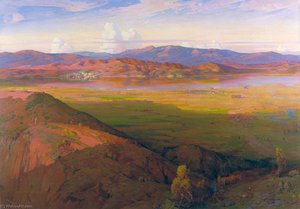
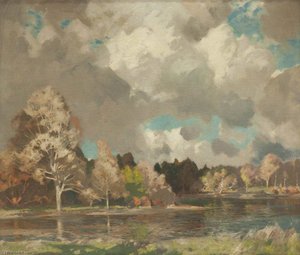
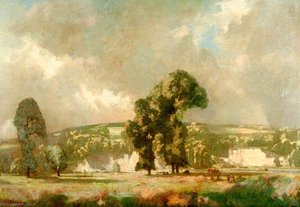
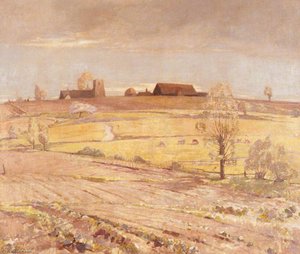
Thomas’s oeuvre is characterized by a profound duality: the ability to capture breathtaking natural beauty and the courage to document the harshness of urban struggle. His landscapes, such as the evocative Suffolk Landscape (from Pinmill), showcase a poetic sensitivity to light and terrain, reflecting the influence of his training in naturalism. Yet, his heart was equally tethered to the social movements of his time. A friend of Charles Dickens, Thomas shared a deep conviction that art should be a catalyst for change, particularly in addressing the systemic evils of poverty and crime.
His commitment to this cause led him to further expand his journalistic empire, eventually launching The Daily Graphic in 1889. Through these platforms, he sought to inspire a citizenry that would campaign against social injustice. His legacy is thus twofold: he was both a master of the wood-engraving technique and a pioneer of modern photojournalistic spirit. Even today, the works of William Luson Thomas stand as vital historical documents, reminding us of a time when the scratch of an engraver's tool could spark the flames of progress and illuminate the darkest corners of society.