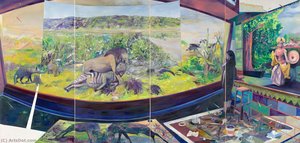
The Canvas of Memory: The Art of Zico Albaiquni
Born in 1987, Zico Albaiquni has emerged as a profound voice in contemporary Indonesian art, weaving a complex tapestry that bridges the gap between historical nostalgia and modern critique. His journey into the heart of painting was not merely a personal choice but an inheritance of spirit; growing up under the influence of his father, the renowned artist Tisna Sanjaya, Albaiquni was immersed in a world where art served as both a witness to history and a tool for social inquiry. While he initially sought refuge in the structured precision of graphic design—perhaps to carve out an identity independent of his father’s formidable legacy—a transformative encounter with the works of Sindudarsono Sudjojono, the pioneer of Indonesian modernism, redirected his path. This moment of revelation ignited a lifelong fascination with how pigments and strokes can capture not just reality, but the very essence of a nation's shifting identity.
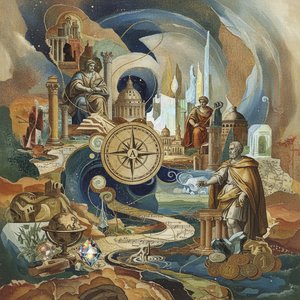
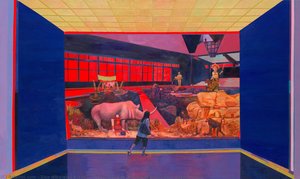
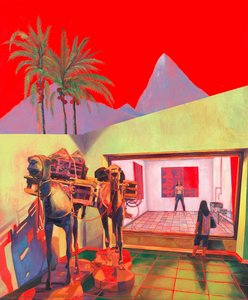
Albaiquni’s practice is characterized by a theatrical approach to composition, where he meticulously studies and reinterprets earlier genres to probe the fundamental role of the artist in society. He often draws upon the Mooi Indië (Beautiful Indies) tradition, a colonial-era style known for its romanticized, idyllic depictions of the Indonesian landscape. However, rather than simply replicating this aesthetic, Albai andquni utilizes its distinctive tonal formulas to create an intriguing, vibrant palette that feels both ancient and strikingly contemporary. His works frequently employ trompe l'oeil illusions, challenging the viewer’s perception by disrupting the traditional rectangular borders of the canvas, effectively blurring the line between the painted world and the physical space of the observer.
Intersections of Tradition and Modernity
The brilliance of Albaiquni’s work lies in its ability to act as a site of negotiation. He does not merely paint landscapes; he investigates the commodification of those landscapes. By referencing the links between art, advertising, and the romanticized imagery used to market Indonesia as an exotic destination, he brings urgent contemporary environmental issues to the forefront of his compositions. His paintings are layered with cultural icons and historical references that coalesce across intersecting planes, creating a sense of depth that is both visual and intellectual. In recent years, his experimentation has taken even more radical turns, as he has begun to incorporate his own studio environment into his compositions, effectively turning the act of creation itself into part of the artwork.
This evolution reflects a deep curiosity regarding the context and operation of painting in the 21st century. His achievements are marked by significant international recognition, having showcased his vision on prestigious global stages. Notable milestones include:
- The 9th Asia Pacific Triennial of Contemporary Art (2018-19) at the Queensland Art Gallery | Gallery of Modern Art, Australia.
- Contemporary Worlds: Indonesia at the National Gallery of Australia (2019).
- On the Nature of Botanical Gardens at Framer Framed, Netherlands (2019).
- Extensive exhibitions across Italy, France, Austria, the Netherlands, Hong Kong, and Singapore.
Through his mastery of both figurative and landscape elements, Zico Albaiquni continues to challenge how we perceive the circulation and function of art. He invites us to look beyond the frame, reminding us that every brushstroke is a dialogue with the past and every canvas is a living, breathing participant in the ongoing story of human experience.