

 Предпросмотр
 Перейти к печати
 Поделиться
 Поделиться


 Скачать
 Похожие работы
 Рентгенография
 Слайд-шоу
 Статистика
The Rest of Diana
 Oil On Canvas
- WallArt
- Baroque
 1645
1645 203.0 x 264.0 cm
 Лувр
Лувр
A Gathering of Gods and Mortals: The World of Jacob Jordaens
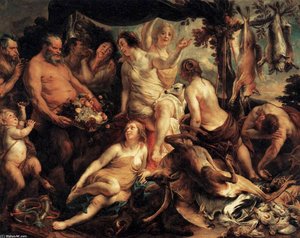
Jacob Jordaens’ “The Rest of Diana” (1645) isn't merely a painting; it’s an immersive experience, a vibrant tableau pulled from the heart of classical mythology. Born in Antwerp during a period of immense artistic flourishing – a time when Flemish Baroque was at its peak – Jordaens inherited a legacy of opulent detail and dramatic storytelling. Unlike many of his contemporaries who sought their fortunes in Italy, he remained firmly rooted in his native Flanders, cultivating a distinctly earthy style that celebrated the pleasures and realities of everyday life, while simultaneously embracing the grandeur of the divine. This painting exemplifies this approach perfectly, offering a glimpse into a world where gods and mortals mingle amidst a lush, almost overwhelming, natural setting.
Baroque Drama: Light, Texture, and Movement
At first glance, “The Rest of Diana” assaults the senses with its sheer abundance – a riot of figures, animals, and overflowing bounty. Jordaens masterfully employs the techniques characteristic of the Baroque period: dramatic chiaroscuro, where pools of light illuminate key elements while plunging others into shadow, creating an intense sense of depth and movement. Thick impasto—the application of paint in heavy, textured layers—dominates the canvas, lending a tactile quality to the scene; you can almost feel the rough bark of the trees, the yielding flesh of the nymphs, and the weight of the overflowing fruit baskets. The artist’s use of lines is equally dynamic – strong, defined outlines for the figures contrast with looser, more expressive brushstrokes in the background foliage, further enhancing the sense of movement and vitality.
Mythological Echoes: Diana, Satyrs, and the Pursuit of Pleasure
The painting’s subject matter is steeped in classical mythology. At its center stands Diana, the Roman goddess of the hunt, depicted here not as a stern huntress but as a figure of sensual delight, surrounded by satyrs, nymphs, and other deities indulging in feasting, hunting, and revelry. The abundance of food and game—deer, boar, grapes, and honeycombs—is a potent symbol of prosperity and indulgence, reflecting the values of the era. The presence of wild animals – untamed and free – speaks to the primal instincts that lie beneath the veneer of civilized society. Diana herself embodies both power and vulnerability, her gaze suggesting a mixture of amusement and perhaps even a hint of danger.
A Window into 17th-Century Antwerp
“The Rest of Diana” offers a fascinating glimpse into the cultural landscape of 17th-century Antwerp. Jordaens’ work reflects the city's status as a major center for art and commerce, a place where wealth and artistic patronage flourished. The painting’s scale—a substantial 203 x 264 cm—indicates its intended prominence within a wealthy collector’s home or grand salon. Furthermore, Jordaens’ decision to remain rooted in Flanders, rather than seeking training in Italy, highlights the vibrant independent art scene that thrived there during this period. His style, characterized by its earthy realism and celebration of everyday life, stands as a testament to the unique artistic identity of Antwerp.
Explore Jacob Jordaens’ “The Rest of Diana” (1645). A Baroque masterpiece depicting a mythological gathering in lush detail. Discover its rich textures, dramatic lighting & historical significance. Learn More
Якоб Йордаенс (1593 – 1678)
Якоб Йордаенс – выдающийся художник барокко из Антверпена, известный своими яркими картинами сельской жизни, пиршествами и аллегорическими композициями. Его работы отражают дух эпохи и являются важной частью фламандского искусства.
Лувр (Paris, France)
Погрузитесь в историю искусства! Лувр в Париже: от Древнего Египта до шедевров Ренессанса, включая Мону Лизу и Давида Микеланджело. Откройте для себя французскую культуру!
Об этом произведении
- Название: The Rest of Diana
- Художник: Якоб Йордаенс
- Год: 1645
- Размер оригинала: 203.0 x 264.0 cm
- Формат: Landscape
- Правовой статус: Общественное достояние
- Местонахождение: Лувр
- Материал: Oil On Canvas
- Техника исполнения: WallArt
- Период творчества: Mature Period
Основные сведения
- Year: 1645-1655
- Notable elements: Dramatic lighting, Impasto textures
- Medium: Oil on canvas
- Dimensions: 203 x 264 cm
- Influences:
- Rubens
- Italian art
- Artistic style: Dynamic composition, Realism, Revelry
- Location: Louvre, Paris
QR-код
