

 Предпросмотр
 Перейти к печати
 Поделиться
 Поделиться


 Скачать
 Похожие работы
 Рентгенография
 Слайд-шоу
 Статистика
right - Last Judgment (detail)1

The Weight of Eternity: Unveiling Michelangelo’s “Last Judgment” Detail
Michelangelo’s “Right – Last Judgment (detail)” isn’t merely a fresco; it's a visceral plunge into the heart of human morality, a dramatic tableau rendered with an intensity that continues to captivate centuries after its creation. Part of the monumental “Last Judgment” adorning the altar wall of the Sistine Chapel in Vatican City, this particular section offers a concentrated dose of the artist’s genius – a study in anatomical precision, psychological torment, and the profound weight of divine judgment. It's a fragment that speaks volumes about the entire composition, revealing not just the figures but also the very soul of Michelangelo’s vision.
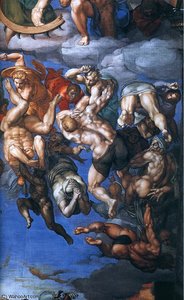
The scene unfolds with a breathtaking dynamism, dominated by the central figure of St. Bartholomew, his flayed skin – a potent symbol of martyrdom and sacrifice – held aloft in his right hand. This isn’t simply a depiction of suffering; it's an embodiment of anguish, a raw expression of pain that resonates deeply within the viewer. The detail is astonishing: every wrinkle, every tear, every fold of flesh conveys a sense of unbearable agony. Notice how Michelangelo masterfully utilizes chiaroscuro – the dramatic contrast between light and shadow – to heighten the emotional impact, drawing our gaze directly to Bartholomew’s tormented face, a self-portrait that adds an unsettling layer of personal intensity to the scene.
A Symphony of Anatomy and Emotion
Michelangelo's unparalleled understanding of human anatomy is on full display here. The musculature of St. Bartholomew is rendered with meticulous accuracy, yet it’s not merely a scientific study; it’s an instrument of expression. Each sinew, each tendon, contributes to the overall sense of suffering and vulnerability. The figures surrounding him – angels, saints, and the damned – are equally compelling in their anatomical realism, but they're also imbued with a powerful emotional charge. The faces are not idealized; they’re contorted in expressions of fear, regret, and despair. This commitment to portraying the human form with such honesty and intensity was revolutionary for its time.
The technique employed is characteristic of Michelangelo’s High Renaissance style: tempera on wet plaster, a method that allowed for vibrant colors and sharp details. The palette is restrained – primarily earthy tones of flesh, ochre, and umber – which further emphasizes the drama of the scene. However, closer inspection reveals subtle variations in color and texture, suggesting a depth and complexity that belies the fresco’s seemingly simple composition.
Echoes of Antiquity and Religious Symbolism
Michelangelo drew heavily on classical art for inspiration, particularly the sculptures of Greek antiquity. The pose of St. Bartholomew, with his outstretched hand holding his own skin, echoes depictions of heroic figures in Roman sculpture. The overall composition – a dramatic narrative unfolding within a defined space – is also reminiscent of classical friezes and reliefs. But Michelangelo doesn’t simply imitate the past; he transforms it, infusing it with Christian symbolism and his own unique artistic vision.
The flayed skin itself carries profound symbolic weight. It represents both Bartholomew's suffering and sacrifice, but also serves as a reminder of humanity’s fallen state – a consequence of sin and disobedience. The figures ascending to the left represent the saved, while those descending to the right embody damnation. The entire scene is a meditation on mortality, judgment, and the eternal consequences of our actions.
A Timeless Masterpiece: Reproductions and Beyond
Michelangelo’s “Right – Last Judgment (detail)” remains one of the most powerful and emotionally resonant works of art ever created. Reproductions offer a remarkable opportunity to experience this masterpiece firsthand, bringing its drama and intensity into your home or office. When selecting a reproduction, consider the quality of materials and printing techniques—a faithful rendering will capture the nuances of Michelangelo’s brushstrokes and color palette. This section of the “Last Judgment” is more than just an image; it's a window into the soul of one of history’s greatest artists – a testament to the enduring power of art to provoke, inspire, and challenge us.
Микеланджело Буонарроти (1475 – 1564)
Микеланджело Буонарроти: гений Ренессанса! Его шедевры – «Давид», «Пьета», росписи Сикстинской капеллы и архитектурные проекты восхищают во всем мире. Погрузитесь в мир великого мастера!
Об этом произведении
- Название: right - Last Judgment (detail)1
- Художник: Микеланджело Буонарроти
- Формат: Landscape
- Правовой статус: Общественное достояние
- Техника исполнения: WallArt
- Период творчества: High Renaissance
- Основной цвет: Espresso
- Предназначение: Statement
- Ключевые слова: michelangelo , fresco , last judgment
- Насыщенность цвета: Monochromatic
Основные сведения
- Dimensions: 34 ft × 21 ft (10.4 m × 6.4 m)
- Year: 1536–1541
- Location: Sistine Chapel, Vatican City
- Subject or theme: Last Judgment
- Notable elements or techniques: Dynamic figures, Anatomical detail
- Artistic style: Renaissance
- Influences: Classical antiquity
QR-код
