

The High Renaissance: A Convergence of Science, Humanism, and Artistry
 The High Renaissance: A Flourishing of Artistic Innovation & Humanist Ideals
Introduction: The Dawn of a New Artistic Era Wikipedia: High Renaissance In art history, the High Renaissance was a short period of the most exceptional artistic production in the Italian states, particularly Rome, capital of the Papal States, and in...
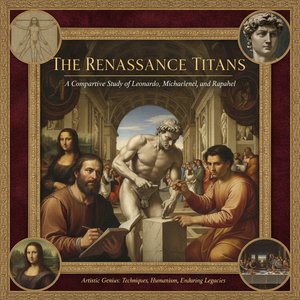
To step into the era of the High Renaissance is to witness a moment where human potential seemed to touch the divine. Spanning roughly from 1490 to 1527, this brief but incandescent period represented the absolute apex of European artistic achievement. It was not merely a continuation of the experimental spirit seen in the Early Renaissance; rather, it was a sophisticated synthesis of scientific observation and poetic idealism. Emerging from the foundations laid in Florence and reaching its zenith under the ambitious patronage of Popes like Julius II in Rome, this movement transformed the artist from a mere craftsman into a celebrated intellectual.
At the heart of this aesthetic revolution lay the philosophical movement of Humanism. Rejecting the medieval preoccupation with purely divine, often abstract iconography, Humanism celebrated human intellect, agency, and earthly beauty. This shift in worldview allowed artists to explore classical mythology alongside religious narratives, treating them not as contradictions but as complementary explorations of universal truths. The era was defined by a profound sense of order, where the chaotic textures of previous decades gave way to compositions characterized by geometric clarity, pyramidal structures, and a sublime equilibrium that sought to capture the very essence of human experience.
Leonardo da Vinci: The Architect of Sfumato and Scientific Observation
 Sfumato
Sfumato (English: sfoo-MAH-toh, Italian: [sfuˈmaːto]; lit. 'smoked off', i.e. 'blurred') is a painting technique for softening the transition between colours, mimicking an area beyond what the human eye is focusing on, or the out-of-focus plane. It i...
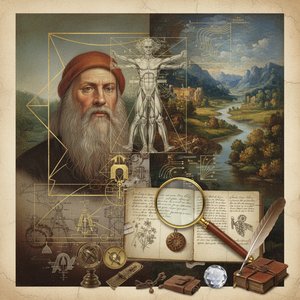
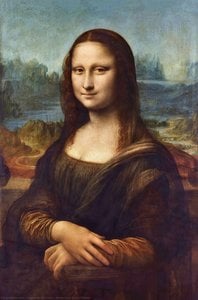
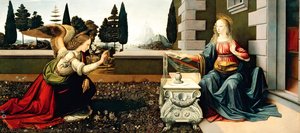
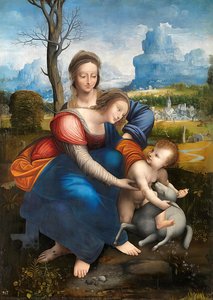
No figure embodies the Renaissance ideal of the polymath more profoundly than Leonardo da Vinci. For Leonardo, painting was an extension of his scientific inquiry into optics, anatomy, and the natural world. His approach was rooted in a deep engagement with reality, driven by his research into how the human eye perceives light and shadow. This rigorous investigation led to his development of sfumato, a technique literally meaning "smoked off." By softening the transitions between colors and tones, Leonardo eliminated harsh outlines, creating a blurred effect that mimured the way the human eye focuses on an object, leaving the periphery in a soft, atmospheric haze.
In masterpieces such as the Mona Lisa and the Virgin of the Rocks, one can observe this mastery of light and shadow. Through sfumato, Leonardo achieved an elusive, illusionistic rendering of the human face, imbuing his subjects with a psychological depth that felt startlingly alive. His work was never just about surface beauty; it was about the underlying mechanics of vision. By applying contemporary scientific knowledge to the canvas, he moved beyond mere depiction toward a state of atmospheric realism, where the boundaries between the subject and the surrounding air seem to dissolve into a seamless, breathing whole.
Michelangelo Buonarroti: The Sculptural Power of Anatomical Mastery
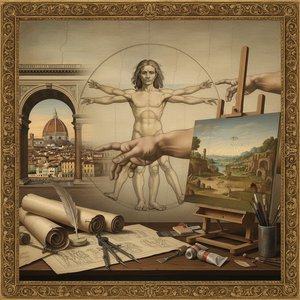 Mastering Perfection: A Definitive Guide to the High Renaissance Art Movement
The Dawn of Harmony: Defining the High Renaissance Era The transition from the Early Renaissance to the High Renaissance marks one of the most profound shifts in the history of human expression. It was an era where the experimental spirit of the prev...
While Leonardo sought the softness of atmosphere, Michelangelo Buonarroti pursued the monumental power of form. Though he considered himself primarily a sculptor, his influence on painting was nothing short of revolutionary. For Michelangelo, the human body was the ultimate vessel for expressing divine struggle and heroic grandeur. His work is characterized by an intense focus on anatomical accuracy, driven by his direct study of human dissection. This knowledge allowed him to depict musculature, tension, and movement with a physical presence that felt almost tactile.
The Sistine Chapel ceiling stands as the definitive testament to his sculptural approach to painting. Here, the figures are not merely painted; they are carved into the very architecture of the chapel. Every limb, every flexed muscle, and every twisting torso is imbued with a sense of weight and kinetic energy. Michelangelo utilized the human form to convey complex theological narratives, using the physical struggle of the body to mirror the spiritual struggles of the soul. His aesthetic was one of terribilità—a sense of awe-inspiring power and emotional intensity that pushed the boundaries of what the human figure could communicate on a two-dimensional surface.
Raphael Sanzio: Achieving the Sublime Equilibrium of Harmony and Grace
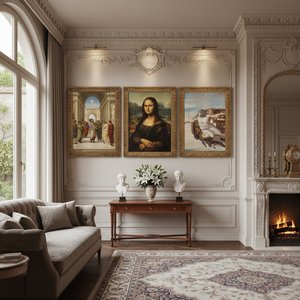 High Renaissance Masterpieces: Iconic Art for Your Home |
Introduction To gaze upon the masterpieces of the High Renaissance is to encounter a moment in time where human potential seemed limitless, and artistic expression reached unprecedented heights. This wasn’t merely a stylistic shift; it was a cultural...
If Leonardo provided the atmosphere and Michelangelo provided the muscle, Raphael Sanzio provided the perfect balance. Often regarded as the master of harmony, Raphael possessed an unparalleled ability to synthesize the innovations of his contemporaries into a style defined by clarity, grace, and compositional perfection. His work represents the "sublime equilibrium" of the High Renaissance, where complex narratives are organized with such geometric precision that they appear effortless and natural.
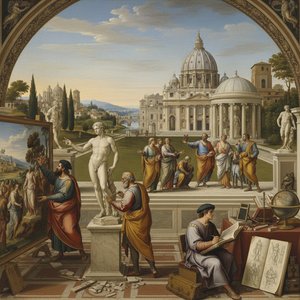
In works like the School of Athens, Raphael demonstrates a masterful command of perspective and architectural grandeur, bringing together the greatest minds of antiquity in a space that feels both vast and intimately ordered. His ability to depict the Madonna with a gentle, serene beauty—often utilizing subtle gradations of light reminiscent of Leonardo’s sfumato—showcases his versatility. Raphael’s compositions often rely on stable, pyramidal structures that guide the viewer's eye through the narrative, creating a sense of peace and stability. He achieved a level of poetic idealism that made the divine feel accessible and the human form appear inherently noble.
A Comparative Analysis: Divergent Techniques in Pursuit of Perfection
 Renaissance art
Renaissance art (1350 – 1620) is the painting, sculpture, and decorative arts of the period of European history known as the Renaissance, which emerged as a distinct style in Italy in about AD 1400, in parallel with developments which occurred in phi...
Comparing these three titans reveals a fascinating divergence in how the same goal—the pursuit of perfection—was approached through different technical lenses. Leonardo’s path was one of observation, using the science of optics to blur the lines between reality and illusion. Michelangelo’s path was one of expression, using the anatomical truth of the body to manifest spiritual and emotional weight. Raphael’s path was one of synthesis, taking the innovations of his peers and refining them into a language of ultimate harmony.
The technical modes available to these masters—sfumato, chiaroscuro (the contrast of light and dark), and cangiante (the use of shifting colors to represent shadows)—were utilized differently by each. Where Leonardo used shadow to create mystery, Michelangelo used it to define mass, and Raphael used it to create depth within a balanced composition. Despite these different trajectories, all three artists shared the fundamental Renaissance conviction that art should reflect the dignity of humankind and the mathematical order of the universe.
The Enduring Legacy: How the Masters Redefined Western Visual Language
The impact of the High Renaissance cannot be overstated; it fundamentally altered the course of Western art. The transition from the medieval period to the modern era was paved by these masters, who moved art away from rigid, symbolic iconography toward a more individualistic and naturalistic view of man. They established the standards for proportion, perspective, and anatomical accuracy that would govern academic training for centuries to come.
Today, we continue to find resonance in their works because they speak to universal truths: the search for meaning, the nature of beauty, and the complexity of the human spirit. Whether through the atmospheric mystery of a Leonardo, the heroic tension of a Michelangelo, or the serene clarity of a Raphael, the High Renaissance remains a pinnacle of human achievement—a moment in history when the boundaries between science, philosophy, and art were beautifully, and permanently, erased.
About ArtsDot.com
ArtsDot.com is a global leader in providing high-quality, hand-painted reproductions of the world's most iconic masterpieces. We specialize in bringing the textures and soul of the Old Masters to modern spaces through meticulous oil paintings on 100% cotton canvas. From custom portrait commissions to large-scale architectural murals, our mission is to make fine art accessible to collectors, professionals, and decorators worldwide. Every piece is a labor of passion, executed by artists holding degrees from prestigious academies, ensuring that the legacy of the Renaissance continues to inspire generations.