
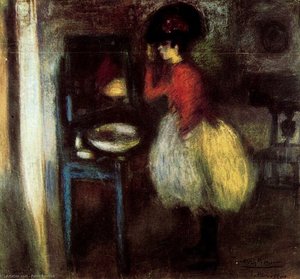

The Foundations of Fragmentation: From Cézanne’s Structure to the Cubist Revolution
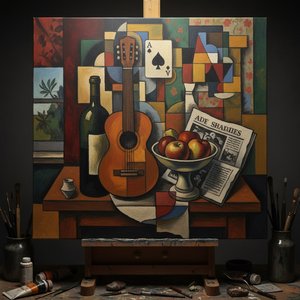 Cubist Still Life: Redefining Reality Through Fragmented Forms and Geometric Abstraction
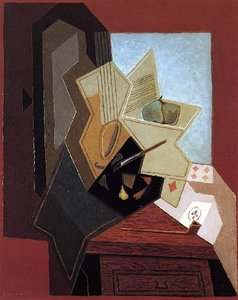
The Genesis of Fragmentation: From Cézanne’s Structure to Cubist Revolution To understand the radical rupture of Cubism, one must first look toward the quiet, structural revolution orchestrated by Paul Cézanne. Before the world was shattered into geo...
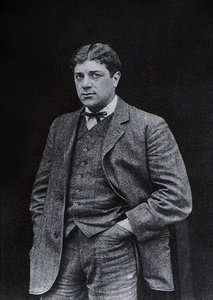
To grasp the radical rupture that Cubism introduced to the modern visual landscape, one must first look toward the quiet, structural revolution orchestrated by Paul Cézanne. Before the world was shattered into geometric planes, Cézanne began the profound work of treating nature not as a fleeting impression of light, but as a collection of fundamental volumes. He sought to find the cylinder, the sphere, and the cone within the landscape and the fruit bowl alike, bridging the gap between the ephemeral beauty of Impressionism and the rigorous intellectualism of the modern era. This structural integrity provided the fertile soil for Georges Braque and Pablo Picasso to cultivate a new visual language.
Where Cézally hinted at the permanence of form, the Cubists fully embraced its dissolution. They moved beyond the single-point perspective that had dominated Western art since the Renaissance, choosing instead to present a multifaceted reality. This transition was not merely a stylistic choice but a philosophical shift—a realization that our perception of an object is a cumulative experience of many viewpoints gathered over time. For the modern designer, this represents the moment when art ceased to be a mere window into a scene and became an autonomous construction of thought, form, and architectural depth.
Analytical vs. Synthetic Cubism: Understanding Form, Texture, and Materiality
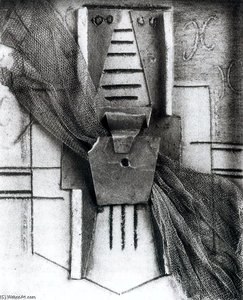 Guitar 5
A Fragmented Vision of Form: Analyzing Picasso’s “Guitar” Pablo Picasso's "Guitar" (1920), a deceptively simple yet profoundly complex sculpture, stands as a pivotal emblem of Synthetic Cubism—a movement that irrevocably altered the trajectory of art...
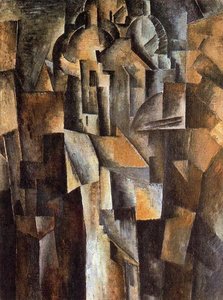
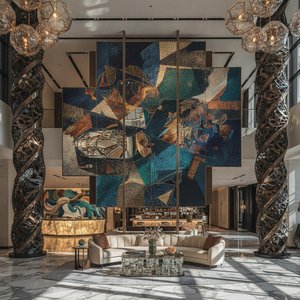
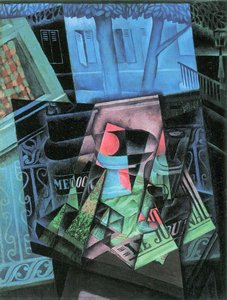
The evolution of Cubism is often categorized into two distinct phases, each offering unique aesthetic opportunities for large-scale interior curation. The early stage, known as Analytical Cubism, served as a laboratory for deconstructing the object. In this phase, artists utilized a monochromatic palette to focus entirely on form and line, dissecting subjects into complex, overlapping planes. This approach creates a sense of intense intellectual rigor and structural complexity, making it ideal for sophisticated corporate lobbies where a sense of stability and depth is required.
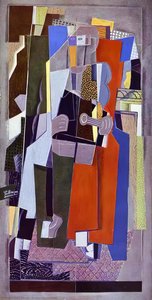
As the movement progressed into Synthetic Cubism, the visual language shifted toward a more additive process. Artists like Picasso began to move away from meticulous shading, instead employing bold, geometric shapes and rectilinear blocks to construct form. This phase introduced a renewed interest in materiality and texture, often incorporating elements that suggested different surfaces and weights. In works such as Picasso’s Guitar (1920), we see the use of simplified, flattened planes that emphasize the immediate surface and the interplay between light and shadow. For procurement managers looking to add vibrancy to a space, Synthetic Cubism offers a more accessible, graphic energy that balances bold composition with tactile richness.
Geometric Abstraction in Modern Spaces: Integrating Cubist Principles into Hotel Interiors
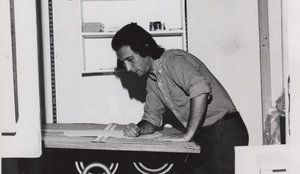 Paolo Cotani
Paolo Cotani: Exploring the Geometry of Emotion Paolo Cotani, born in Rome in 1940, is an Italian painter whose distinctive approach to abstraction has garnered international acclaim. His artistic journey began amidst the vibrant intellectual current...
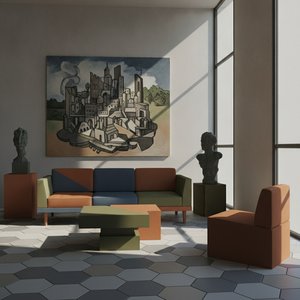
For the hospitality designer, the principles of Cubism offer a sophisticated toolkit for managing spatial perception. The movement’s preoccupation with geometric abstraction allows for the creation of environments that feel both structured and dynamic. By utilizing the language of cubes, spheres, and cylinders, one can introduce an element of "revealed structure" into a room, much like Cubist sculpture does when presenting fragments that allow the viewer to interpret volume through shifting viewpoints.
Integrating these principles requires a thoughtful approach to color and rhythm. The use of geometric forms can guide the eye across a large lounge or dining area, creating a sense of movement without the need for distracting narratives. Much like the works of Auguste Herbin or the later explorations of Paolo Cotani, where geometry is used to convey emotion through precise arrangement, a designer can use Cubist-inspired elements to evoke tranquility or energy. The key lies in the balance between the fragmented subject and the cohesive architectural environment, ensuring that the art serves as an anchor for the room's overall aesthetic.
The Power of Multi-Panel Compositions: Using Cubist Layouts for Large-Scale Architectural Walls
 Cubist sculpture
Cubist sculpture developed in parallel with Cubist painting, beginning in Paris around 1909 with its proto-Cubist phase, and evolving through the early 1920s. Just as Cubist painting, Cubist sculpture is rooted in Paul Cézanne's reduction of painted ...
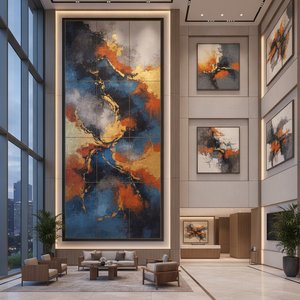
One of the most effective ways to implement Cubist aesthetics in modern architecture is through the use of multi-panel or polyptych compositions. The Cubist tendency toward fragmentation lends itself naturally to splitting a single, complex image across three, four, or five separate canvases. This "multi-panel" trend is particularly effective for wide hotel corridors, grand staircases, or expansive feature walls in restaurant settings. These layouts allow the artwork to interact directly with the architecture, breaking the plane of the wall and creating a rhythmic, sculptural effect.
When executing these large-scale installations, it is vital that the colors and brushstrokes flow seamlessly across every panel to maintain a cohesive visual narrative. At ArtsDot.com, our artists ensure that the geometric continuity is preserved, allowing the fragmented forms of a Cubist piece to wrap around the edges or bridge the gaps between frames with professional precision. This method transforms a flat surface into a dynamic, multi-dimensional experience, much like the way Cubist sculpture translates painting back into a semi-reality.
Customizing the Vision: Transforming Modern Photography into Cubist Oil Masterpieces
 Geometric abstraction
Geometric abstraction is a form of abstract art based on the use of geometric forms sometimes, though not always, placed in non-illusionistic space and combined into non-objective (non-representational) compositions. Although the genre was popularize...
The true power of modern art procurement lies in the ability to "remix" history to suit a specific design brief. Through advanced customization, it is now possible to take contemporary imagery and reimagine it through the lens of historical movements. Our Professional Digital Mockup Service allows designers to see exactly how a custom commission will look on their specific wall before the first brushstroke is applied, removing the uncertainty often associated with large-scale art orders.
This capability extends to "Period Shifts," where a modern photograph can be transformed into a Cubist masterpiece. Using our AI Masterpiece Transformation tool, a client can upload a photo and see it reconstructed with the angular planes and multifaceted perspectives characteristic of the early 20th century. Once the digital design is perfected, our skilled artists—holders of prestigious Fine Arts degrees—hand-paint the vision onto 100% cotton canvas. The result is a bespoke, museum-grade work that features the deep tonal range and visible brushstrokes of true oil painting, providing a unique, high-impact centerpiece that is as much an architectural element as it is a piece of fine art.
For professionals managing large-scale projects, ArtsDot.com provides the reliability of a global trade supplier. From custom sizing and multi-panel engineering to VAT-compliant documentation for international hospitality chains, we ensure that your vision is delivered with operational excellence. Whether you are seeking a single statement piece or a coordinated collection for an entire hotel property, our process—from digital mockup to final DHL/FedEx delivery—is designed for efficiency, quality, and total transparency.