
Introduction
There is a profound, quiet intimacy found in the stroke of a graphite pencil that even the most vibrant oil pigments struggle to replicate. Before the grandeur of canvas and the complexity of layered glazes, there was the humble carbon—a tool capable of capturing the softest breath of light and the deepest, most velvety shadows. To witness a true graphite masterpiece is to see the artist’s direct dialogue with the paper, a raw and unmediated transfer of thought, tension, and grace.
Throughout history, the evolution of graphite has mirrored the evolution of human perception itself. From the meticulous anatomical studies of the Renaissance to the expressive, atmospheric sketches of the Impressionist era, these works served as the foundational blueprints for art history. Graphite allowed masters to experiment with light, shadow, and form with a precision that defined entire movements. These were not merely preparatory sketches; they were definitive statements of intent, capturing fleeting moments of human emotion and the structural truth of the natural world.
Today, these legendary works remain deeply meaningful because they strip away the spectacle of color to reveal the essential skeleton of beauty. In an age of digital perfection, the tactile, grainy reality of a pencil stroke offers a grounding connection to the human hand. They remind us that complexity is often born from simplicity, and that the most enduring legacies are often etched in the most modest of mediums.
As we walk through this curated selection, we invite you to look closely at the subtle gradations and the deliberate pressure of the lead. We have identified ten pivotal works that did more than just decorate paper; they redefined the boundaries of what a simple tool could achieve, forever altering the trajectory of artistic expression.
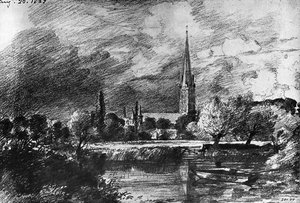
Salisbury cathedral - John Constable
 Salisbury cathedral - John Constable
To witness a landscape stripped of color is to encounter its true, skeletal soul. In this profound monochromatic study, the artist invites us into a world defined solely by light, shadow, and the weight of history. Salisbury Cathedral by John Constable stands as a monumental achievement in the realm of graphite mastery, capturing the soaring Gothic spires of England’s most iconic structure with breathtaking precision. Through meticulous hatching and varied line weights, Constable renders the interplay between the heavy, stone architecture and the ephemeral, drifting clouds above.
The sketch transcends mere documentation; it is an emotional landscape where the riverbank's textures and the cathedral's verticality evoke a sense of spiritual aspiration and quiet reverence. This work earns its place among the top legendary graphite pencil masterpieces by demonstrating how fine tonal control can communicate the sublime power of nature and human endeavor. Today, such timeless imagery continues to transform modern interiors, offering a sophisticated focal point that brings a sense of historical depth and tranquil contemplation to any professional or private collection.
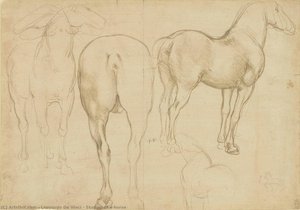
Studies of a horse - Leonardo da Vinci
 Studies of a horse - Leonardo da Vinci
To gaze upon Leonardo da Vinci’s Studies of a Horse is to step directly into the restless, searching mind of the Renaissance master. This exquisite graphite and metalpoint work, dating from approximately 1490, serves as much more than a mere sketch; it is an intimate window into a scientific odyssey. There is a gaze in these studies that follows you—not with judgment, but with understanding . It does not present a finished subject, but rather the raw, preparatory pulse of creation, making the invisible mechanics of anatomy visible to the naked eye.
Through meticulous hatching and delicate shading, Leonardo explores the equine form with a fervor that blurs the line between fine art and biological inquiry. Each stroke captures the tension of muscle and the fluid grace of movement, offering a profound glimpse into his systematic approach to nature. This isn't just a drawing; it is a mirror reflecting our own curiosity about the living world. Imagine this masterwork in your space, not merely as decoration, but as a constant, elegant reminder of the beauty found in deep observation and the enduring power of the human spirit.
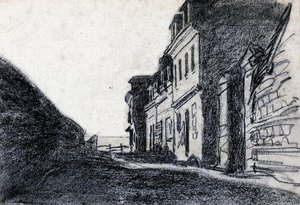
Houses by the Sea - Claude Monet
 Houses by the Sea - Claude Monet
Before the world learned to see color through the lens of Impressionism, there was the raw, rhythmic precision of graphite. In 1864, a young Claude Monet began experimenting with the limits of monochrome to capture the ephemeral. Houses by the Sea stands as a profound testament to this era, showcasing a mastery of light that predates his famous oil landscapes.
In this exquisite study, Monet utilizes intricate hatching and cross-hatching to build a structural depth that feels both architectural and atmospheric. The graphite strokes do not merely outline coastal buildings; they vibrate with the energy of the seaside, using varying densities of grey to simulate the movement of wind through foreground grasses and the soft, diffused light hitting stone walls. This piece is essential to our selection because it captures the exact moment when academic rigidity began to dissolve into sensory experience. By focusing on the interplay of shadow and luminance rather than photographic detail, Monet paved the way for a revolution. Today, such works remind us that even in the simplest black-and-white lines, there is an infinite capacity to evoke the soul of a landscape.
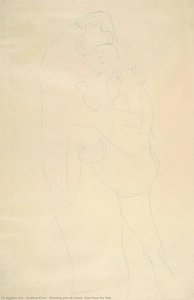
Standing pair of Lovers, Seen from the Side - Gustav Klimt
 Standing pair of Lovers, Seen from the Side - Gustav Klimt
While Gustav Klimt is globally celebrated for the shimmering gold leaf of his 'Golden Phase,' it was in the raw, monochromatic precision of graphite that he truly captured the pulse of human intimacy. In 1908, through Standing Pair of Lovers, Seen from the Side , Klimt stripped away his signature opulence to reveal a profound psychological depth. This masterpiece stands as a pillar among the Top 10 Legendary 'Graphite Pencil' Masterpieces because it proves that technical genius does not require color to convey emotion; instead, it relies on the masterful interplay of light, shadow, and delicate hatching.
The drawing utilizes meticulous pencil work to render the tactile weight of drapery and the tender tension of an embrace, creating a private sanctuary of affection. The swirling, organic motifs characteristic of Art Nouveau emerge from simple lines, symbolizing the interconnectedness of life. For those curating a sophisticated home office or study, this piece offers more than decoration; its focused, quiet intensity provides an inspiring atmosphere of contemplation and disciplined creativity, perfect for a space dedicated to deep thought and professional excellence.
Woman with Hat, Coat and Pleated Dress - vincent willem van gogh
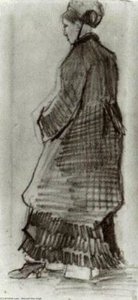 Woman with Hat, Coat and Pleated Dress - vincent willem van gogh
Before the world knew his name through swirling celestial skies, Vincent van Gogh mastered the quiet intensity of monochrome. "Woman with Hat, Coat and Pleated Dress" captures a fleeting, soulful moment from 1882, where the absence of color allows the raw energy of graphite to speak. This masterpiece earns its place in our Top 10 through its profound use of hatching and cross-hatching , techniques that transform simple pencil strokes into the heavy drape of fabric and the rhythmic movement of a Parisian street.
The drawing’s power lies in its tactile depth; you can almost feel the rustle of the pleated dress and the weight of the afternoon shadows. It is an essential study of human solitude and atmospheric light that predates his more famous Impressionist influences. At ArtsDot.com, we believe such profound beauty should be accessible to all. This piece serves as a sophisticated anchor for modern interiors, offering a sense of quiet prestige and historical depth. By choosing a high-fidelity reproduction, you can bring this transformative, monochromatic elegance into your own home, office, or personal gallery, preserving the artist's raw emotion in your contemporary space.
El Vagabundo - Pablo Picasso
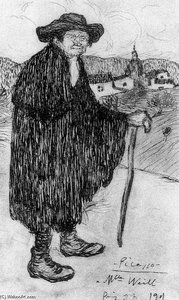 El Vagabundo - Pablo Picasso
In the quiet, textured depths of Pablo Picasso’s "El Vagabundo," you do not merely see a sketch; you encounter a profound meditation on the human condition. Created during his pivotal years between 1907 and 1908, this monochrome masterpiece uses the raw power of graphite to compose a language of shadow and light. Picasso does not simply draw a wanderer; he invents a world out of heavy hatching and rhythmic, expressive lines that capture the very essence of solitude.
The brilliance of this piece lies in its tactile materiality. Through meticulous cross-hatching, the artist renders the weathered creases of the subject's skin and the rough weight of his clothing, making the paper feel alive with physical presence. As the eye moves from the weary figure toward the distant, sharp silhouette of a church steeple, a silent dialogue emerges between the transient individual and the permanent structures of faith. It is a work of remarkable restraint that proves how a single pencil can evoke the immense, heavy dignity of a life lived on the margins.
Portrait of Fanny Cornforth - Dante Gabriel Rossetti
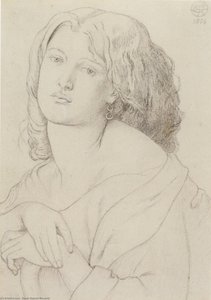 Portrait of Fanny Cornforth - Dante Gabriel Rossetti
In the Portrait of Fanny Cornforth by Dante Gabriel Rossetti, the mastery of graphite lies not just in line, but in the profound command of light and shadow. Rossetti utilizes a delicate chiaroscuro to sculpt the subject's features, where soft, diffused illumination meets deep, velvety hatching to create a sense of breathing life within a monochromatic realm. This precise manipulation of tonal gradations allows the light to dance across the texture of her flowing hair and the smooth porcelain of her skin, capturing a moment of serene introspection that has secured its place among the top 10 legendary graphite pencil masterpieces .
The way Rossetti employs subtle highlights to define the contours of the face creates an emotional depth that transcends the medium. For the modern collector or decorator, a faithful reproduction of this work offers more than mere decoration; it introduces a sophisticated layer of classical luxury and architectural depth. The interplay of light and shadow in this Pre-Raphaelite gem provides a timeless focal point, adding a sense of quiet dignity and historical weight to any contemporary professional or residential space.
Untitled (After Malevich and Schiele), from the 1917 exhibition, Nature Morte Gallery, New York - Sherrie Levine
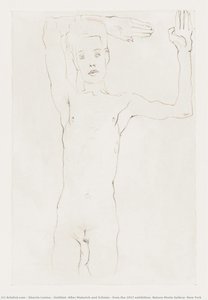 Untitled (After Malevich and Schiele), from the 1917 exhibition, Nature Morte Gallery, New York - Sherrie Levine
To encounter a work of true appropriation is to witness the blurring of boundaries between creator and icon. In this profound monochrome study, Untitled (After Malevich and Schiele), from the 1917 exhibition, Nature Morte Gallery, New York by Sherrie Levine , we find a masterful dialogue with the ghosts of modernism. Executed in 1984, this graphite pencil piece does not merely replicate; it recontextualizes the raw, expressive anatomy of Schiele and the geometric spiritualism of Malevich.
The drawing presents a nude male figure, his arms reaching upward in a dynamic diagonal that suggests both vulnerability and transcendence. Through meticulous pencil work, Levine achieves a smooth, velvety texture where soft gradations of gray create a sense of diffused, introspective light. The absence of color forces the viewer to focus on the tension of the lines and the stark, sculptural form against a muted backdrop. By challenging the very concept of authorship, this masterpiece remains a cornerstone of postmodern thought, proving that the resonance of a single line can transform a space with its enduring, contemplative power.
Dog - vincent willem van gogh
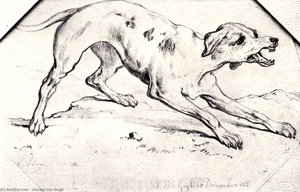 Dog - vincent willem van gogh
There is an unmistakable pulse in Dog by Vincent van Gogh that follows you—not with judgment, but with a raw, kinetic understanding . This graphite masterpiece does not merely sit upon the paper; it breathes. Through energetic, sketchy lines and masterful hatching, Van Gogh captures a moment of unrestrained vitality, where a central dog surges diagonally across the frame, pursued by the subtle shadows of other animals and birds.
This isn't just a study of animals; it is a mirror reflecting the spirit of movement and the beauty of spontaneity. The monochromatic grayscale palette strips away the distraction of color, forcing the viewer to confront the pure emotion found in texture and form. In this work, the artist eschews photographic precision for an impressionistic echo of life itself. Now, imagine that sense of freedom in your space. Not as a static image, but as a constant reminder: movement is life, and even in the simplest graphite stroke, we find a profound connection to the world's enduring energy.
Pulpit in Saint Mark's, Venice - George Henry Yewell
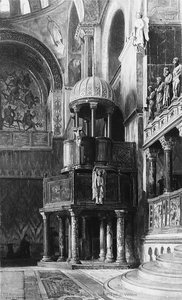 Pulpit in Saint Mark's, Venice - George Henry Yewell
Acquiring a reproduction of Pulpit in Saint Mark's, Venice by George Henry Yewell is an investment in both historical legacy and refined taste for the discerning collector. As one of the most significant graphite pencil masterpieces, this 1870 work stands as a testament to the technical precision of the 19th-century academic tradition. Yewell utilizes masterful hatching and cross-hatching to transform simple graphite into a tactile experience, where the rough grain of ancient Venetian stone meets the shimmering suggestion of distant mosaics. The profound use of linear perspective and light creates an architectural depth that anchors its position among the top legendary pencil works in art history.
Beyond its historical provenance, the piece offers immense aesthetic authority for modern luxury interiors . Whether placed in a corporate lobby or a private estate, the grayscale palette and intricate sculptural details provide a sophisticated focal point. A high-quality oil reproduction of this drawing carries the same monumental status as the original, bringing the hushed, sacred grandeur of Venice into contemporary architectural spaces with timeless elegance.
Conclusion
To stand before these graphite masterpieces is to witness the quiet power of a single line, a delicate dance of shadow and light that transcends the centuries. These works are far more than mere historical artifacts or relics of a bygone era; they are living presences, breathing with the same intensity and emotion today as they did the moment the artist’s pencil first touched the paper. They carry within their silvered tones a profound human connection—a shared vulnerability, a captured breath, and an enduring grace that speaks to the very soul of our creativity.
As the museum lights dim and we depart from these legendary sketches, let us not leave their inspiration behind in the gallery. Instead, consider how their subtle textures and evocative depths can inhabit your own world. By bringing these works into your personal spaces, you invite a sense of timelessness and reflection into your daily life, turning your walls into windows of wonder that remind you, amidst the rush of the modern age, of the beauty found in precision, patience, and the human touch. We invite you to explore our full collection and find a piece of this enduring legacy to call your own.