

The Great Rebellion: Breaking the Chains of Academic Tradition
 Capturing Light: The Revolution of Impressionism and the Enduring Legacy of Claude Monet
The Dawn of a Revolution: Breaking from Academic Tradition Impressionist Landscapes: 10 Masterpieces for Your Home | ArtsDot Introduction Imagine stepping into a world bathed in dappled sunlight, where colors dance and shimmer with an ethereal quali...
To understand the seismic shift brought about by Impressionism, one must first envision the rigid, somber atmosphere of the mid-19th-century French art world. For decades, the Académie des Beaux-Arts held an iron grip on artistic expression, enforcing a standard of perfection that favored dark, studio-bound compositions and historical or mythological subjects. These academic works were characterized by invisible brushstrokes and a polished, almost photographic finish that sought to hide the hand of the artist entirely. However, a group of rebels, led by the visionary Claude Monet, began to chaul the foundations of this establishment. They were dissatisfied with the conservative standards of the Salon, seeking instead to capture the raw, unfiltered sensation of life as it unfolded.
This rebellion was not merely about subject matter; it was a fundamental rejection of the controlled, artificial reality presented by the Academy. Alongside contemporaries like Renoir and Pissarro, Monet sought to organize independent exhibitions that bypassed the gatekeepers of tradition. The landmark exhibition of 1874 served as a watershed moment, introducing a style so radical that it was initially met with derision—the very term Impressionism was born from a critic's mockery of Monet’s work, Impression, soleil levant. What the critics saw as unfinished or sloppy, the artists saw as the birth of a new visual language, one that prioritized the immediate perception over the meticulously rendered detail.
Chasing the Ephemeral: The Science of Light and Color in Impressionism
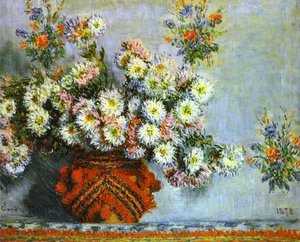 Chrysanthemums
Introduction to Claude Monet and Impressionism Claude Monet (1840-1926) was a French artist who played a pivotal role in the development of impressionist painting, which sought to capture the fleeting effects of light and color in the natural world. ...
At the heart of this aesthetic revolution lay an obsession with the transient. Monet and his peers were not merely painters of landscapes; they were chroniclers of fleeting moments, poets of light and color who understood that the world is never static. They recognized that light is the true protagonist of every scene, constantly shifting, dancing, and transforming the appearance of everything it touches. To capture this, they moved away from the heavy, earth-toned palettes of the past, embracing bright, vibrant colors that could vibrate against one another on the canvas. This technique, often referred to as broken color, involved applying small, energetic strokes of pure pigment, allowing the viewer's eye to optically mix the colors from a distance.
This scientific approach to perception allowed them to capture the way shadows are not merely black or grey, but composed of deep blues, purples, and reflected hues from the surrounding environment. In works like Chrysanthemums, one can observe Monet's mastery in using color to suggest the movement of air and the subtle variations in light that define a flower's vitality. By focusing on the ephemeral—the split-second magic before the eye can even name what it sees—the Impressionists transformed the canvas into a sensory experience, where the sun doesn't just shine but seems to vibrate against the water and the meadow.
En Plein Air: Moving the Studio into the Natural World
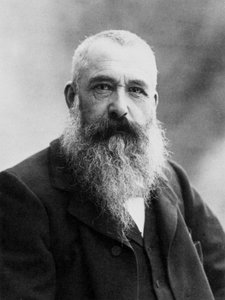 Claude Monet
A Life Immersed in Light: The World of Claude Monet Oscar-Claude Monet, a name synonymous with Impressionism, wasn't merely a painter of landscapes; he was a chronicler of fleeting moments, a poet of light and color. Born in Paris on November 14, 184...
Perhaps the most radical physical change in artistic practice was the move from the controlled environment of the studio to the unpredictable beauty of the outdoors. Influenced by the pivotal mentorship of Eugène Boudin, Monet embraced the practice of en plein air painting. This was a departure from the tradition of sketching outdoors only to complete much larger, more calculated works within the safety of a studio. For the Impressionists, the act of painting directly from nature was essential to capturing the true essence of the atmosphere. They traded the dark, enclosed corridors of academic training for the windswept coasts of Normandy and the lush, sun-drenched gardens of Giverny.
This method required a new kind of technical agility. Painting outdoors meant contending with changing weather, shifting sunlight, and the rapid passage of time. An artist might find themselves racing against the setting sun to capture the precise glow of dusk. This spontaneity is palpable in works such as Woman with a Parasol, where the wind-blown veil of Madame Monet and the billowing white dress of his wife are rendered with a sense of immediate, breathless movement. By embracing the elements, the Impressionists brought a raw, organic energy to their work that made the landscape feel alive, breathing, and intimately connected to the viewer.
Mastering the Moment: Analyzing Monet’s Iconic Series and Techniques
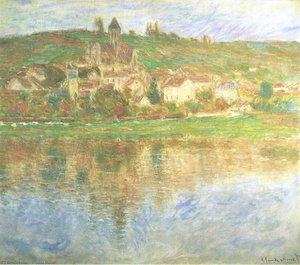 Vetheuil
Claude Monet: Vetheuil – A Symphony of Light and Memory Claude Monet, one of the most revered figures in Impressionist art, didn’t merely depict a landscape; he wrestled with capturing its essence—the fleeting dance of light upon water and stone—a pu...
As Monet’s career progressed, his fascination with light led him to a groundbreaking innovation: the series painting. He realized that a single subject could be transformed entirely by the time of day or the season. By painting the same subject—be it haystacks, cathedrals, or his beloved water lilies—multiple times, he was able to explore the profound impact of light and weather on form. These series were not mere repetitions; they were deep investigations into the nature of perception itself. In each iteration, the subject becomes a vessel for color and atmosphere, often dissolving into a symphony of light where the boundaries between object and environment begin to blur.
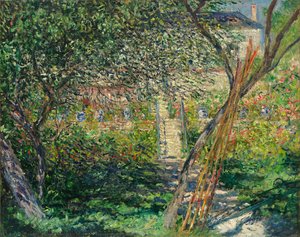
This obsession with the transient is most evident in his later works, such as Vetheuil or the immersive Water Lilies. In these pieces, Monet moved toward an almost abstract way of seeing, where the heavy textures of impasto and the layering of pigment created a tactile depth that invited the viewer to lose themselves in the composition. He became the ultimate architect of the ephemeral, creating canvases where the air feels heavy with moisture and the water seems to shimmer with life. His ability to manipulate texture and tone allowed him to capture not just what the eye sees, but how the heart feels when witnessing a fleeting moment of natural beauty.
The Ripple Effect: How Impressionism Paved the Way for Modernism
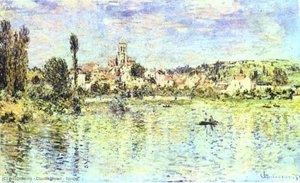 Spring
Introduction to Claude Monet and Impressionism Oscar-Claude Monet, a seminal French artist (1840-1926), played a pivotal role in founding Impressionist painting, significantly influencing modernism. His philosophy, primarily based on capturing immedi...
The legacy of the Impressionist revolution extends far beyond the 19th century, acting as the foundational spark for much of modern art. By breaking the monopoly of the Academy and prioritizing subjective experience over objective realism, Monet and his contemporaries opened the floodgates for every movement that followed. The emphasis on visible brushstrokes, bold color palettes, and the exploration of light paved the way for Post-Impressionism, Fauvism, and eventually the abstract movements of the 20th century. They proved that art did not need to be a mirror of reality; it could be an interpretation of sensation.
The ripples of this movement can be seen in the works of artists who sought even greater abstraction or more intense emotional expression. The freedom to experiment with form and the courage to challenge established norms became the hallmark of the modern era. Even today, the Impressionist focus on the sensory experience continues to resonate within contemporary design and digital art, reminding us to slow down and observe the subtle, beautiful transitions in our own rapidly changing world.
Preserving the Impression: Bringing Timeless Masterpieces into Contemporary Spaces
 Monet's Masterpieces: 25 Iconic Artworks to Transform Your Home
Introduction Imagine stepping into a world bathed in dappled sunlight, where water lilies shimmer and fields of poppies dance in the breeze. Claude Monet’s art isn't merely about depicting scenes; it’s about capturing an *impression* – a fleeting mom...
In our fast-paced, digital age, the works of Monet and the Impressionists serve as a profound reminder of the value of presence and observation. Their art invites us to breathe deeply and experience the world anew. While the original masterpieces reside in hallowed halls like the Musée Marmottan Monet in Paris, the spirit of their revolution can be brought into any modern interior through high-quality reproductions.
For the contemporary enthusiast, a hand-painted oil reproduction offers a way to connect with this historical grandeur. Unlike flat prints, a true oil reproduction on cotton canvas retains the visible brushstrokes and deep tonal ranges that define the Impressionist style. Whether it is a large-scale multi-panel set designed to transform a wide wall or a custom "remixed" piece that brings a personal memory into the light-drenched style of Monet, these works allow the timeless beauty of the 19th century to live on in the architectural spaces of the 21st. To experience this magic for yourself and explore how these legendary styles can transform your home, visit ArtsDot.com.