

The Great Rebellion: Breaking the Rules of the Royal Academy
 The Pre-Raphaelite Brotherhood: Rediscovering Romanticism, Mythological Depth, and Vivid Detail in Victorian Art
The Rebellion Against Tradition: The Birth of the Pre-Raphaelite Brotherhood In the mid-19th century, the rigid corridors of the British Royal Academy felt increasingly stifling to a group of young, fervent visionaries. Driven by a profound dissatisf...
In the mid-19th century, the air in London’s artistic circles was thick with a sense of stagnation. The British Royal Academy, the ultimate gatekeeper of taste, had become a place of rigid formulas and predictable, somber compositions. For a group of young, fervent visionaries, these "slosh" techniques—as they disparable the heavy-handed, muddy academic style—felt like a cage. In 1848, a small circle of rebels, including William Holman Hunt, John Everett Millais, and Dante Gabriel Rossetti, decided to stage an artistic coup. They formed the Pre-Raphaelite Brotherhood (PRB), looking backward to move forward. Their mission was radical: they sought to bypass the polished, artificial traditions established by Raphael and his successors, reaching instead for the raw, unadulterated sincerity found in the era of the early Renaissance.
This wasn't just a stylistic choice; it was a moral imperative. These artists believed that art had lost its soul to academic vanity. By rejecting the dark, muted palettes favored by their predecessors, they sought to reconnect the viewer with a sense of spiritual purity and truth. They wanted to strip away the artificiality of the studio and replace it with an uncompromising devotion to the authentic. This rebellion was fueled by a profound dissatisfaction with the burgeoning realities of Victorian England, a period marked by rapid industrialization and social upheaval. In their defiance, they found a way to celebrate the divine complexity of nature, ensuring that every leaf and every glint of light served as a testament to a more honest way of seeing.
Hyper-Realism Meets High Drama: The Visual Language of Detail
 Christ in the House of His Parents
Sir John Everett Millais's 'Christ in the House of His Parents': A Window into Victorian Faith Sir John Everett Millais’s “Christ in the House of His Parents,” often referred to as "The Carpenter’s Shop," stands as a monumental achievement within the...
To step in front of a Pre-Raphaelite canvas is to experience a sudden, breathtaking clarity that defies the era's typical gloom. While their contemporaries were content with soft edges and atmospheric shadows, the Brotherhood embraced an almost scientific level of observation. They pioneered a revolutionary technique: painting on a wet white ground. This allowed light to pass through layers of pigment and reflect back from the canvas, creating a luminous intensity reminiscent of stained glass. The result was a symphony of color—vibrant, saturated, and startlingly real.
This pursuit of naturalism demanded an extraordinary level of painstaking execution. In works like William Holman Hunt’s Self Portrait, one sees the beginnings of this intense engagement; his direct, unwavering gaze establishes a connection that feels unprecedented for its time. The movement's commitment to detail meant that no element was too small to be ignored. Whether it was the precise stitching on a garment, the delicate texture of a petal, or the complex folds of silk, every detail was rendered with photographic precision. This meticulous realism, seen vividly in Millais’s Christ in the House of His Parents, often scandalized Victorian society because it presented the sacred and the domestic with such gritty, unidealized honesty. It was a visual language where truth was found in the minute, and beauty was inseparable from reality.
Dreamscapes and Myths: Navigating the Romanticism of Burne-Jones and Rossetti
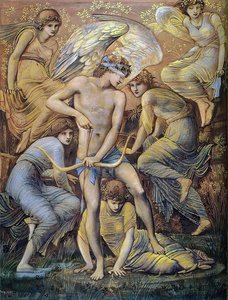 Cupid's Hunting Fields
Cupid's Hunting Fields: A Pre-Raphaelite Reverie Edward Coley Burne-Jones’s “Cupid’s Hunting Fields” is more than simply a depiction of a mythological scene; it’s an immersion into the very heart of Pre-Raphaelite ideals – a yearning for beauty, a re...
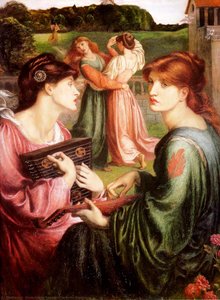
As the movement evolved beyond its initial rebellious phase, it drifted into even more evocative and ethereal territories. The second generation of Pre-Raphaelites, led by figures like Dante Gabriel Rossetti and Edward Burne-Jones, moved away from the sharp-edged realism of the founders toward a more dreamlike, aestheticized world. Rossetti, a true polymath, blurred the lines between poetry and painting, creating works that were as symbolically rich as his verses. His art championed "art for art’s and sake," focusing on the pursuit of beauty through mythological and literary themes.
This era introduced a profound engagement with the fantastical. In Burne-Jones’s Cupid's Hunting Fields, we are invited into a timeless realm where gods and mortals intertwine amidst lush, idyllic landscapes. Here, the intensity is not found in scientific detail, but in a quiet, atmospheric reverence for the natural world and the legends of old. The figures are often rendered with a graceful, almost languid stillness, embodying themes of love, innocence, and longing. This shift toward the romantic and the mythological allowed the Pre-Raphaelite legacy to expand into a realm of pure imagination, where the boundaries between the physical world and the dreamscape became beautifully blurred.
Beyond the Canvas: The Influence of Pre-Raphaelite Aesthetics on Modern Design
--- title: The Pre-Raphaelite Legacy url: https://localhost:5000/exhibitions/listings/2014/preraphaelite-legacy description: This exhibition brings together some thirty objects from across the Museum and from local private collections to highlight th...
The ripples of the Pre-Raphaelite movement extend far beyond the gilded frames of 19th-century galleries. Their obsession with intricate patterns, organic forms, and the integration of art into daily life laid the groundwork for much of modern decorative design. The movement’s influence can be seen in the Arts and Crafts movement, where the reverence for craftsmanship and the beauty of natural motifs became a central tenet. This aesthetic philosophy—that even the most functional object should possess artistic merit—continues to resonate in contemporary interior design and graphic arts.
Even today, we see echoes of their "total work of art" approach in how we curate our modern environments. The way they utilized color palettes to evoke specific emotional states or used botanical elements to ground a space is a technique still mastered by designers worldwide. From the intricate textures found in high-end wallpapers to the bold, narrative-driven compositions in modern digital illustration, the Pre-Raphaelite spirit of storytelling through visual detail remains a powerful tool for those looking to add depth and character to their surroundings.
Reimagining History: Bringing Pre-Raphaelite Vibrancy to Contemporary Spaces
 Lady Lever Art Gallery
A Victorian Vision Brought to Life: The Soul of Port Sunlight To step through the doors of the Lady Lever Art Gallery is to transcend the modern era and enter a meticulously curated dream of the nineteenth century. Nestled within the idyllic model vi...
In an age of mass production and digital flatness, there is a growing hunger for the tactile, the textured, and the profound. Reintroducing the Pre-Raphaelite aesthetic into a modern home offers a way to bridge the gap between historical grandeur and contemporary minimalism. The bold colors and dramatic narratives of these works provide a striking contrast to the clean lines of modern architecture, acting as soulful anchors in a room.
Whether it is through a large-scale multi-panel arrangement that spans a wide wall or a meticulously hand-painted reproduction that captures the impasto brushstrokes of a master, bringing this era into the present is about more than just decoration; it is about reclaiming a sense of wonder. By selecting pieces that emphasize luminous light and intricate detail, collectors can transform a standard living space into a curated sanctuary of history and emotion. The Pre-Raphaelite world reminds us that art should not merely decorate a wall—it should invite us to step through a window into another time.
At ArtsDot.com, we specialize in preserving this extraordinary legacy. Our master artists are dedicated to creating authentic, hand-painted oil reproductions that capture the very soul of these masterpieces. From custom portraits that utilize historical styles to large-format murals that recreate the grandeur of a bygone era, we provide the tools to bring the vibrant, dreamy world of the Pre-Raphaelites directly into your modern lifestyle.