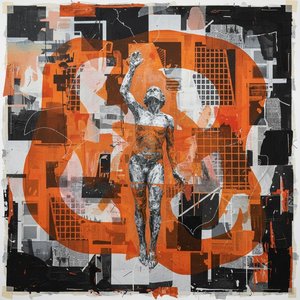
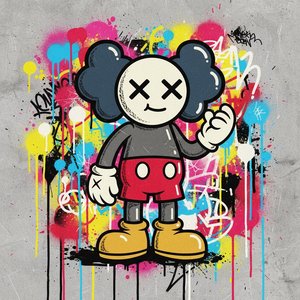

The Great Collision: Where Renaissance Grandeur Meets Pop Art Energy
 Renaissance art
Renaissance art (1350 – 1620) is the painting, sculpture, and decorative arts of the period of European history known as the Renaissance, which emerged as a distinct style in Italy in about AD 1400, in parallel with developments which occurred in phi...
Imagine the silent, hallowed halls of a 15th-century Florentine cathedral suddenly interrupted by the electric pulse of a neon sign. This is not a clash of eras, but a high-octance fusion that defines our current visual zeitgeist. The Renaissance was an era of rebirth, a period where scientific precision and humanistic depth transformed the canvas into a window of divine proportion. Fast forward to the mid-20th century, and we see a different kind of rebirth: Pop Art. Where the masters sought the eternal through subtle glazes and anatomical perfection, the Pop pioneers—think Warhol’s rhythmic repetition or Lichtenstein’s graphic punch—sought the immediate through the bold, the banal, and the mass-produced.
Today, we are witnessing a spectacular collision of these two worlds. The heavy, soulful weight of classical tradition is being stripped of its stuffiness and injected with the vibrant, unapologetic energy of street culture. It is a movement that refuses to choose between the museum and the street corner. This aesthetic tension creates a space where the profound meets the playful, allowing us to appreciate the structural genius of the Old Masters while celebrating the loud, saturated, and hyper-real aesthetics of modern consumerism. It is a visual dialogue that bridges centuries, proving that true impact lies in the unexpected overlap of high culture and pop iconography.
Sampling the Masters: How Appropriation Drives Modern Visual Culture
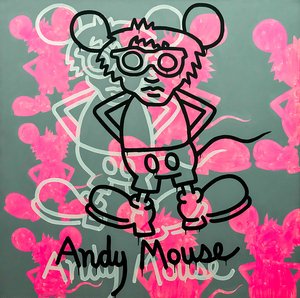 Andy mouse
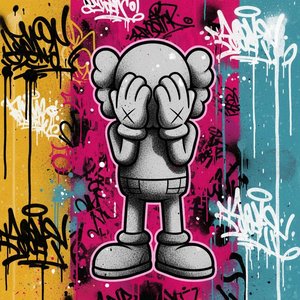
Andy Mouse: A Pop Art Icon Reimagined Keith Haring’s *Andy Mouse* isn't merely a cartoon; it’s a vibrant collision of artistic movements and cultural icons. Born from the late 20th-century Neo-Pop Art movement, this piece brilliantly merges the unive...
In the world of music, sampling is the art of taking a recognizable loop and recontextualizing it to create something entirely new. In the visual realm, this technique—known as appropriation—is the engine driving the most exciting trends in contemporary art. We see this clearly in works like Keith Haring’s Andy Mouse, where the universally recognized silhouette of Mickey Mouse is reimagined through a lens of Neo-Pop aesthetic. By merging Disney’s global familiarity with the bold, social commentary-driven lines of Haring, the artwork becomes a hybrid icon that resonates with both childhood nostalgia and critical modern observation.
This process of borrowing and transforming is not about lack of originality; it is about the power of recontextualization. Just as Roy Lichtenstein took the fleeting, voyeuristic moments of comic strips and elevated them to monumental artistic statements through his signature Ben-Day dots, modern creators are looking back at the Renaissance to find new textures for their digital age. When we take a classical composition and subject it to the aggressive, saturated palette of Chromatic Convergence—utilizing cyan, magenta, and orange—we aren't erasing history; we are remixing it. We are using the foundation of the past to build a more vibrant, confrontational present.
From Oil to Ink: The Evolution of Iconography in Street and Digital Art
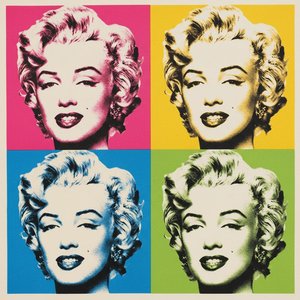 Jean-Paul Faubert
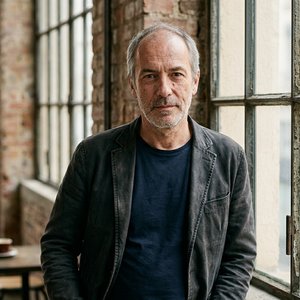
The Architect of Pop Iconography Born in 1973 and currently based in the vibrant cultural hub of Lyon, Jean-Paul Faubert has established himself as a preeminent figure in contemporary digital imagery. His practice is an uncompromising devotion to the...
The transition from the meticulous, layered oil glazes of the Renaissance to the flat, high-contrast tones of digital imagery represents one of the most radical shifts in human expression. Renaissance masters utilized light and shadow—chiarosc::scuro—to create a sense of three-dimensional reality and spiritual depth. In contrast, the architects of modern pop iconography, such as Jean-Paul Faubert, embrace the mechanical precision of the gaze. By stripping away the nuance of shadow and utilizing the rhythmic grid repetition found in Warhol-style silkscreens, contemporary artists explore the cold, deadpan essence of our consumerist reality.
This evolution has brought about a fascinating new materiality. We have moved from the tactile, heavy impasto of traditional oils to the sleek, infinitely reproducible digital file. Yet, the most compelling art today exists in the intersection of these mediums. There is a growing movement where the digital "glitch" or the intentional ink misregistration of a print meets the physical weight of a hand-painted canvas. This creates a tension between the flatness of the screen and the textured soul of the brushstroke, allowing collectors to experience the speed of modern culture through the enduring permanence of fine art.
The Remix Generation: Recontextualizing Classics for a Digital-Native Era
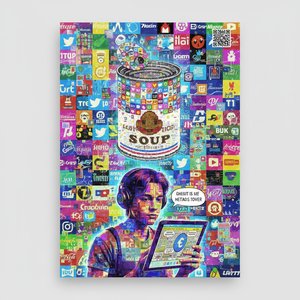 Pop Art 2.0: Recontextualizing Appropriation & Consumerism for a Digital Native Generation
The Remix Generation: How Digital Culture Revived Pop Art’s Spirit Pop Art, born from the post-war boom of consumerism and mass media, felt startlingly *new* when it burst onto the scene in the 1950s. Artists like Andy Warhol and Roy Lichtenstein dar...
For the digital native, the concept of "originality" has been redefined by the relentless flow of information, memes, and viral aesthetics. We live in an era of Pop Art 2.0, where appropriation happens at warp speed through filters, AI generators, and social media feeds. The spirit of the original Pop movement—its embrace of mass media and everyday objects—has found its ultimate expression in our digital existence. The way we share a GIF or curate an Instagram feed is, in many ways, a modern iteration of the Warholian factory: a continuous loop of re-sharing, remixing, and re-imagining.
This generation does not see a boundary between a 17th-century portrait and a contemporary selfie; they see both as raw material for creativity. This is why "Period Shifts" are becoming such a powerful trend—the ability to take a modern moment and transform it into a masterpiece through the lens of a historical style. Whether it is applying the light-drenched technique of Monet to a digital photograph or reimagining a street-style portrait with the structural intensity of a Renaissance fresco, the goal is the same: to find new meaning in the familiar by layering the old world onto the new.
Trend Forecast: Why High-Low Aesthetic Fusion is Dominating Urban Interiors
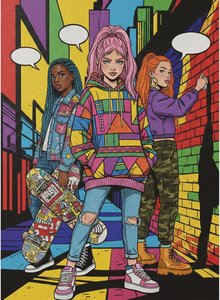
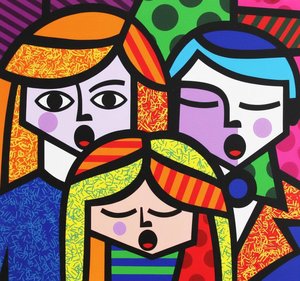 Chromatic Convergence of Three Faces in a Vibrant Pop Art Symphony
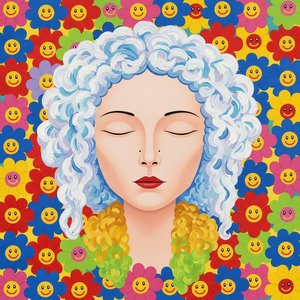
A Vision of Aggressive Confrontational Pop Experience the electric pulse of Chromatic Convergence of Three Faces in a Vibrant Pop Art Symphony , a breathtaking masterpiece that redefines the boundaries of modern graphic expression. This work captures...
As we look toward the future of interior design and art curation, the "High-Low" fusion is set to dominate. The modern urban professional—the Jakes of the world who shop by visual impact rather than art history—is moving away from monochromatic minimalism toward spaces that tell a complex, layered story. We are seeing a surge in the popularity of multi-panel, large-format works that split iconic imagery across three or five canvases, creating a cinematic, architectural presence on wide walls.
The trend is moving toward pieces that command attention through chromatic tension and bold, graphic energy. Expect to see more "remixed" classics in living spaces: an oil-painted reproduction of a Renaissance figure wearing streetwear, or a custom portrait where a pet is reimagined as a historical general. The future of art in the home is not about quiet contemplation, but about vibrant, high-impact statements that bridge the gap between the museum and the street. It is an era of unapologetic expression, where the grandeur of the past provides the perfect, high-contrast backdrop for the energy of the present.
Discover your next statement piece at ArtsDot.com. From hand-painted oil reproductions that capture every brushstroke to bold, digital-ready prints, we provide the tools to remix your world. Whether you are looking for a custom portrait from photo or a large-scale mural to transform your space, our mission is to bring high-impact, contemporary energy to your collection.