


The Aura of Authority: Defining the Academic Portrait Tradition
To step into the presence of a true academic portrait is to encounter more than mere pigment on canvas; it is to engage with a carefully constructed legacy of power, intellect, and permanence. Unlike the fleeting snapshots of our digital era, the tradition of academic portraiture was forged in the prestigious ateliers of the nineteenth century, where the goal was not simply to capture a likeness, but to immortalize an essence. This movement, rooted in the rigorous standards of the great European academies, sought to elevate the individual through the lens of idealized realism. When we gaze upon works like Ernest Gustave Girardot’s depiction of Richard Lewis Nettleship, we are not just seeing a scholar; we and witnessing the visual manifestation of Victorian intellectual prestige, where every fold of fabric and shadow of the brow serves to reinforce the subject's standing within the hierarchy of knowledge.
The power of these portraits lies in their ability to command a room through sheer gravitas. This is achieved through a disciplined adherence to classical proportions and a profound respect for the anatomical truth. The academic tradition does not shy away from the weight of history; rather, it leans into it, using the subject's features to tell a story of lineage, achievement, and character. It is an art form that demands attention, pulling the viewer into a silent dialogue with the past, where the boundaries between the living sitter and the eternal image begin to blur.
Mastering the Gaze: Technique, Texture, and the Art of Realism
The true magic of academic realism resides in the invisible labor of the brush. To achieve such breathtaking fidelity, artists employed a sophisticated layering process that transcends simple representation. Consider the meticulous mastery found in Vincenzo Camuccini’s sketches or the textured depth of monochrome works like Nicholas Roerich’s Platon. Here, we see the brilliance of hatching and tonal gradation—techniques designed to manipulate light and shadow, known as chiaroscuro, to create a three-dimensional illusion that feels almost tactile. The artist does not merely paint skin; they paint the way light interacts with the subtle translucency of flesh, the ruggedness of a beard, or the soft sheen of silk.
This level of technical precision is what separates a mere likeness from a masterpiece. In the hands of an academic master, texture becomes a narrative tool. The heavy, confident application of paint—the impasto—can convey the ruggedness of a soldier’s uniform or the weathered wisdom of a philosopher, while smooth, blended transitions evoke the delicate elegance of a lady's complexion, much like the refined grace seen in Charles François Jalabert’s Portrait de Mme Paul Rattier. It is this interplay of light and physical substance that gives these works their enduring vitality, ensuring that the texture of the paint itself contributes to the emotional resonance of the subject.
Beyond the Subject: Symbolism and the Construction of Legacy
An academic portrait is rarely a vacuum; it is a dense tapestry of semiotic clues. Every element within the frame—from the books resting on a mahogany desk to the specific way a hand rests upon a hilt—is a deliberate choice intended to communicate status, vocation, and virtue. The genre functions as a visual language of prestige. A scholar is surrounded by the tools of his trade, not merely as props, and a noblewoman is draped in fabrics that signal her economic dominion. This symbolic architecture allows the viewer to decode the subject's identity long before they recognize their face.
This construction of legacy extends beyond the physical objects to the very composition itself. The use of profile views, reminiscent of classical Roman busts, can imbue a contemporary figure with an air of ancient, unshakeable authority. By referencing the aesthetics of antiquity, academic painters connected their subjects to a lineage of greatness that spans centuries. This intentional layering of meaning ensures that the portrait serves as a monument, a permanent record of a life lived with purpose, designed to withstand the erosions of time and the shifting whims of fashion.
From Canvas to Contemporary Space: Integrating Classics into Modern Interiors
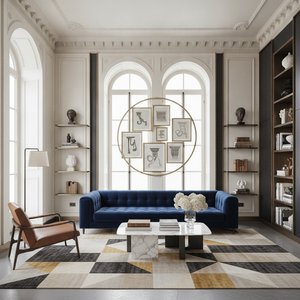
In the modern era, there is a profound resurgence in the desire to anchor contemporary living spaces with the weight of history. While our current design landscapes often lean toward minimalism and sleek, industrial lines, the introduction of an academic portrait provides a necessary counterpoint—a "soul" for the room. Integrating such a piece into a high-end interior is an exercise in sophisticated contrast. A large-scale, hand-painted reproduction of a classical figure can act as a focal point that breaks the monotony of modern glass and steel, adding warmth, depth, and a sense of curated history to a penthouse or a private library.
The key to successful integration lies in scale and placement. Much like architectural elements, these paintings function as anchors for the eye. Whether it is a multi-panel arrangement that spans a wide hallway or a single, commanding portrait above a mantle, the presence of academic art elevates the entire aesthetic of the home. It transforms a house into a gallery, signaling to guests that the inhabitant values the continuity of human achievement and possesses a refined, discerning eye for the enduring beauty of the past.
The New Renaissance: Reimagative Historical Portraits for the Digital Age
We are currently witnessing a fascinating intersection where the ancient meets the avant-garde. The digital age has not diminished our reverence for the masters; rather, it has provided us with unprecedented tools to reimagine them. Through advanced technology and the artistry of modern specialists, we can now engage in a "period shift," taking the personal milestones of today—a wedding portrait or a family heirloom—and translating them into the stylistic language of the Old Masters. This is the new frontier of portraiture: the ability to bridge the gap between our ephemeral digital lives and the permanent, oil-on-canvas tradition.
This movement allows for a personalized form of immortality. We can now envision ourselves through the lens of 17th-century chiaroscuro or see our descendants rendered with the soft, light-drenched textures of the Impressionists. It is a democratization of prestige, where the techniques once reserved for royalty and the elite are made accessible to the modern collector. As we continue to innovate, the spirit of academic excellence remains the foundation, ensuring that even as our methods change, the power, the emotion, and the profound authority of the portrait remain undiminished.
At ArtsDot.com, we celebrate this enduring legacy by bringing the museum experience into your private collection. From meticulously hand-painted oil reproductions that capture every authentic brushstroke to custom commissions that transform your personal memories into historical masterpieces, our mission is to preserve and share the grandeur of art history with a global audience. Whether you are seeking a singular statement piece or a bespoke reimagining of your own story, we invite you to explore the timeless beauty of the masters.