
Introduction
Step into a world where the boundaries between reality and dreams dissolve into a feverish, beautiful blur. To explore the top 25 artworks of Max Ernst is not merely to browse a collection of paintings; it is to embark on a psychological expedition through the deepest corridors of the human subconscious. Ernst was the ultimate architect of the unexpected, a master who didn't just paint images, but engineered entire universes where logic fails and the marvelous takes flight.
Emerging from the wreckage of World War I, Ernst became a central protagonist in two of the most radical movements of the 20th century: Dada and Surrealism . While Dada allowed him to weaponize absurdity against a broken societal order, Surrealism gave him the tools to map the irrational. He pioneered groundbreaking techniques like frottage —rubbing textures to reveal hidden spirits—and grattage , scraping paint to uncover secret landscapes. His work was a rebellion against the predictable, a visual manifestation of Freud’s theories, and a defiant celebration of the chaotic energy found within our dreams.
Today, Ernst’s legacy vibrates with a contemporary pulse. In an era dominated by digital manipulation and hyper-real imagery, his ability to find profound meaning in chance and texture feels more relevant than ever. His canvases serve as a blueprint for anyone looking to find beauty in the fragmented, the strange, and the uncanny. He teaches us that there is a deep, resonant truth to be found in the shadows of our imagination.
As we navigate this curated selection of his most impactful works, prepare to encounter textures that breathe, creatures that haunt, and landscapes that defy gravity. From his early disruptive collages to his most complex, dream-drenched oil masterpieces, this list celebrates the enduring power of a man who taught the world to see the magic hidden in the irrational.
The Elephant Celebes - Max Ernst
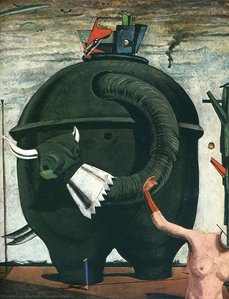 The Elephant Celebes - Max Ernst
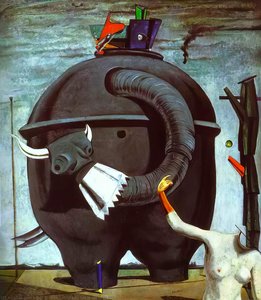
In The Elephant Celebes , the lines aren’t merely drawn; they are choreographed into a fever dream of Dadaist rebellion. This isn't just a painting; it is a dance frozen in time , where the mechanical and the organic collide with startling intensity. At its center sits an enigmatic, boiler-like creature—an anthropomorphized beast that feels both ancient and industrial. The composition pulls you into a hallucinatory landscape of muted greens, heavy shadows, and sudden, sharp accents of red.
Ernst masterfully blends the chaotic energy of collage with the precision of oil painting, creating a visual rhythm that feels both unsettling and strangely harmonious. The presence of the headless mannequin and the surreal, totemic shapes invite you to explore the deep recesses of the subconscious mind. What if your living room could hold that same balance? What if your walls could breathe rhythm through such profound mystery? As one of the most iconic works in the top 25 artworks of Max Ernst, this piece remains a masterclass in making chaos feel like pure, poetic harmony.
Europe after the Rain II - Max Ernst
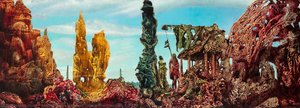 Europe after the Rain II - Max Ernst
There is a gaze in Europe after the Rain II by Max Ernst that follows you—not with judgment, but with understanding . This isn’t just a landscape; it is a mirror reflecting the fractured psyche of a world in turmoil. Created in 1942 amidst the chaos of World War II, this masterpiece stands as one of the most profound entries in our collection of the top 25 artworks of Max Ernst .
As you step closer, the painting reveals a breathtaking, surreal ecosystem where organic rock formations in fiery reds, burnt oranges, and deep golds seem to pulse with life. These towering, alien structures intertwine with decaying architectural remnants, creating a visual symphony of destruction and rebirth. The texture is visceral, utilizing heavy impasto techniques that give the landscape a palpable, three-dimensional weight. It invites you into a dreamscape where nature reclaims the ruins of civilization, reminding us that even after the storm, something new and hauntingly beautiful emerges. Imagine this transformative energy in your own space—not just as decor, but as a powerful reminder of resilience.
Of This Men Shall Know Nothing - Max Ernst
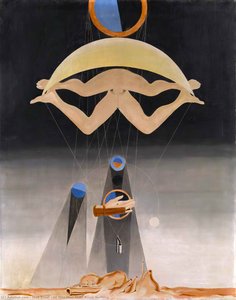 Of This Men Shall Know Nothing - Max Ernst
Imagine stepping into a dream where the laws of gravity have simply dissolved, leaving you suspended in a silent, cosmic void. This is the visceral experience of Of This Men Shall Know Nothing . Created in 1923, this masterpiece captures Max Ernst at his most transformative, bridging the chaotic energy of Dada with the psychological depth of Surrealism. The painting pulls you into an unsettling yet hypnotic landscape where nude, elongated figures float like celestial apparitions, tethered to mysterious blue spheres by thin, spectral strings.
The muted palette of earthy browns and grays creates a heavy, melancholic atmosphere, pierced only by the haunting glow of a central light source. It earns its place among the top 25 artworks of Max Ernst because it does more than depict a scene; it visualizes the very tension of the human subconscious. Bringing this level of surrealist intensity into a modern interior offers more than just decor—it provides a profound focal point for contemplation, inviting a sense of mystery and intellectual depth into your daily living space.
Napoleón en el desierto - Max Ernst
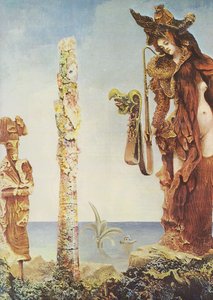 Napoleón en el desierto - Max Ernst
Owning Napoleón en el desierto by Max Ernst isn’t just a purchase; it is an inheritance of the avant-garde. As one of the most striking entries in our collection of the top 25 artworks of Max Ernst, this 1941 masterpiece serves as a profound lineage of taste for the modern collector. The piece plunges you into a fever dream of surrealist mastery, where the boundaries between history and hallucination dissolve.
The canvas is a rich tapestry of earthy ochres, warm browns, and muted pastels, creating an atmosphere of quiet prestige and unsettling mystery. You can almost feel the textured, weathered surfaces—the crumbling columns and turbulent, encroaching waters—as Ernst uses fragmented lines to evoke decay and transformation. A serene female figure in elaborate robes stands amidst the wreckage, her presence a haunting contrast to the masked male figure watching from the shadows. This is more than a painting; it is a sensory journey through the subconscious, bringing the high-impact, psychological depth of Surrealism directly to your walls.
The Robing of the Bride - Max Ernst
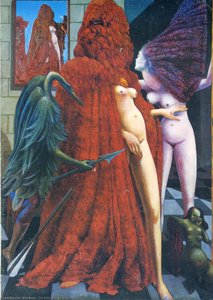 The Robing of the Bride - Max Ernst
In The Robing of the Bride , the sheer materiality of Max Ernst’s vision hits you instantly through the heavy, visceral texture of the crimson drapery. The thick, impasto-like application of red paint creates a sense of overwhelming power, as if the fabric itself possesses a life force. This tactile intensity is balanced by the ethereal, dreamlike rendering of the figures—one with hair like billowing purple clouds and another with skin as smooth as marble. Ernst’s mastery lies in this tension between the grotesque and the sublime, using bold, angular lines to craft a scene that feels both mythic and deeply psychological.
As one of the most significant works in our collection of the top 25 artworks of Max Ernst , this piece demands more than just a digital glance. At ArtsDot.com, we specialize in preserving this tactile, three-dimensional quality . Our handmade oil reproductions capture every heavy brushstroke and dramatic shadow, ensuring the unsettling energy and rich, saturated palette of this Surrealist masterpiece are brought into your space with true museum-grade depth.
Les dieux obscurs (Dark Gods) - Max Ernst
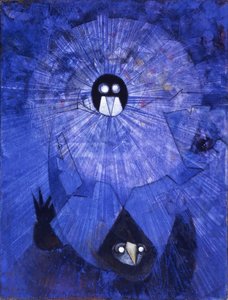 Les dieux obscurs (Dark Gods) - Max Ernst
In Les dieux obscurs (Dark Gods), the raw materiality of Max Ernst’s vision comes alive through a heavy, visceral interplay of texture and shadow. To witness this piece is to feel the tension in the brushwork, where thick, expressive impasto clashes against smoother, atmospheric transitions. This tactile depth creates a hauntingly three-dimensional landscape of deep blues and obsidian blacks, centering on a colossal, watchful entity that looms over a fragile, bird-like figure. The radiating lines cutting through the composition don't just guide the eye; they pulse with an unsettling, outward energy that defines Ernst’s mastery of Surrealist psychological weight.
At ArtsDot.com, we believe such profound textures should never be flattened by a mere print. Our high-end, hand-painted oil reproductions are meticulously crafted to preserve this tactile, three-dimensional quality . By using authentic bristles and layered oils on cotton canvas, we capture every ridge of paint and every dramatic shadow, ensuring that the dark, dreamlike soul of Ernst’s top masterpieces is brought into your space with all its original, commanding presence.
Stratified Rocks, Nature's Gift of Gneiss Lava Iceland Moss… - Max Ernst
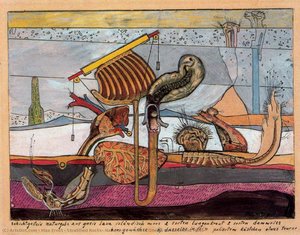 Stratified Rocks, Nature's Gift of Gneiss Lava Iceland Moss… - Max Ernst
Stepping into Stratified Rocks, Nature's Gift of Gneiss Lava Iceland Moss… feels like stumbling upon a fever dream caught in amber. There is an immediate, visceral sense of dread and disorientation that hits you; the jagged, distorted figures don't just inhabit the landscape—they seem to be emerging from the very grit and volcanic debris of the earth itself. This 1920 masterpiece captures the raw, unsettling energy of the post-war era, where the boundaries between human ritual and primordial chaos dissolve into a single, haunting vision.
As one of the top 25 artworks of Max Ernst , this piece serves as a profound psychological mirror. The heavy, textured layers of dark reds and earthy browns create a claustrophobic, ritualistic atmosphere that pulls you into a world of subconscious shadows. Integrating such a high-impact, surrealist work into your collection does more than just decorate a wall; it transforms a personal sanctuary into a space for deep, introspective reflection. It is a bold statement piece for those who crave art with soul, grit, and an unapologetic edge.
untitled (8351) - Max Ernst
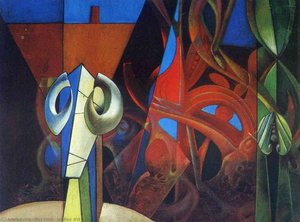 untitled (8351) - Max Ernst
In Max Ernst’s untitled (8351) , a bruised, melancholic violet dominates the horizon, casting an unsettling yet hypnotic mood over the entire canvas. This deep, somber hue works in tandem with earthy ochres to create a landscape that feels less like a physical place and more like a fever dream pulled straight from the subconscious. As one of the top 25 artworks of Max Ernst, this piece earns its status through its masterful command of atmospheric tension; the way the dark shadows bleed into the desolate plains captures the very essence of Surrealist anxiety.
For the modern collector, integrating such a high-impact piece into a contemporary interior can redefine a room's energy. The moody violet and muted earth tones are perfect for anchoring a sophisticated dining room or a dimly lit lounge, providing a focal point that commands attention without overwhelming the space. By using this painting to set the emotional lighting of your home, you invite a sense of intellectual depth and avant-garde mystery, turning a standard living area into a curated gallery experience.
After Us Motherhood - Max Ernst
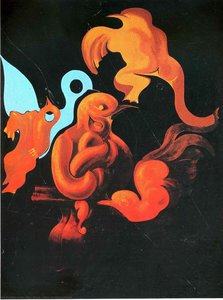 After Us Motherhood - Max Ernst
In “After Us Motherhood,” Max Ernst delivers a high-impact visual punch that cements his place among the top 25 artworks of Max Ernst. This 1927 masterpiece is a fever dream rendered in oil, where the boundaries between innocence and the monstrous completely dissolve. The composition hits you with an immediate emotional tension: a vulnerable baby sits perched atop a table, surrounded by a chaotic menagerie of birds and shadowed by the looming, predatory presence of a dragon. It is a visceral exploration of survival and instinct that feels incredibly modern.
Ernst’s technical mastery creates a tactile experience; his use of layered textures and a striking palette of evocative oranges, deep blues, and sharp yellows provides a depth that digital prints simply cannot replicate. For the contemporary collector, this piece brings a bold, surrealist energy to any space, acting as a sophisticated conversation starter that bridges the gap between psychological depth and avant-garde design. It is not just a painting; it is an immersive descent into the beautiful, unsettling logic of the subconscious.
The Forest - Max Ernst
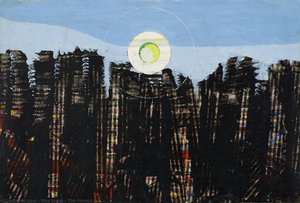 The Forest - Max Ernst
In The Forest by Max Ernst, the interplay of light serves as the ultimate protagonist. The composition is anchored by a luminous, ethereal moon that pierces through the nocturnal gloom, casting a haunting chiaroscuro across a distorted cityscape. This masterful command of illumination does more than just light a scene; it creates a psychological threshold between the urban and the organic. By utilizing stark whites against deep, moody blues and greens, Ernst directs the viewer's gaze through a dreamscape where buildings emerge like spectral monoliths from the shadows.
This sophisticated manipulation of light and shadow is precisely why this piece remains a cornerstone in the top 25 artworks of Max Ernst . The way the moonlight catches the edges of the silhouetted trees and architectural fragments creates a sense of movement and mystery that is incredibly captivating. When reproduced as a high-quality oil painting, this dramatic contrast brings an unparalleled sense of depth and luxury to a contemporary space, transforming a modern wall into a window onto the subconscious mind.
Le Petite Tortue - Max Ernst
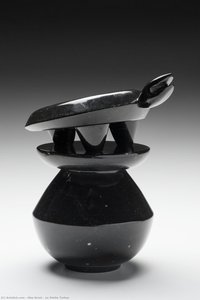 Le Petite Tortue - Max Ernst
In the realm of 20th-century surrealism, few pieces command a room with such quiet, architectural authority as Le Petite Tortue . While Max Ernst is legendary for his chaotic Dadaist collages and dream-logic paintings, this 1967 masterpiece shifts the narrative toward a striking, minimalist precision. Carved from polished black marble, the sculpture functions as a masterclass in geometric abstraction, stripping away the subconscious noise to focus on the raw tension between light and shadow.
The work is a rhythmic vertical ascent: a heavy, meticulously carved base supports an inverted bowl-like structure, which culminates in a delicate, pointed apex. Its high-sheen surfaces catch directional light, creating sharp highlights that dance across its dark, liquid planes. In today’s design-conscious interiors, this piece feels incredibly contemporary—its obsession with negative space and structural balance mirrors the sleek, high-impact aesthetic of modern urban luxury. As one of the top 25 artworks of Max Ernst , Le Petite Tortue remains a vital cultural touchstone, proving that even within the surreal, there is profound beauty in absolute clarity and mathematical grace.
Moonmad - Max Ernst
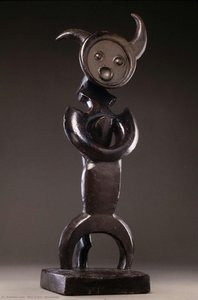 Moonmad - Max Ernst
Before he became a titan of the Surrealist movement, Max Ernst was deep in the trenches of psychological study, using his knowledge of psychiatry to dismantle reality itself. This intellectual rebellion finds its physical form in Moonmad , a sculpture that captures the exact moment the subconscious breaks through the surface of the conscious mind. The piece features a stylized, metallic face frozen in a state of pure, unadulterated shock—an open-mouthed gasp that mirrors the sudden intrusion of a dream into waking life.
Technically, the work is a masterclass in subtractive precision, stripping away the excess to reveal an expressive, raw gesture that defies traditional portraiture. It isn't just about bronze and form; it is about the visceral sensation of surprise . As one of the top 25 artworks of Max Ernst, Moonmad serves as a powerful anchor for any contemporary space. Integrating such a high-impact, enigmatic piece into a modern home office or study creates an atmosphere of profound intellectual depth, inspiring a workspace defined by curiosity, bold thinking, and the courage to explore the unexpected.
Illustration to "A Week of Kindness" - Max Ernst
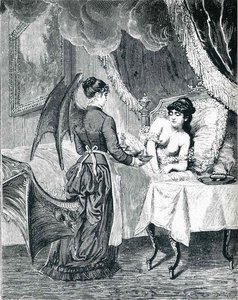 Illustration to "A Week of Kindness" - Max Ernst
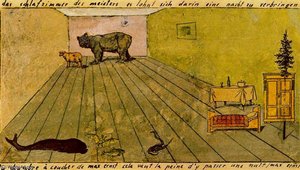
To encounter the Illustration to "A Week of Kindness" is to step directly into a fever dream curated by one of the most radical minds in art history. As a standout piece in our collection of the top 25 artworks of Max Ernst, this 1934 masterpiece functions less like a drawing and more like a psychological portal. Ernst utilizes a high-contrast, monochromatic palette to transform a familiar bedroom setting into a site of supernatural tension.
The visual impact is immediate: the meticulous hatching creates a tactile, gothic texture that feels incredibly modern in a contemporary, design-conscious space. The sudden, jarring emergence of bat-like wings from a standing figure disrupts the domestic stillness, embodying the very essence of Surrealist disruption. For the collector seeking pieces with profound emotional intelligence, this work offers a sophisticated interplay of light and shadow. It is a hauntingly beautiful exploration of the subconscious that brings an edgy, intellectual depth to any curated interior, proving that true avant-garde legacy never loses its punch.
Temptation of St. Anthony - Max Ernst
 Temptation of St. Anthony - Max Ernst
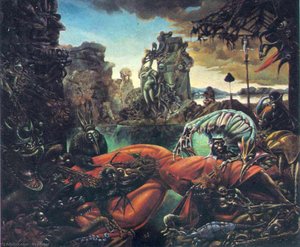
Step into a fever dream where the boundaries of reality dissolve. In Temptation of St. Anthony , Max Ernst delivers a visceral plunge into the subconscious, moving far beyond mere biblical narrative to explore the fractured nature of human desire. Painted in 1945, this masterpiece vibrates with an unsettling beauty; it is a landscape of psychological tension where heavy textures and distorted perspectives collide.
The composition is a sensory overload of symbolic imagery. You’ll find the central figure vulnerable amidst a swarm of creeping beetles and ethereal butterflies—creatures that embody both decay and transformation. Ernst uses thick, controlled impasto and unsettling diagonals to guide your eye through this hallucinatory dreamscape. For the modern collector, this piece acts as a profound focal point for any contemporary space. Its complex layers of shadow and light don't just decorate a wall; they provoke deep reflection and spark creative dialogue, making it an essential highlight in any survey of the top 25 artworks of Max Ernst . It is art that demands you look closer, inviting a sense of mystery into your home.
Paysage avec lac et chimères - Max Ernst
 Paysage avec lac et chimères - Max Ernst
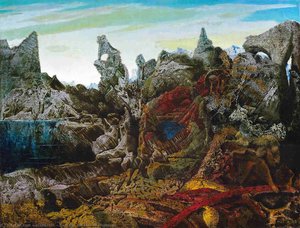
In Paysage avec lac et chimères , Max Ernst freezes a moment of profound psychological tension, where the boundary between a dream and a nightmare dissolves into a misty, blue-toned horizon. This masterpiece earns its place among the top 25 artworks of Max Ernst because it perfectly captures the haunting disorientation of 1940s Europe, using the alchemy of decalcomania to let chance dictate the landscape's jagged, organic textures.
The painting breathes with a restless energy; earth tones and muted blues whisper of a world in flux, while the central, multi-limbed chimera emerges from the canvas like a fragment of a fractured subconscious. The smooth, reflective surface of the lake acts as a mirror for both the sky and the viewer's own anxieties, creating a sense of infinite depth. For the modern collector, this piece offers more than just surrealist intrigue—it brings a sophisticated, contemplative edge to any contemporary space, serving as a powerful focal point that invites deep introspection and celebrates the beautiful instability of the human imagination.
Ubu Imperator - Max Ernst
 Ubu Imperator - Max Ernst
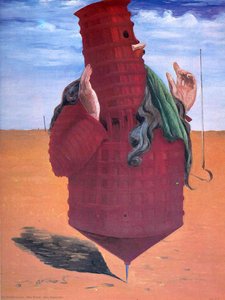
A deep, unsettling crimson dominates Ubu Imperator , casting a heavy, authoritative shadow over the entire composition. This striking use of red—seen in the central figure's attire and the massive, cannon-like object—sets a mood of intense psychological tension and raw, primal energy. As one of the top 25 artworks of Max Ernst , this piece earns its status through a masterful command of color that bridges the gap between Dadaist chaos and Surrealist dreamscapes. The way the blood-red tones clash against the organic, textured backgrounds creates a visual friction that is impossible to ignore.
For the modern collector or designer, integrating a piece with such a high-impact palette can redefine a room's atmosphere. In a minimalist living space, the aggressive warmth of this red can serve as a bold focal point, anchoring the room with a sense of historical weight and avant-garde edge. Whether you are looking to inject drama into a dining area or create a conversation piece in a studio, the visceral energy of Ernst’s color theory provides an unparalleled tool for curating sophisticated, high-concept interiors.
Scène - Max Ernst
 Scène - Max Ernst
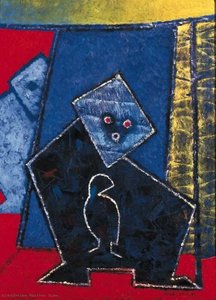
What if I told you that “Scène” by Max Ernst was born from a moment of rebellion—a stroke of defiance against the ordinary? This isn't just a painting; it is a psychological manifesto captured on canvas. In this hauntingly beautiful tableau, the boundaries between reality and the subconscious dissolve, leaving us with an intense encounter between avian figures and a mysterious, red-trimmed blue box. Its inclusion in our Top 25 is demanded by its sheer ability to redefine visual emotion through texture and tension.
Ernst utilizes a rugged, organic technique that feels almost tactile, as if the surfaces of the birds and the landscape are breathing with life. The deep blues and sharp red accents create a high-impact visual punch that commands any room. At ArtsDot.com, we believe art should be more than decor; it should be an experience. Imagine this surreal masterpiece anchoring your office or living space, turning a simple wall into a portal to the dreamworld. “Scène” proves that your space is not just a room—it is a bold, curated statement of identity.
Everyone Here Speaks Latin - Max Ernst
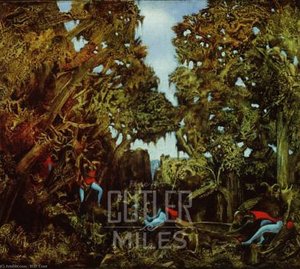 Everyone Here Speaks Latin - Max Ernst
There is a gaze in Everyone Here Speaks Latin by Max Ernst that follows you—not with judgment, but with a profound, dreamlike understanding . This isn’t just a depiction of a woodland scene; it is a mirror for the subconscious. As one of the most essential pieces in our collection of the top 25 artworks of Max Ernst, this 1943 masterpiece invites you to wander through a labyrinth where the boundaries between reality and dream dissolve entirely.
The canvas vibrates with heavy impasto textures, where trees emerge from the surface like living, breathing entities. Amidst the dense thicket, ambiguous figures, an umbrella, and a distant boat create a surrealist tableau of transition and vulnerability. Painted during the global upheaval of WWII, the work captures a moment suspended in time—a dialogue between primal nature and ancient intellect. Now, imagine that enigmatic atmosphere in your space. Not watching you, but reminding you : you are part of this deeper, more visceral story. It is a powerful piece for any collector looking to make the invisible visible.
Dibujo al natural - Max Ernst
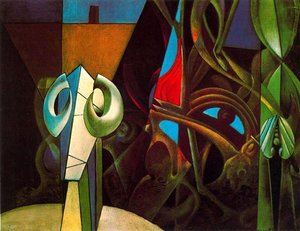 Dibujo al natural - Max Ernst
To encounter Dibujo al natural by Max Ernst is to step directly into the fever dream of a Surrealist master, unveiling a piece that feels less like a drawing and more like a portal to the subconscious. As one of the top 25 artworks of Max Ernst, this work commands attention through its sheer psychological depth and the unsettling beauty of its composition.
The piece vibrates with an eerie, dreamlike energy, where the boundaries between reality and hallucination dissolve. Ernst masterfully weaves a narrative of strange, symbolic objects—a colossal, long-necked avian creature that dominates the frame, a misplaced clock, and a watchful eye peering from the periphery. These elements create a sense of profound mystery and intellectual intrigue. For the modern collector, this artwork offers more than just visual impact; it brings a layer of sophisticated, avant-garde prestige to any high-end interior. It is a conversation starter that embodies the legacy of Dada and Surrealism, making it an essential cornerstone for those who curate spaces defined by bold, transformative storytelling and timeless, subversive elegance.
Barbarians Marching to the West - Max Ernst
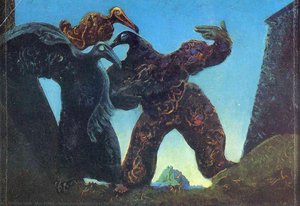 Barbarians Marching to the West - Max Ernst
What story does the fractured, apocalyptic landscape of “Barbarians Marching to the West” tell? Created in 1937, this masterpiece captures the visceral dread of a world on the brink of World War II. As one of the top 25 artworks of Max Ernst, it stands as a definitive pillar of Surrealism, breaking ground by translating global political anxiety into a fever dream of avian predators and desolate terrain. The composition is anchored by two colossal, mythic birds locked in an aggressive dance, symbolizing unstoppable forces of destruction that dwarf the solitary human witness nearby.
Ernst’s use of grattage —scraping paint to reveal geological textures—gives the piece a rugged, tactile depth that feels unearthed from a nightmare. For the modern collector, this painting offers more than just a visual impact; it provides a profound, atmospheric escape. Integrating such a high-impact, textured work into your space brings a sense of historical weight and psychological complexity, turning a contemporary room into a curated gallery of deep, evocative storytelling.
Pieta or Revolution by Night - Max Ernst
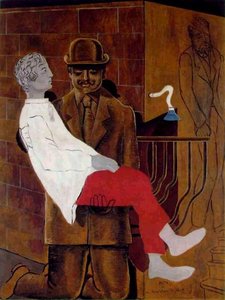 Pieta or Revolution by Night - Max Ernst
Before the world knew him as a Surrealist icon, Max Ernst was navigating the psychological wreckage of the Great War, a period that birthed his most unsettling visions. In Pieta or Revolution by Night , he achieves a breathtaking conceptual leap, bridging the chaotic rebellion of Dada with the dream-logic of Surrealism. The painting subverts the sacred gravity of Michelangelo’s Pietà , replacing divine solace with a stark, existential dread. Ernst utilizes a somber, heavy palette and masterful light manipulation to create a landscape of uncertainty, where formal attire and lifeless figures collide against a backdrop of impending societal collapse.
The technical execution—a sophisticated layering of textures on canvas—commands the room, offering a profound visual anchor for any serious collection. This work does not merely decorate; it provokes deep contemplation through its atmospheric tension and symbolic weight. For the modern professional, hanging such a masterpiece in a home office or study fosters an environment of intense intellectual focus and sophisticated grit, mirroring the very ambition required to master one's own creative or corporate landscape.
It's a Highway to Heaven - Max Ernst
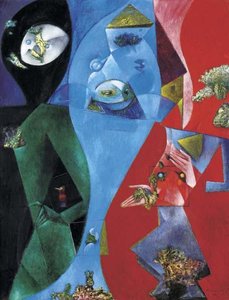 It's a Highway to Heaven - Max Ernst
Before the world recognized him as a Surrealist icon, Max Ernst was navigating the chaotic wreckage of the Dada movement, finding beauty in the fragmented and the absurd. In "It's a Highway to Heaven," he achieves a psychological breakthrough that secures its place among the top 25 artworks of Max Ernst . This isn't just a painting; it is a visual glitch in reality. Ernst utilizes a sophisticated, experimental approach, layering oil paints with collage-like elements to create a monumental figure composed of superimposed faces and wandering birds. The piece vibrates with a green-hued, kaleidoscopic energy, where every overlapping visage acts as a layer of the subconscious.
The technical alchemy here—the way textures collide and colors bleed into one another—creates a profound sense of depth that defies the flat surface of the canvas. For the modern professional, hanging such a transformative piece in a home office or study does more than decorate; it stimulates the intellect. The intricate, dreamlike complexity of this masterpiece fosters an atmosphere of deep focus and boundless creativity, making it the ultimate anchor for a sophisticated, design-conscious workspace.
Fleurs-écaille - Max Ernst
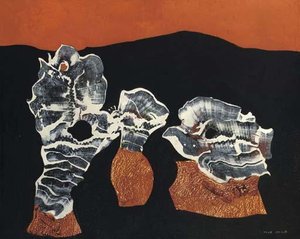 Fleurs-écaille - Max Ernst
In Fleurs-écaille by Max Ernst, a profound, monochromatic stillness dominates the frame, setting a mood of quiet introspection and psychological depth. By stripping away vibrant hues, Ernst focuses our attention on a stark, grayscale palette where the interplay of light and shadow becomes the true protagonist. This mastery of tonal range—moving from deep, obsidian shadows to ethereal, misty whites—is exactly why this piece stands as one of the top 25 artworks of Max Ernst . It isn't just a painting; it is a tactile exploration of texture, where weathered rocks and delicate shells emerge from a dreamlike void.
For the modern collector or interior designer, this artwork serves as a high-impact anchor for a minimalist or contemporary space. The neutral, achromatic scheme allows Fleurs-écaille to integrate seamlessly into a sophisticated living room or a moody, design-conscious dining area, acting as a focal point that directs emotional lighting and complements architectural textures. It brings a sense of curated, avant-garde calm, turning any wall into a window onto the Surrealist subconscious.
Forêt et soleil - Max Ernst
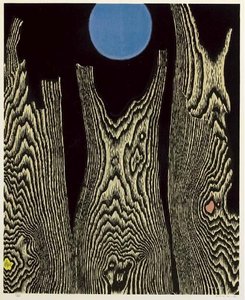 Forêt et soleil - Max Ernst
What if I told you that Forêt et soleil by Max Ernst was born from a moment of rebellion—a stroke of defiance against the ordinary? This isn't just a painting; it is an invitation to wander through the corridors of the subconscious. In this masterpiece, the forest becomes a living, breathing entity, where distorted trunks and lunar light collide to create a nocturnal dreamscape that feels both haunting and hypnotic.
Its inclusion in our Top 25 artworks of Max Ernst is essential because it redefines how we perceive nature—not as a static landscape, but as a psychological frontier. The way the moon pierces through the dense, textured canopy captures a tension between shadow and revelation that remains unmatched in Surrealist history. At ArtsDot.com, we believe art should do more than decorate; it should provoke. Imagine this surreal nocturnal vision anchoring your studio or lounge, turning a blank wall into a portal for deep reflection. Bringing this level of high-impact, dreamlike energy into your personal sanctuary ensures that your space isn't just a room—it is a profound aesthetic statement.
Landscape with Wheatgerm - Max Ernst
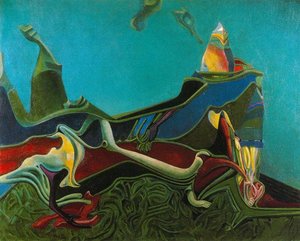 Landscape with Wheatgerm - Max Ernst
Max Ernst’s 1936 masterpiece, Landscape with Wheatgerm , is a high-impact descent into the surreal, capturing the raw tension between biological rebirth and psychological unrest. As one of the most essential entries in our top 25 artworks of Max Ernst, this piece stands out for its ability to dissolve the rational world into a dreamscape of textured complexity. Ernst utilizes a masterful layering of oil and collage elements to create a surface that feels tactile and alive, mirroring the depth of the human subconscious.
Visually, the painting is a powerhouse of symbolic contrast; the potent imagery of the wheatgerm represents embryonic potential, yet it is shadowed by a sense of profound fragility. For the modern collector or design-conscious professional, this work offers an incredible edge. Its intricate textures and hauntingly beautiful composition provide a sophisticated anchor for contemporary interiors, bringing a sense of intellectual depth and avant-garde energy to any space. It is not just a landscape; it is a visceral experience of life’s constant struggle between creation and decay.
Conclusion
As the light fades on this exploration of Max Ernst’s universe, we leave behind more than just a gallery of images; we depart from a landscape of the subconscious. To walk through these twenty-five masterpieces is to witness the moment where logic breaks and the dream takes hold. These works are not mere relics of the Dada or Surrealist eras, frozen in the amber of art history, but are living, breathing forces that continue to pulse with the same raw, disruptive energy they possessed a century ago. They remind us that beneath the surface of our structured, modern lives, there remains a vast, untamed territory of imagination waiting to be rediscovered.
The textures of his frottage, the unsettling beauty of his collages, and the haunting depth of his landscapes serve as a bridge between the historical avant-garde and our contemporary visual language. They continue to shape the way we perceive the boundaries of reality, inspiring designers, dreamers, and collectors to embrace the unexpected. Whether through a bold statement piece in a modern loft or a quiet, evocative presence in a private study, Ernst’s vision remains an invitation to look closer, to question, and to find beauty in the irrational.
We invite you to carry this sense of wonder into your own space. If these surreal visions have stirred your imagination, we encourage you to explore the full collection of his works, where the boundary between the real and the imagined is forever blurred. As the museum doors close and the shadows lengthen, remember that the true power of art lies in its ability to stay with us, whispering new meanings long after the final glance has been cast.