


The Alchemist's Palette: Selecting Colors to Evoke Subconscious Resonance
--- title: The Visual “Language” of Emotions url: https://www.denverartmuseum.org/en/edu/lesson/visual-language-emotions hostname: denverartmuseum.org sitename: denverartmuseum.org date: 2025-01-01 --- Students will examine how the composition of O’K...
To approach a blank canvas is to stand before a silent void, waiting for the first spark of transmutation. In the realm of fine art, color is never merely a descriptive tool; it is a psychological language capable of bypassing the intellect to strike directly at the soul. The true alchemist of the brush understands that certain hues possess an inherent emotional frequency. Consider the profound weight of a deep, velvety crimson. When applied with intention, as seen in works like Adrien Cordier’s Crimson Solitude, these reds do not simply represent a subject; they evoke the heavy, soulful presence of nostalgia and the visceral pulse of memory. The interplay between vibrant cadmium reds and soft, creamy highlights creates a tension that mirrors the human experience—the collision of passion and peace.
The selection of a palette requires a deep understanding of chromatic harmony and its ability to dictate mood. A master might employ a triadic-adjacent system, utilizing cool cerulean and cyan to establish a tranquil, meditative substrate, much like the aquatic sanctuary found in Christian Noiret’s Serene Azure Depths. By contrasting these stable, cool tones with sudden bursts of lime-green or unexpected warmth, the artist creates a visual rhythm that prevents the eye from resting too easily, forcing a continuous emotional engagement. This is the science of resonance: choosing pigments that do not just decorate a surface but vibrate with the frequency of the intended sentiment, turning a mere arrangement of minerals and oils into a profound psychological landscape.
The Architecture of Texture: Using Impasto to Sculpt Physical Emotion
 Impasto
Impasto is a technique used in painting where paint is laid on an area of the surface thickly, usually thick enough that the brush or painting-knife strokes are visible. Paint can also be mixed right on the canvas. When dry, impasto provides texture;...
Beyond the spectrum of color lies the dimension of touch. In the hands of a master, the canvas ceases to be a flat plane and transforms into a living, breathing topography. This is achieved through the venerable technique of impasto, a method where paint is laid upon the surface with such thickness that the very movement of the artist remains etched in the medium. Derived from the Italian word for dough or mixture, impastro allows the artist to sculpt with pigment, building dense, tactile universes that demand a physical response from the viewer. To witness the works of David Moreau is to experience a masterclass in this architectural application; he does not merely paint shadows and light, but builds them, creating ridges and valleys that catch the light and cast their own miniature shadows.
This sculptural approach serves a purpose far greater than mere ornamentation. The physical presence of thick, gestural strokes adds an element of raw, visceral energy to the work. When the paint appears to emerge from the canvas, it breaks the boundary between the two-dimensional image and the three-dimensional world. This texture can communicate chaos through turbulent, undulating bands of cobalt, or serenity through smooth, creamy applications that mimic the softness of light. The heavy, rhythmic strokes of a palette knife provide a sense of permanence and weight, ensuring that the emotion captured is not a fleeting thought but a monumental, physical reality that the viewer can almost feel with their fingertips.
Light as a Narrative Device: From Chiaroscuro to Luminous Abstraction
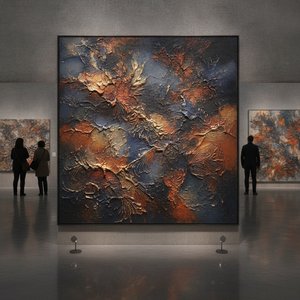 Top 25 Masterpieces by Christian Noiret: A Journey Through Abstract Texture and Light
Introduction To step into the world of Christian Noiret is to abandon the safety of recognizable forms and surrender to a profound, silent dialogue between light and matter. As one wanders through his most significant works, one does not merely obser...
If color provides the voice and texture provides the body, then light is the breath of a masterpiece. Throughout art history, the manipulation of light has served as the primary narrator of drama and divinity. The classical tradition of chiaroscuro—the dramatic contrast between deep shadow and brilliant illumination—has long been used to direct the viewer's eye and instill a sense of mystery or sanctity. In more contemporary explorations, this narrative shifts toward a luminous abstraction, where light is not just hitting an object but seems to be trapped within the very layers of the paint itself. This creates a depth that shifts as one moves through a room, making the artwork feel like a dynamic, living entity.
In works exploring the intersection of light and matter, such as Laurent Moreau’s Cerulean Horizon, light acts as a boundary or a bridge. A stark, luminous white void can represent an infinite, ethereal expanse, while directional light dancing across raised impasto ridges creates a hypnotic, three-dimensional topography. This interplay allows the artist to control the viewer's perception of space and time. By carefully managing where the light falls and where it disappears into velvety shadows, the painter directs the emotional journey, leading the observer from the recognizable world into a realm of pure, unadulterated sensation.
Compositional Tension: Guiding the Viewer's Emotional Journey
 Crimson Solitude: A Monumental Study of Nostalgia and Impasto Light
A Vision of Radiant Nostalgia In the quiet intersection of urban memory and tactile splendor lies Crimson Solitude: A Monumental Study of Nostalgia and Impasto Light , a breathtaking exploration of color, texture, and the enduring soul of the city. T...
The arrangement of elements within a frame is the invisible hand that guides the human psyche. A composition can be a place of absolute stillness or a theater of intense conflict. Through the use of receding diagonals, as seen in the immersive descent of Noiret’s aquatic studies, an artist can pull the viewer into a hidden sanctuary, guiding the eye from a detailed foreground toward a hazy, infinite horizon. Conversely, a centered, symmetrical composition can evoke a sense of monumental stability and divine clarity, anchoring the viewer in a moment of profound focus.
ienteMasterful composition often relies on the tension between structured spontaneity and organic chaos. An artist might use heavy, gestural shapes to soften structural edges, making even man-made objects feel organic and alive. By manipulating lines—making them fluid rather than geometric—the painter suggests a kinetic energy frozen in time. This careful orchestration of visual weight ensures that the viewer does not merely observe the painting but undergoes an experience, moving through the intended emotional arc from the initial encounter to a final, lingering realization.
The Tactile Soul: Bridging the Gap Between Materiality and Memory
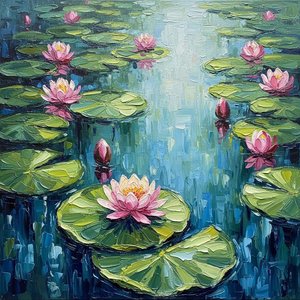 Serene Azure Depths: A Singular Impasto Study of Floating Petals and Verdant Ripples
An Immersive Descent into Serenity In the quiet corners of the contemporary art world, few works manage to arrest the viewer with such immediate, meditative grace as Serene Azure Depths: A Singular Impasto Study of Floating Petals and Verdant Ripples...
At its most profound level, great art functions as a sensory bridge between the physical world and our internal reservoirs of memory. The materiality of oil paint—its slow drying time, its ability to be layered, its heavy consistency—allows for a unique form of expression that mimics the complexity of human thought. When we look at a painting that utilizes thick, textured layers, we are not just seeing an image; we are witnessing the physical traces of a creative act. This tactile depth ensures that the artwork retains its soul, whether viewed in person or through a high-quality reproduction.
This connection to memory is often triggered by the way light interacts with the physical ridges of the paint. A single highlight on a thick stroke of white can evoke the brightness of a childhood summer, while a deep, shadowed crevice in the impasto can mirror the weight of grief. The ability of an artist to translate these intangible, ephemeral emotions into something as permanent and tangible as oil on canvas is the true essence of creative alchemy. It is this bridge between the material and the emotional that allows a masterpiece to transcend its era and speak to the universal human condition.
Preserving the Vision: The Science of Longevity in Oil Masterpieces
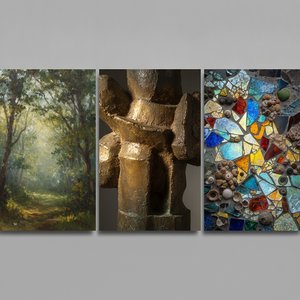 Top 25 Masterpieces by David Moreau: A Journey Through Texture and Light
Introduction Step into a world where the canvas ceases to be a flat surface and transforms into a living, breathing landscape of shadow and light. To experience the top 25 works of David Moreau is to witness a masterclass in the architecture of textu...
To ensure that the emotional resonance of a masterpiece endures for generations, one must respect the delicate chemistry of the medium. The preservation of art is a rigorous discipline involving the use of specific oils and protective finishes. For instance, the use of safflower oil for whites is a deliberate choice to prevent the yellowing that can plague lesser works over time. Furthermore, the application of a final coat of Damar varnish serves as a vital shield, protecting the intricate textures and vibrant pigments from the encroulting forces of dust, moisture, and atmospheric pollutants.
True mastery extends beyond the initial application of paint to the long-term stewardship of the vision. Using flexible gesso to prevent cracking and ensuring that the canvas is properly braced on sturdy stretcher bars prevents the physical degradation of the work. When these scientific principles are applied with academic excellence, the artwork becomes a legacy—a permanent vessel for human emotion that remains as vibrant and evocative centuries after the artist's final brushstroke.
At ArtsDot.com, we honor this tradition of excellence by offering museum-quality, hand-painted oil reproductions that capture the very soul of history's greatest works. Our artists, trained in prestigious academies, utilize these time-honored techniques to ensure every stroke and texture is a faithful tribute to the original masters. Whether you seek to transform a personal memory into a custom masterpiece or wish to adorn your space with a reconstructed classical icon, our commitment to the alchemy of art ensures that your investment becomes a lasting part of your own history.