
The Twilight of Tradition: From Impressionism to Post-Impressionist Foundations
 Post-Impressionism
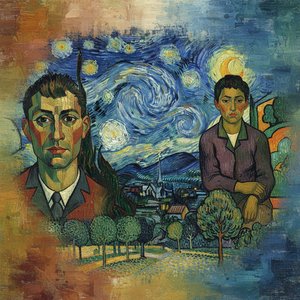
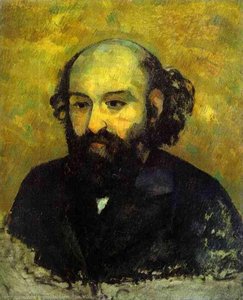
Post-Impressionism (also spelled Postimpressionism) was a predominantly French art movement which developed roughly between 1886 and 1905, from the last Impressionist exhibition to the birth of Fauvism. Post-Impressionism emerged as a reaction agains...
To understand the seismic shifts of the early 20th century, one must first look back at the flickering light of the late 19th century. Before the radical fragmentation of form took hold, there was the ephemeral beauty of Impressionism. This movement, born in the bustling ateliers of Paris, sought to capture the fleeting essence of a moment—the way sunlight dances upon the Seine or how shadows soften at dusk. Artists like Claude Monet and Pierre-Auguste Renoir moved away from the rigid, dark palettes of academic realism, embracing visible brushstrokes and an obsession with optical truth. However, as the century drew to a close, a profound dissatisfaction began to stir within the artistic community. The Impressionists had mastered the depiction of light, but they had left behind the structural integrity of the subject.
This tension birthed Post-Impressionism, a period roughly spanning from 1886 to 1905, which acted as a bridge between the sensory observations of the past and the conceptual abstractions of the future. This was not a single, unified movement but rather a collection of individualistic responses to the limitations of Impressionism. Artists began to move beyond mere naturalism, seeking instead to imbulate their canvases with symbolic content and more permanent, structured forms. They were no longer content to simply record what the eye saw; they sought to express what the soul felt and what the mind understood about the underlying architecture of reality.
The Geometry of Vision: Paul Cézanne and the Seeds of Proto-Cubism
 Cézanne's Masterpieces: 25 Iconic Artworks to Transform Your Space
Introduction There’s a quiet intensity that clings to Paul Cézanne's work, an almost palpable sense of searching—a relentless pursuit of capturing the essence of light and form. To assemble a ‘Top 25’ is, in itself, a somewhat reductive act; it feels...
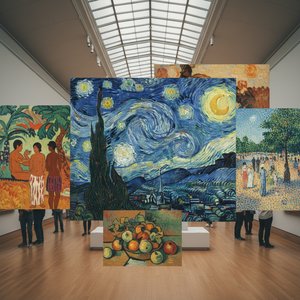
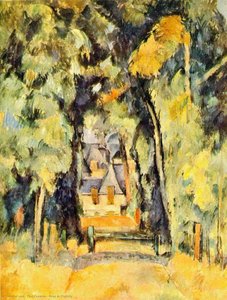
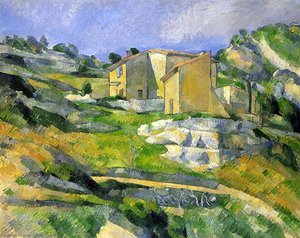
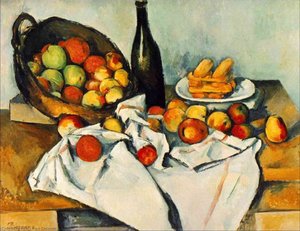
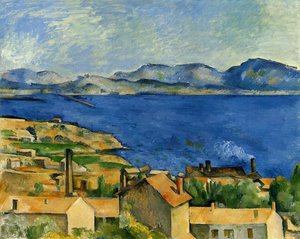
At the heart of this transition stood Paul Cézanne, a figure whose quiet intensity and relentless pursuit of form would forever alter the trajectory of Western art. Often described as the father of modern art, Cézanne did not seek to destroy tradition but to reinterpret it through a lens of structural permanence. He possessed an almost scientific obsession with the essence of light and volume, treating the natural world not as a collection of fleeting impressions, and instead as a series of fundamental geometric shapes. In his masterful still lifes, such as Peaches, Pears and Grapes, one observes a deliberate departure from traditional perspective. He did not merely paint fruit; he wrestled with the very weight and presence of those objects within space.
Cézanne’s technique involved a unique approach to color and composition, where he used patches of color to build up form, a method that hinted at the much later development of pointillism. By focusing on the solidity of objects—the way an apple or a water pitcher occupies space—he began to strip away the illusionistic depth favored by the Old Masters. This reduction of the world into cylinders, spheres, and cones provided the essential vocabulary for the next generation of rebels. His work represents a period often termed Proto-Cubism, a vital phase where the boundaries between observation and memory began to blur, paving the way for a complete deconstruction of the visual plane.
Deconstructing Reality: The Cubist Revolution and the Fragmentation of Form
 Deconstructing Reality: Cubism's Revolutionary Impact on 20th-Century Art
The Genesis of Fragmentation: Precursors to Cubism Wikipedia: Cubism Cubism is an early-20th-century avant-garde art movement which began in Paris. It revolutionized painting and the visual arts, and sparked artistic innovations in music, ballet, lit...
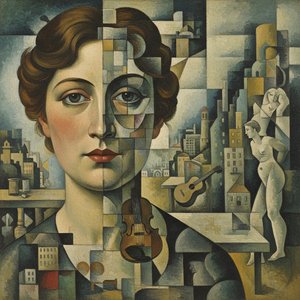
If Cézanne provided the vocabulary, then Pablo Picasso and Georges Braque provided the revolution. Emerging in Paris at the dawn of the 20th century, Cubism was perhaps the most radical departure from representational art since the Renaissance. This movement sought to dismantle the single-point perspective that had dominated European painting for centuries. Instead of viewing a subject from one fixed vantage point, Cubist artists analyzed, broke up, and reassembled their subjects into a mosaic of fragmented planes. They presented the viewer with multiple viewpoints simultaneously, reflecting the complexity and dynamism of modern life.
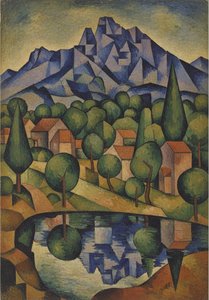
The movement was not merely about destruction; it was an intellectual endeavor to represent a more complete truth. Figures like Jean Dominique Antony Metzinger played a crucial role here, acting not only as a painter but as a theorist who helped define the movement's logic. In his seminal writings, such as Note sur la peinture, he explored how objects could be understood through successive experiences in space and time. This facet of form—the breaking of an object into geometric facets—challenged the very notion of what a painting should be. The canvas was no longer a window into a simulated world, but a flat surface where reality was reconstructed through a complex, intellectualized language of lines and shapes.
The Radical Edge: Rayonism, Suprematism, and the Russian Avant-Grate
 Mikhail Larionov: Rayonism, Primitivism & the Dawn of Russian Avant-Garde Painting
The Precursors: Russian Art Before the Avant-Garde Wikipedia: Russian avant-garde The Russian avant-garde was a large, influential wave of avant-garde modern art that flourished in the Russian Empire and the Soviet Union, approximately from 1890 to 1...
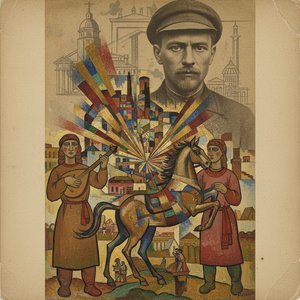
While Paris was the epicenter of Cubist thought, a parallel and equally explosive energy was erupting in the East. The Russian avant-garde flourished between 1890 and 1930, driven by a fervent desire to create an art that reflected the revolutionary spirit of a changing nation. This era saw the birth of movements like Rayonism, conceived by Mikhail Larionov and Natalia Goncharova. Rayonism focused on the intersection of light rays reflected from various objects, creating a purely abstract language of light and color that moved away from any recognizable subject matter.
Even more profound was the emergence of Suprematism, led by the visionary Kazimir Malevich. This movement pushed abstraction to its absolute limit, seeking a "pure" artistic feeling through the use of simple geometric forms—squares, circles, and crosses—set against stark backgrounds. The influence of this movement extended far beyond the canvas; figures like Lazar Khidekel demonstrated how Suprematist principles could be applied to architecture, envisioning a new world built on the foundations of geometric purity. This period in Russia was a tapestry of radical experimentation, where the boundaries between painting, design, and social reconstruction were perpetually being redrawn.
A New Language of Light: Fauvism and the Liberation of Color
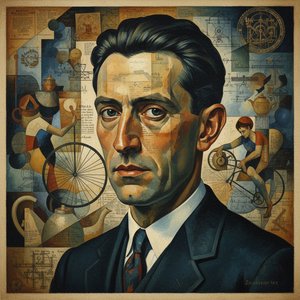 Jean Dominique Antony Metzinger: Pioneering Cubism & the Evolution of Abstract Form
Early Influences & The Fauvist Foundation Jean Dominique Antony Metzinger’s artistic journey began not with the fractured planes of Cubism for which he would become renowned, but amidst the vibrant hues and expressive brushwork of late 19th-century F...
Parallel to the structural experiments of Cubism was the emotive explosion of Fauvism. If Cubism was an intellectual movement of form, Fauvism was a visceral movement of color. The "Fauves," or wild beasts, utilized colors that were entirely unmoored from reality. A sky might be rendered in a shocking crimson; a face might be streaked with vibrant greens and yellows. This liberation of color allowed artists to use the palette as a direct conduit for emotion rather than a tool for mimicry.
This movement, though relatively short-lived, left an indelible mark on the modern aesthetic. By prioritizing the expressive power of pigment over the descriptive accuracy of light, the Fauves broke the final tether to naturalism. They proved that color could exist as its own subject, capable of generating rhythm, tension, and atmosphere independent of the objects it adorned. This emphasis on the painterly surface and the emotional resonance of hue became a cornerstone for much of the expressive art that would follow in the 20th century.
Legacy of the Vanguard: How Early Modernism Redefined the Artistic Canon
--- title: Avant-garde | Tate author: Boris Groys; Claire Bishop url: https://www.tate.org.uk/art/art-terms/a/avant-garde hostname: tate.org.uk description: Tate glossary definition for avant-garde: Art that is innovatory, introducing or exploring ne...
The era of Early Modernism was not merely a series of disconnected stylistic shifts; it was a continuous, turbulent dialogue about the nature of perception. From the structural foundations laid by Cézanne to the radical abstractions of the Russian avant-garde and the chromatic intensity of the Fauves, these artists collectively dismantled the traditional hierarchies of art. They moved the focus from the external world to the internal experience, from the imitation of nature to the creation of new realities.
Today, we see the echoes of this revolution in every corner of contemporary design, architecture, and visual culture. The courage to break tradition remains a fundamental driver of human creativity. For those who seek to surround themselves with the profound weight of history, these masterpieces offer more than just aesthetic beauty; they offer a window into the very moment when the modern world was born. At ArtsDot.com, we celebrate this enduring legacy by providing museum-quality reproductions that allow collectors and enthusiasts to bring the transformative energy of the avant-garde into their own homes, preserving the spirit of the masters for generations to come.