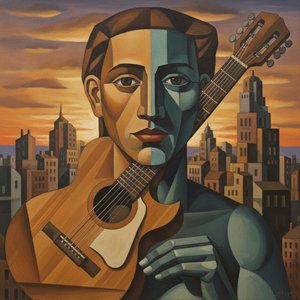
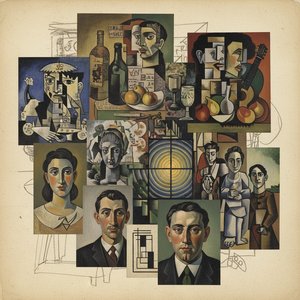
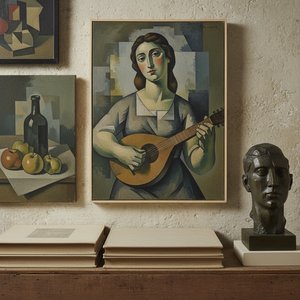
The Genesis of Fragmentation: Breaking from Renaissance Perspective
 Cubism Unveiled: How Picasso and Braque Redefined Modern Art through Geometric Revolution
The Genesis of Fragmentation: Breaking from Traditional Perspective Cubism - The Metropolitan Museum of Art --- title: Cubism - The Metropolitan Museum of Art author: Sabine Rewald url: https://www.metmuseum.org/essays/cubism hostname: metmuseum.org ...
To understand the seismic shift brought about by Cubism, one must first envision the world as it was viewed through the lens of the Renaissance. For centuries, Western art adhered to a sacred contract with reality, utilizing linear perspective to create a window-like illusion of depth and a single, fixed viewpoint. This tradition demanded that the artist act as a mirror, capturing a frozen moment in time from one precise vantage point. However, as the dawn of the twentieth century approached, the stability of this visual contract began to dissolve. The rapid industrialization of Europe, coupled with profound scientific breakthroughs like Einstein’s theory of relativity, challenged the very notion of absolute space and time.
The radical departure of Cubism was not merely an aesthetic choice but a fundamental questioning of how we perceive existence. Artists began to reject the inherited concept that art should simply copy nature. Instead of presenting a singular, deceptive truth, they sought to represent the subject in a greater context, acknowledging that our experience of an object is composed of many fleeting glances and shifting angles. This movement dismantled the traditional hierarchy of sight, replacing the tranquil stability of the Renaissance with a dynamic, fractured reality that mirrored the complexity of a modernizing world.
Analytic Cubism: Deconstructing Form through Intellectual Rigint
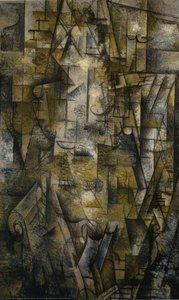
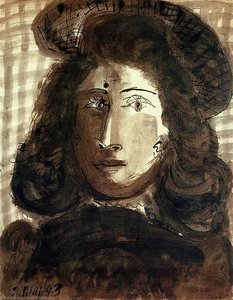
Between 1907 and 1912, the movement entered its most intellectually rigorous phase, known as Analytic Cubism. This period was characterized by an almost scientific approach to the canvas, where the subject was meticulously dissected into its constituent parts. In works such as Pablo Picasso’s
Portrait of Georges Braque, we witness the abandonment of traditional portraiture in favor of a deconstructed anatomy. The face is broken down into interlocking planes and sharp angles, rendered in a somber, monochromatic palette of browns, grays, and ochres. By stripping away vibrant color, the artists forced the viewer to focus entirely on the interplay of geometric forms and the structural essence of the subject.
This phase was less about what was being painted and more about
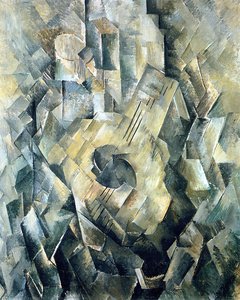
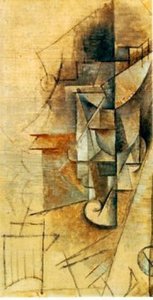
how it was being seen. The technique involved fracturing forms and presenting multiple viewpoints simultaneously, creating a sense of depth that did not rely on traditional shading but on the overlapping of translucent, crystalline shapes. It was an analytical process—a way to "analyze" the object by viewing it from the front, side, and top all at once. This complexity challenged the viewer's eye to reconstruct the image, turning the act of looking into an active, intellectual puzzle that bridged the gap between the seen and the known.
Synthetic Cubism: The Revolution of Collage and Texture
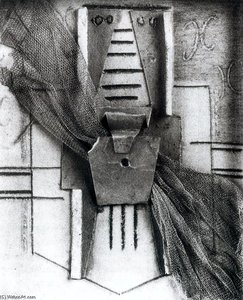 Guitar 5
A Fragmented Vision of Form: Analyzing Picasso’s “Guitar” Pablo Picasso's "Guitar" (1920), a deceptively simple yet profoundly complex sculpture, stands as a pivotal emblem of Synthetic Cubism—a movement that irrevocably altered the trajectory of art...
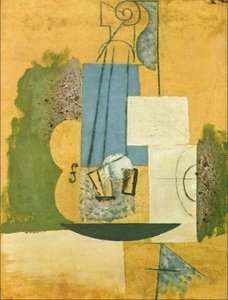
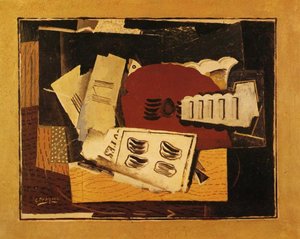
As the movement evolved, it transitioned from the analytical deconstruction of forms toward a more additive process known as Synthetic Cubism. If the first phase was about taking things apart, this second phase was about putting them back together in entirely new, unexpected ways. This era introduced the revolutionary concept of collage, where artists began to incorporate real-world elements—newspaper clippings, wallpaper, and sand—directly onto the canvas. This blurred the boundary between high art and everyday life, challenging the very definition of what constitutes a "painting."
In this stage, the composition became more decorative and less monochromatic. The introduction of texture allowed for a richer, more tactile experience, as seen in works like Picasso’s
Guitar. Rather than purely representing a musical instrument through paint, the artist used geometric abstraction and varied materials to evoke its presence. This period emphasized the flat, two-dimensional surface of the canvas, celebrating the "constructed" nature of art. It was a celebration of synthesis, where disparate elements were woven into a cohesive, albeit fragmented, whole, paving the way for much of the abstract art that would follow in the decades to come.
The Collaborative Vision: The Symbiotic Relationship of Picasso and Braque
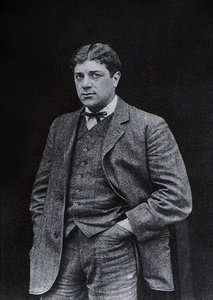
It is impossible to discuss the birth of Cubism without acknowledging the profound, almost telepathic collaboration between Pablo Picasso and Georges Braque. Their relationship was one of intense mutual influence, a period so closely intertwined that their respective works from 1908 to 1912 were often nearly indistinguishable to contemporary critics. While Picasso brought a restless, transformative energy and a background of technical mastery, Braque provided a disciplined, structural foundation rooted in his early training as a decorator.
Braque’s upbringing in a family of house painters instilled in him a deep appreciation for the materiality of art—the way texture and structure define a space. This practical craftsmanship complemented Picasso's more iconoclastic spirit. Together, they pushed the boundaries of the medium, moving from the bold colors of Fauvism toward the structured geometry of Cubism. Their partnership was not merely a friendship but a shared laboratory for experimentation, where each artist’s innovation served as the catalyst for the other’s evolution, ultimately creating a unified language of fragmentation that would redefine the trajectory of modern art.
Beyond the Canvas: The Global Legacy and Architectural Influence of Cubism
 Czech Cubism
Czech Cubism (referred to more generally as Cubo-Expressionism) was an avant-garde art movement of Czech proponents of Cubism, active mostly in Prague from 1912 to 1914. Prague was perhaps the most important center for Cubism outside Paris before the...
The ripples of the Cubist revolution extended far beyond the studios of Paris, influencing nearly every facet of twentieth-century creativity. The movement's emphasis on geometric structure and the rejection of traditional perspective found echoes in music, ballet, literature, and even architecture. In places like Prague, "Czech Cubism" emerged as a unique branch of the movement, applying cubist principles to the built environment through sharp points, slicing planes, and crystalline shapes in architectural design.
Today, the legacy of Picasso and Braque remains a cornerstone of our visual vocabulary. The movement taught us that reality is not a static image but a multifaceted experience. For those who seek to bring this profound sense of history into their own spaces, the preservation of these masterpieces is essential. At
ArtsDot.com, we honor this legacy by offering museum-quality, hand-painted oil reproductions of these canonical works. Our master artists, holding degrees from prestigious academies, meticulously recreate the visible brushstrokes and deep tonal ranges of the Cubist masters on 100% cotton canvas. Whether you are an art student studying the mechanics of fragmentation or a collector looking to anchor a room with a piece of history, our collection allows you to own a tangible connection to the revolution that shattered reality.