The Dawn of Vision: Masaccio and the Transition from Medieval to Renaissance Realism
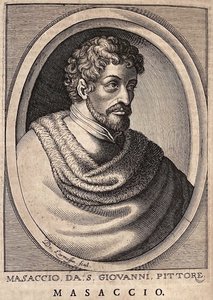 tommaso di ser giovanni di mone cassai
Tommaso di Ser Giovanni di Mone Cassai: The Dawn of Renaissance Vision Tommaso di Ser Giovanni di Mone Cassai, more famously known as Masaccio, stands as a pivotal figure in the transition from medieval to Renaissance art – a revolutionary painter wh...
To understand the profound shift that occurred during the Italian Renaissance, one must look back to the early 15th century, a period where the flat, symbolic language of the Middle Ages began to dissolve into something far more visceral and human. At the heart of this metamorphosis stood Tommaso di Ser Giovanni di Mone Cassai, known to history as Masaccio. Though his life was tragically brief—concluding at the age of twenty-seven—his impact on Western art was nothing short of revolutionary. Before Masaccio, much of European painting relied upon a decorative, often two-dimensional approach that prioritized theological symbolism over physical reality. However, through a radical commitment to observation, Masaccio introduced a sense of weight and volume that had been absent for centuries.
Masaccio’s genius lay in his ability to marry the rediscovered principles of ancient architectural perspective with a profound understanding of the human form. By employing linear perspective, he did not merely create a clever optical illusion; he constructed a window into a believable three-dimensional world. This was complemented by his pioneering use of
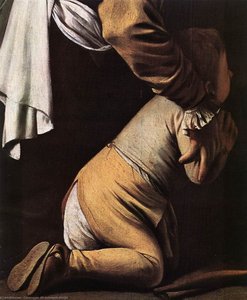
chiaroscuro, where the deliberate contrast between light and shadow allowed figures to emerge from the darkness with a palpable sense of mass and solidity. His frescoes in the Brancacci Chapel serve as a testament to this new era, where characters no longer float weightlessly against gold backgrounds but stand firmly upon the earth, subject to the same laws of gravity and light as the viewer. For those who seek to capture this foundational moment of realism, our hand-painted oil reproductions offer a tactile connection to this very dawn of modern vision, preserving the heavy brushstrokes and tonal depth that define Masaccio's legacy.
Architectural Harmony: The Revival of Classical Order and Brunelleschi’s Legacy
 Renaissance architecture
Renaissance architecture is the European architecture of the period between the early 15th and early 16th centuries in different regions, demonstrating a conscious revival and development of certain elements of ancient Greek and Roman thought and mat...
As the painters were redefining the canvas, architects were simultaneously reshaping the Italian skyline, looking backward to antiquity to move forward into a new age. The Renaissance was, at its core, a
rinascita—a rebirth of the classical Greek and Roman ideals of symmetry, proportion, and geometry. This movement found its most potent expression in Florence, led by visionaries such as Filippo Brunelleschi. Moving away from the complex, irregular profiles of the Gothic tradition, Renaissance architecture sought a divine order through mathematical precision. The introduction of semicircular arches, hemispherical domes, and rhythmic colonnables transformed urban landscapes into stages of civic pride and intellectual clarity.
This architectural revolution was not merely about aesthetics; it was an embodiment of humanist philosophy, where the structure of a building reflected the structured logic of the universe. The works of Brunelleschi, characterized by their harmonious facades and balanced proportions, provided the physical framework within which the era's great art could flourish. This sense of structural permanence and mathematical grace continues to inspire those who curate sophisticated interiors today. Much like the architects of old, we believe that art should provide a sense of balance to a space. Whether through large-format murals or meticulously framed canvases, bringing these classical proportions into a modern home allows for a seamless dialogue between historical grandeur and contemporary living.
The Mastery of Light: Chiaroscuro and the Evolution Toward Baroque Intensity
 Chiaroscuro
In art, chiaroscuro (English: kee-AR-ə-SKOOR-oh, -SKURE-, Italian: [ˌkjaroˈskuːro]; lit. 'light-dark') is the use of strong contrasts between light and dark, usually bold contrasts affecting a whole composition. It is also a technical term used by a...
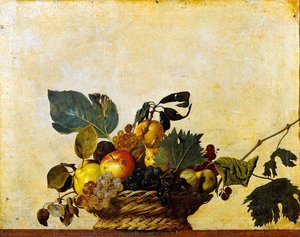
As the Renaissance progressed, the serene clarity of the early masters began to give way to a more dramatic and emotionally charged aesthetic. This evolution led us toward the late 16th century and the dawn of the Baroque, a period defined by an almost theatrical use of light. The technical foundation for this shift was laid by the mastery of
chiaroscuro—the use of strong contrasts between light and dark to achieve a sense of volume and drama. While the early Renaissance used light to define form, the later masters used it to manipulate emotion.
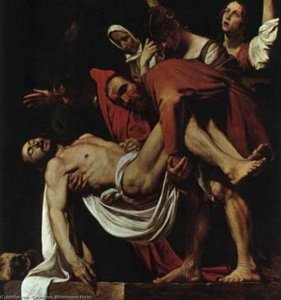
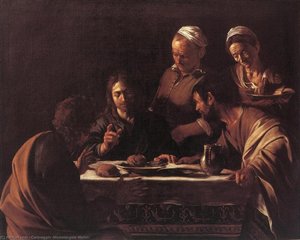
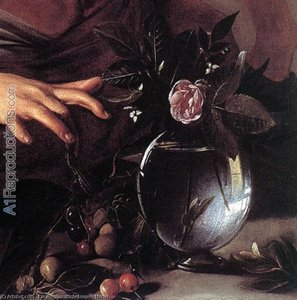
This transition reached its zenith in the works of Michelangelo Merisi da Caravaggio. His approach, often referred to as
tenebrism, pushed
chiaroscuro to its extreme, plunging much of the composition into deep, impenetrable shadows while illuminating key subjects with a harsh, directional light. This was not merely an aesthetic choice; it was a way to focus the viewer's attention intensely upon the human drama, stripping away unnecessary detail to reveal the raw essence of suffering, resilience, and divinity. The shadows in a Caravaggio painting are as much a part of the narrative as the light itself. At ArtsDot.com, our artists specialize in capturing this very intensity. Our oil reproductions utilize thick impasto and deep tonal ranges to ensure that the dramatic interplay of shadow and brilliance is felt physically on the canvas, providing a depth that no digital print can replicate.
Spiritual Drama: The Counter-Reformation and Art as a Tool of Persuasion
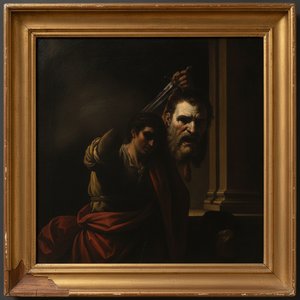 Drama and Light: A Definitive Guide to the Italian Baroque Masterpieces and the Revolution of Chiaroscuro
The Counter-Reformation Context: Art as a Tool of Spiritual Persuasion Italian Baroque Italian Baroque (or Barocco) is a stylistic period in Italian history and art that spanned from the late 16th century to the early 18th century. == History == The ...
The shift toward Baroque intensity was deeply intertwined with the turbulent religious landscape of the late 16th century. During the Counter-Reformation, the Roman Catholic Church sought to respond to the challenges of the Protestant Reformation by revitalizing its spiritual connection with the faithful. The Council of Trent mandated that art should serve as a powerful, silent orator—an instrument of clarity and emotional resonance designed to inspire awe and devotion. This era demanded an end to the overly intellectualized and obscure allegories of Mannerism; instead, the Church called for imagery that was accessible, visceral, and deeply moving.
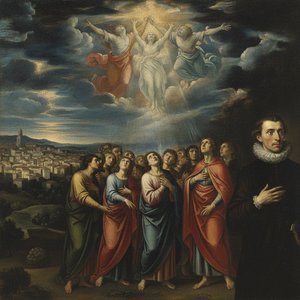
This period saw the birth of art as a tool of spiritual persuasion. Masterpieces like Guercino’s
Saint François en extase exemplify this movement, where the use of light serves as a conduit for divine presence. The goal was to bridge the gap between the earthly and the celestial, making the miraculous feel tangible. Every brushstroke in an altarpiece from this era was intended to pull the viewer into a state of profound contemplation. This legacy of emotional storytelling remains one of the most compelling reasons to collect classical art. By choosing a reproduction that emphasizes these dramatic textures and spiritual themes, collectors can transform a private space into a sanctuary of historical and emotional depth.
From Da Vinci to Caravaggio: Defining the Human Form and Emotional Depth
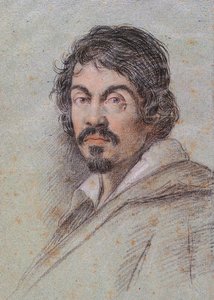 Caravaggio
A Life Forged in Shadow and Light Michelangelo Merisi da Caravaggio, a name synonymous with the dramatic intensity of Baroque painting, was born in Milan in 1571, a period steeped in both artistic flourishing and societal upheaval. His early life was...
The trajectory of Italian art from the High Renaissance to the Baroque is essentially a journey toward a deeper understanding of the human soul. Leonardo da Vinci, the quintessential Renaissance man, brought an unparalleled scientific precision to the depiction of anatomy and atmosphere. His use of
sfumato—the subtle, smoky blending of colors and tones—allowed for a lifelike softness that captured the mystery of human expression. Da Vinci’s work was about the intellect and the observation of nature; he sought to map the very mechanics of life through light and shadow.
However, as we move toward the era of Caravaggio, the focus shifts from the intellectualized beauty of the Renaissance to the raw, unvarnished reality of the human condition. Caravaggio rejected idealized forms in favor of a gritty realism, often using ordinary people from the streets of Rome as models for saints and martyrs. This movement brought a new level of psychological depth to portraiture and religious scenes alike. The transition from the delicate red chalks of Da Vinci’s self-portraits to the heavy, light-drenched canvases of the Baroque represents the full spectrum of human experience—from the quiet contemplation of genius to the intense struggle of existence. For the discerning history lover, owning a piece that reflects this evolution is an opportunity to hold a fragment of humanity's greatest intellectual and emotional achievements.
Preserving the Renaissance: Bringing Masterpieces into the Modern Interior
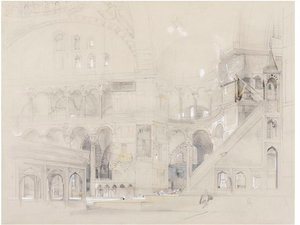 Interior of Hagia Sophia, Constantinople
Discover the exquisite interior of Hagia Sophia, Constantinople, by John Frederick Lewis. A detailed architectural sketch capturing Byzantine grandeur, perfect for art collectors and history enthusiasts.
The enduring power of the Italian Renaissance lies in its ability to transcend time. The themes of light, shadow, proportion, and human emotion remain as relevant in a modern penthouse as they were in a Florentine palazzo. However, preserving this legacy requires more than just admiration; it requires a commitment to quality and authenticity. In an age of mass-produced, flat digital prints, the true essence of these masterpieces—the visible brushstrokes, the textured impasto, and the rich, layered pigments—is often lost.
At ArtsDot.com, we believe that every home deserves the soul of a masterpiece. Our mission is to provide high-quality, hand-painted oil reproductions that honor the academic excellence of the original masters. Each piece is meticulously crafted by artists holding degrees from prestigious Fine Arts academies, ensuring that the
chiaroscuro of Caravaggio or the precision of Da Vinci is captured with museum-grade accuracy. We offer a bespoke experience, from professional digital mockups to custom "period shifts," allowing you to reimagine history within your own aesthetic. Whether you are looking for a single iconic work like the
Mona Lisa or a multi-panel set to adorn a grand staircase, our service ensures that these timeless treasures continue to inspire generations to come.