
Introduction
To step into the world of Expressionism is to abandon the comfort of reality and surrender to the raw, unbridled pulse of the human psyche. Unlike the Impressionists, who sought to capture the fleeting dance of light upon a landscape, the Expressionist masters turned their gaze inward. They were not interested in how a face looked under the midday sun, but rather how grief, anxiety, or ecstasy felt within the soul. It was an art of distortion, of jarring colors, and of thick, emotive brushstrokes that seem to vibrate with a life of their own.
Emerging primarily in Germany at the dawn of the 20th century, this movement arose from a period of profound cultural upheaval. As the industrial revolution reshaped the landscape and the shadows of impending global conflict loomed over Europe, artists felt an urgent need to communicate the psychological tension of the modern age. Through groups like Die Brücke and Der Blaue Reiter , they stripped away the polite veneers of academic tradition to reveal a more visceral truth—one that embraced the jagged edges of human experience.
Today, these masterpieces remain profoundly resonant. In an era still defined by rapid technological shifts and collective uncertainty, the emotional honesty of Expressionism speaks directly to our contemporary condition. We recognize ourselves in their swirling skies and haunting portraits; we feel the same tremors of existential searching that drove the artists decades ago. Their work serves as a timeless mirror to the complexities of being alive.
In the following curation, we invite you to walk through a gallery of shadows and light. We have selected ten definitive works—each a cornerstone of the movement—that do more than merely depict a scene; they capture a scream, a prayer, and a revolution. Prepare to encounter the canvases that fundamentally redefined the boundaries of what art can communicate.
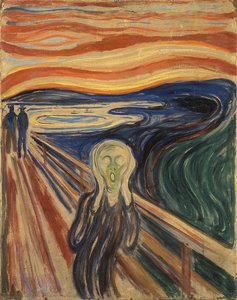
The Scream - Edvard Munch
Imagine standing on a desolate bridge as the sky suddenly fractures into violent ribbons of fiery orange and blood-red, mirroring an internal fracture of the soul. This is the visceral world of Edvard Munch’s The Scream (1893) , a cornerstone of the Expressionism movement . The painting does not merely depict a landscape; it captures a psychic event. Through swirling, turbulent lines and a hauntingly distorted perspective, Munch translates existential dread into visible form, using thick, emotive brushstrokes that pulse with the rhythm of an unheard cry.
The composition is a masterclass in tension, where the cool, deep blues of the fjord clash against the heat of the sunset, creating a sensory vortex of anxiety and isolation. As a definitive masterpiece of modern angst , its presence in a collection offers more than decoration; it provides a profound point of reflection on the human condition. For those seeking to anchor a room with intellectual depth, a hand-painted oil reproduction of this icon brings a textured, museum-grade intensity to your walls, inviting viewers to contemplate the raw beauty found within life's most turbulent emotions.
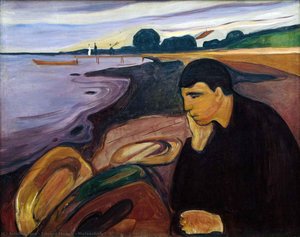
Melancholy - Edvard Munch
To encounter Melancholy by Edvard Munch is to step directly into the raw, unshielded psyche of the fin-de-siècle era. As a cornerstone of the Expressionism movement, this 1894 masterpiece transcends mere landscape; it is a profound psychological portrait that captures the weight of human isolation with haunting precision. Munch utilizes a somber, muted palette of deep blues, purples, and murky greens to evoke a pervasive sense of gloom, where the turbulent shoreline serves as a liminal space for introspection.
The painting’s influence on the Top 10 Masterpieces That Defined the Expressionism Art Movement lies in its revolutionary abandonment of objective reality in favor of emotional truth. Through distorted forms and energetic, impasto-like brushstrokes, Munch communicates a visceral tension that remains strikingly modern. For the discerning collector, bringing such a work into a refined interior offers more than mere decoration; it introduces a legacy of profound emotional intelligence and a timeless, brooding beauty that commands the room, inviting quiet contemplation and a deep connection to the history of modern angst.
Composition VII - Wassily Wassilyevich Kandinsky
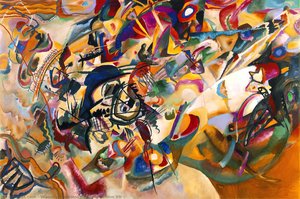 Composition VII - Wassily Wassilyevich Kandinsky
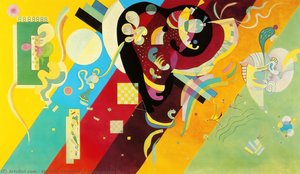
What story does the swirling, cosmic chaos of Composition VII by Wassily Kandinsky tell? Created in 1913, this monumental work stands as a pinnacle of the Expressionism movement, marking the moment where art finally broke free from the shackles of representational reality. Emerging from the spiritual fervor of the Der Blaue Reiter group, Kandinsky sought to translate "inner necessity" into a visual symphony, heavily influenced by the emotive power of Wagnerian opera and Theosophical mysticism.
The canvas is a breathtaking vortex of saturated oranges, deep blues, and energetic, biomorphic forms that suggest themes of creation and destruction. To possess such a piece is to invite a profound sensory escape into the sublime; its rhythmic, gestural brushstrokes offer a dynamic focal point for modern interiors seeking intellectual depth. For collectors looking to anchor their space with history, our hand-made oil reproductions capture every thick, impasto layer and vibrant hue of this masterpiece. Whether you seek a large-scale museum-grade canvas or a transformative multi-panel set, bringing Kandinsky’s abstract energy into your home allows you to live within the very heartbeat of art history.
Madonna - Edvard Munch
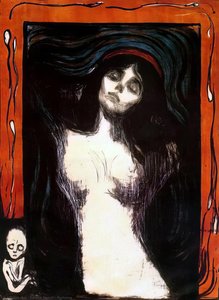 Madonna - Edvard Munch
In 1894, Edvard Munch delivered a visceral blow to traditional aesthetics with Madonna , a work that serves as a cornerstone of the Expressionist movement. Moving far beyond the idealized religious iconography of the past, Munch utilizes a jarring, swirling palette of fiery oranges and abyssal blacks to map the topography of human suffering. The central figure, rendered with skeletal vulnerability, is enveloped in a chaotic, halo-like vortex that evokes psychological oppression rather than sanctity.
The painting’s power lies in its raw, tactile immediacy—the loose, frantic brushstrokes and heavy textures mirror the artist's own internal struggles with grief and mortality. To possess a reproduction of this masterpiece is to invite a profound emotional dialogue into your home; it transforms a mere wall into a gallery of the soul. Whether you are drawn to the haunting symbolism of the ghostly infant or the intense, rhythmic energy of the composition, bringing this piece into your space ensures that your environment is not just decorated, but spiritually transformed by the very essence of Expressionist genius.
Woman in a Green Jacket - August Macke
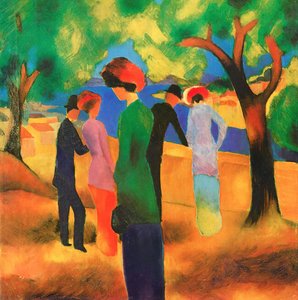 Woman in a Green Jacket - August Macke
In Woman in a Green Jacket , August Macke captures a fleeting pulse of light and life, freezing a moment of pre-war serenity within a kaleidoscope of color. This masterpiece stands as a pillar of the Expressionism movement because it transcends mere depiction; it is a rhythmic dance of Orphic Cubist shapes and Fauvist vibrancy that breathes vitality into the canvas. The emerald hues of the central figure do not merely sit upon the surface but vibrate against the deep, angular shadows of the landscape, creating a sensory experience where color becomes emotion itself.
As you observe the simplified, blocky silhouettes strolling through this stylized park, you feel the tension between modern anonymity and social connection. The energetic, visible brushstrokes lend a tactile depth that makes the scene feel alive, offering a sophisticated focal point for any contemporary space. Bringing a reproduction of this 1913 treasure into a home introduces an atmosphere of cultured optimism and intellectual depth, serving as a window into the soul of the Der Blaue Reiter era.
The Self-Seers II (Death and Man) - Egon Schiele
 The Self-Seers II (Death and Man) - Egon Schiele
To stand before a work of such profound psychological weight is to confront the very essence of human fragility. In The Self-Seers II (Death and Man) by Egon Schiele, we encounter a cornerstone of the Expressionist movement, a piece that transcends mere portraiture to become a visceral meditation on mortality. Painted in 1911 amidst the societal anxieties of Vienna, Schiele utilizes jagged, angular lines and a somber palette of earthy ochres and bruised browns to evoke an atmosphere of inescapable fate.
The painting’s power lies in its tactile intensity; the thick, visible impasto brushstrokes create a restless, swirling surface that mirrors the subject's inner turmoil. As a skeletal hand reaches from the shadows toward a gaunt, mask-like figure, the viewer is pulled into a claustrophobic dance with death itself. This masterpiece remains essential to our collection of the top 10 works defining Expressionism because it captures the movement's raw, unshielded emotional truth. Bringing a high-quality oil reproduction of this haunting vision into your home offers more than decor; it introduces a profound sense of introspection and a sophisticated, dramatic focal point that invites endless contemplation.
Self-portrait of a 'Degenerate Artist' - Oskar Kokoschka
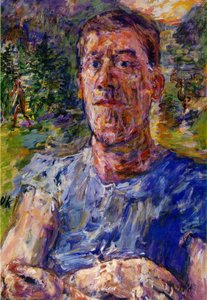 Self-portrait of a 'Degenerate Artist' - Oskar Kokoschka
In Self-portrait of a 'Degenerate Artist' , Oskar Kokoschka utilizes a diffused, almost spectral light that avoids traditional chiaroscuro in favor of an atmospheric, psychological glow. Rather than a single external source, the illumination seems to emanate from the subject’s very turmoil, catching the thick, impasto ridges of deep purples and bruised blues. This command of light—where shadows are not merely dark but are composed of vibrant, unsettling hues—captures the fractured reality of 1937 Europe. By eschewing naturalistic lighting, Kokoschka secured this work's place among the top masterpieces of Expressionism, transforming a mere likeness into a visceral record of resistance against the Nazi regime's condemnation.
The energetic, visible brushstrokes and the way light dances across the textured canvas create a sense of movement that is both haunting and profound. For the discerning collector, owning a high-quality oil reproduction of this piece brings that same dramatic depth into a modern interior. The interplay of cool tones and heavy texture provides a sophisticated focal point, adding a layer of historical gravity and sculptural luxury to any contemporary wall.
Great Scene of Agony - Max Beckmann
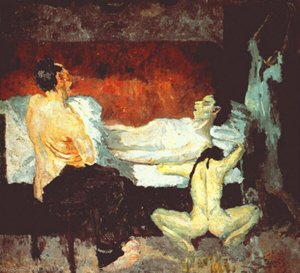 Great Scene of Agony - Max Beckmann
In the haunting shadows of Great Scene of Agony by Max Beckmann, time seems to fracture, leaving behind a raw, frozen moment of human vulnerability. This work earns its place among the top masterpieces of the Expressionism movement through its profound ability to externalize internal trauma, predating the widespread disillusionment of the early 20th century. The canvas breathes with a heavy, tactile energy; thick impasto brushstrokes create a landscape of flesh and shadow, where muted ochres, deep browns, and somber greens whisper of mortality and existential unease.
The composition, featuring figures caught in a state of profound fragility, uses distorted forms to bypass the intellect and strike directly at the soul. It is a visceral exploration of the human condition that transcends its historical era. For the modern collector, bringing such a powerful piece into a home offers more than mere decoration; it introduces a sophisticated, intellectual depth. Whether rendered as a large-scale oil reproduction or a textured canvas, Beckmann’s mastery of light and psychological tension provides a commanding focal point that invites deep introspection and serves as a timeless testament to the power of emotional truth.
Reclining Nude with Blue Cushion - Amedeo Clemente Modigliani
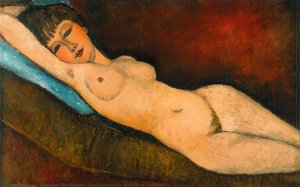 Reclining Nude with Blue Cushion - Amedeo Clemente Modigliani
What if I told you that Reclining Nude with Blue Cushion by Amedeo Clemente Modigliani was born from a moment of rebellion—a stroke of defiance against the ordinary? This work does not merely depict a figure; it serves as a manifesto of the Expressionist spirit. Its inclusion in our selection of the top masterpieces of the movement is earned through its radical departure from anatomical realism, favoring instead elongated, lyrical forms and a hauntingly beautiful melancholy that captures the raw essence of modern sensuality.
The painting’s power lies in its dramatic tension: the warmth of earthy ochres and fiery reds clashing against the cool, grounding presence of the vibrant blue cushion. Modigliani’s visible brushstrokes and flattened, geometric shapes invite a deep, introspective gaze, turning the canvas into a window of vulnerability. At ArtsDot.com, we believe such profound emotional depth should not be confined to museum walls. Imagine this masterpiece reimagined as a hand-painted oil reproduction in your own sanctuary, transforming a quiet corner of your home into a sophisticated statement of historical significance and timeless elegance.
Three Studies for Figures at the Base of a Crucifixion - Francis Bacon
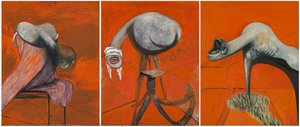 Three Studies for Figures at the Base of a Crucifixion - Francis Bacon
In the haunting corridors of 1944, Francis Bacon composed a visual scream that forever altered the trajectory of the Expressionism movement. In Three Studies for Figures at the Base of a Crucifixion , the artist does not merely depict light; he uses it as a visceral language of trauma. The searing, monochromatic orange backdrop does not illuminate a scene so much as it traps these distorted, amorphous entities within a claustrophobic cage of existential dread.
As you stand before this triptych, you feel the weight of post-war anxiety in every thick, gestural brushstroke. These figures—bulbous, elongated, and stripped of recognizable humanity—are archetypes of pure, unadulterated suffering. The way the stark, directional light hits the fleshy, distorted forms creates a sense of movement that is both hypnotic and deeply unsettling. It is this mastery of emotional atmosphere that secures its place among the greatest masterpieces of the era. For those seeking to bring this profound depth into their own space, our hand-painted oil reproductions capture every heavy impasto texture and haunting hue, allowing the raw power of Bacon’s vision to transform your walls into a portal of historical reflection.
Conclusion
As the lights dim on our journey through these visceral landscapes and distorted figures, we are reminded that Expressionism was never merely about a change in technique, but a profound shift in the human spirit. These masterpieces do not exist solely as relics of a turbulent era; they remain living presences, breathing with an intensity that defies the passage of time. Each jagged line and emotive color choice serves as a bridge across centuries, connecting the raw, internal struggles of the early 20th-century masters directly to our own contemporary sensibilities.
To stand before such works is to enter into a timeless conversation—a silent dialogue between the artist’s hand and the admirer’s soul. Whether through the haunting shadows of a nocturnal street or the electric vibrance of a distorted sky, these paintings invite us to confront our own depths, finding beauty in the unrest and strength in the rawest forms of human emotion. They possess the unique power to transform a mere space into a sanctuary of reflection, shaping our interiors and our inner worlds alike.
We invite you to continue this exploration and bring the evocative energy of this movement into your own home by browsing our full collection . In every hand-painted reproduction we offer, we strive to preserve that essential pulse—the visible brushstroke, the textured impasto, and the enduring heartbeat of art history—ensuring that the profound legacy of Expressionism continues to inspire, move, and resonate for generations to come.