
The Architect of Impressionism: Pissarro’s Visionary Legacy
To understand the genesis of modern perception, one must look toward the quiet, steadfast presence of Camille Pissarro. While names like Monet and Renoir often command the immediate spotlight of the Impressionist movement, it was Pissarro who served as its foundational architect, a mentor whose influence wove through the very fabric of the avant-garde. Born in the tropical warmth of St. Thomas, his journey to the heart of France brought with it a unique, observant eye—one that sought not just to depict a scene, but to capture the rhythmic pulse of existence itself. He was more than a painter; he was a bridge between eras, a man whose devotion to the evolution of light allowed him to guide younger artists through the radical transition from traditional realism to the fractured, luminous beauty of the Impressionist revolution.
Pissarro’s legacy is defined by an unwavering commitment to the truth of the landscape. Unlike those who sought the dramatic or the theatrical, Pissarro found divinity in the mundane. His life was a continuous study of the shifting seasons and the subtle nuances of the French countryside. This dedication ensured that his work remained anchored in a profound sense of place, making him a vital figure for any collector who values art that speaks to the enduring connection between humanity and the earth. He did not merely paint landscapes; he documented the soul of the land, creating a visual diary of a world in transition.
A Symphony of Light: Decoding the Technique of the Pontoise Landscapes
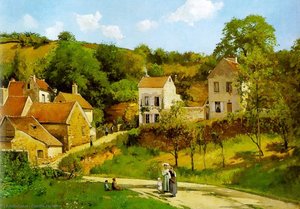
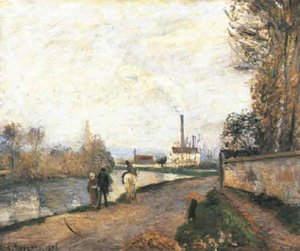
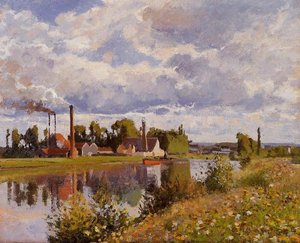
In the celebrated works produced during his time in Pontoise, such as the iconic Landscape at Pontoise, we witness a masterclass in atmospheric orchestration. Here, the artist moves beyond simple representation to engage in a complex dialogue with light. The technique is characterized by a delicate balance of structure and spontaneity. Through the use of short, broken brushstrokes, Pissability creates a shimmering effect that mimics the way sunlight filters through a humid afternoon haze or dances upon a dew-covered meadow. There is no harsh line to separate the earth from the sky; instead, there is a seamless integration of color and tone that suggests a world breathing in unison.
The brilliance of the Pontoise period lies in how Pissarro utilized color temperature to suggest depth and movement. By juxtaposing warm ochres with cool, cerulean shadows, he achieved a sense of three-dimensional vitality on a two-dimensional plane. This was not merely an aesthetic choice but a scientific pursuit of optical truth. When viewing these masterpieces, the eye does not rest on a single point; rather, it wanders through a mosaic of light, experiencing the same ephemeral magic that the artist felt while standing before his easel in the French fields. It is this rhythmic application of pigment that gives his landscapes their unmistakable, vibrating energy.
Rural Tranquility and the Rural Soul: The Essence of Eragny and Beyond
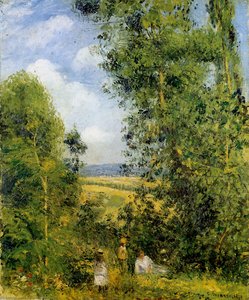
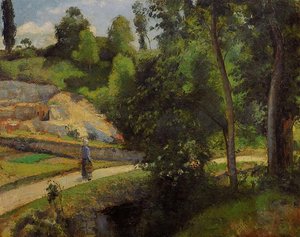
As Pissarro’s gaze moved toward Eragny, his work took on a more intimate, pastoral character. In pieces such as Field at Eragny, the artist captures a profound sense of rural tranquility that transcends mere scenery. These works are deeply rooted in observation, reflecting a life lived in harmony with the rhythms of agricultural toil and natural cycles. There is a certain dignity in his depiction of the fields—a reverence for the soil and the quiet labor that sustains life. The compositions often lead the viewer’s eye through winding paths or across vast, sun-drenched expansions, inviting a meditative state of contemplation.
This era of his work serves as a poignant reminder of the beauty found in stillness. While the industrial revolution was beginning to reshape the edges of the French landscape, Pissarro’s canvases remained sanctuaries of peace. He captured the essence of the countryside not as a nostalgic relic, but as a living, breathing entity. Through his eyes, the simple act of a field swaying in the breeze or a distant farmhouse nestled in the trees becomes an epic narrative of endurance and grace. To behold these works is to experience a profound connection to the ancestral landscapes that continue to inspire the human spirit.
The Master of Texture: Exploring Color, Brushwork, and Atmospheric Depth
To truly appreciate Pissarro is to engage with the tactile nature of his medium. His approach to the canvas was far from flat; he embraced a rich, textured application that gave his paintings a physical presence. The use of impasto—the thick, sculptural application of paint—allows certain highlights to catch actual light within a room, creating a dynamic interplay between the artwork and its environment. This texture is essential to conveying the weight of the earth and the lightness of the air. Every stroke carries intention, building layers of pigment that create a sense of atmospheric depth that a mere print can never fully replicate.
The complexity of his color palette also demands close study. Pissarro avoided the use of heavy blacks, preferring to derive shadows from deep violets, blues, and forest greens. This decision prevented his shadows from becoming "dead" spaces, ensuring that even the darkest corners of a landscape remained infused with reflected light. This sophisticated use of color ensures that the paintings possess a luminous quality, as if they are lit from within. It is this mastery of the chemical and physical properties of oil paint that allows his works to retain their vibrancy and emotional resonance across centuries.
Pissarro’s Enduring Influence on the Evolution of Modern Art
The ripples of Pissarro’s innovation can be felt throughout the trajectory of modern art. His ability to find structure within the ephemeral paved the way for the more radical experiments of Post-Impressionism and even the structured abstractions of the early 20th century. By teaching his contemporaries that the subject matter was secondary to the perception of light and color, he liberated future generations of artists from the constraints of literal representation. His influence is a testament to the power of a disciplined yet open-minded approach to creativity.
Today, as we look back upon his oeuvre, we see more than just historical artifacts; we see a blueprint for how to perceive the world with wonder. Whether through the meticulous recreation of his oil masterpieces or the study of his techniques in art history, Pissarro continues to teach us that there is infinite complexity to be found in a single field, a single tree, or a single moment of light. His work remains a cornerstone of the classical art enthusiast's collection, offering a timeless window into the beauty of the natural world.
At ArtsDot.com, we celebrate this enduring legacy by bringing the masters to your walls. Our studio specializes in high-quality, hand-painted oil reproductions that honor the tactile brushwork and luminous depth of artists like Camille Pissarro. From museum-grade Giclée prints to bespoke, multi-layered oil commissions, we provide a bridge between art history and your modern home. Whether you seek to transform a personal memory through our custom services or find a centerpiece for a grand gallery wall, our commitment to academic excellence ensures that every piece we create is a testament to the enduring magic of fine art.