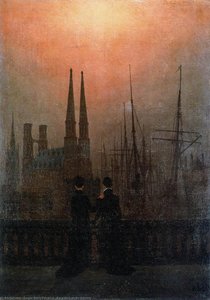

The Rejection of Reason: The Intellectual Dawn of Romanticism
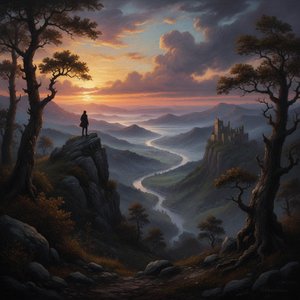 The Power of Emotion: A Definitive Guide to the Sublime and Soulful Art of Romanticism
The Rejection of Reason: The Intellectual Origins of Romanticism The Evocative Brushstroke: Exploring Emotion, Individuality & the Sublime in Romanticism's Artistic Landscape The Dawn of Feeling: Romanticism's Rejection of Enlightenment Rationality T...
To understand the profound impact of Romantic landscape art, one must first envision the rigid, sunlit world of the Enlightenment that preceded it. For decades, European thought was anchored in the cool precision of logic, scientific inquiry, and a structured symmetry that celebrated the measurable and the observable. It was an era of clarity, yet as the Industrial Revolution began to reshape the continent with burgeoning factories and increasingly crowded, alienating cities, a deep spiritual discontent took root. The clinical order of the age started to feel insufficient for capturing the true complexity of the human experience. This seismic shift in the late 18th century represented a fundamental re-evaluation of what it meant to be human, moving away from the mathematical perfection of Neoclassicism toward a fervent embrace of emotion and intuition.
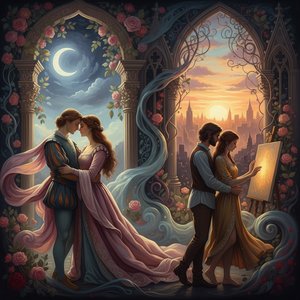
This movement was not merely an aesthetic alternative; it was a passionate rebellion against the perceived coldness of modernity. Influenced by thinkers such as Jean-Jacques Rousseau, who championed subjectivity and argued that genuine understanding stems from personal feeling rather than objective analysis, Romanticism sought to reclaim the soul from the grip of pure intellect. Artists began to turn away from the rigid social conventions of their time, seeking refuge in a reimagined past—particularly a medieval era characterized by chivalry and organic community—and in the untamed reaches of the human psyche. It was a period where the artist’s internal landscape became just as significant as the external world, paving the way for an art that prioritized the evocative brushstroke over the instructional line.
Defining the Sublime: Nature’s Uncontrollable Majesty and Terror
 Sublime (philosophy)
In aesthetics, the sublime (from Latin sublīmis 'uplifted, lofty, exalted, etc.; elevated, raised') is the quality of greatness, whether physical, moral, intellectual, metaphysical, aesthetic, spiritual, or artistic. The term especially refers to a g...
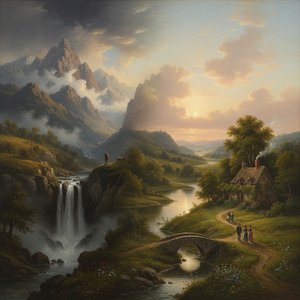
At the very heart of the Romantic movement lies the concept of the Sublime—a quality of greatness that transcends all possibility of calculation, measurement, or imitation. In the realm of aesthetics, the sublime refers to an experience of such overwhelming magnitude that it borders on the terrifying. Unlike the beautiful, which offers pleasure through harmony and proportion, the sublime evokes a sense of awe mixed with a profound realization of human insignificance. It is found in the vastness of a mountain range, the fury of a storm, or the infinite depth of a darkened sea. This fascination with the uncontrollable power and unpredictability of nature offered an essential alternative to the ordered world of Enlightenment thought.
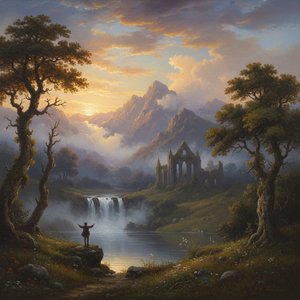
The sublime serves as a bridge between the physical landscape and the metaphysical spirit. When an observer gazes upon a scene of cataclysmic extremes, they are confronted with the sheer scale of existence. This tension between the awe-inspiring beauty of the natural world and the inherent danger it poses creates a unique emotional resonance. It is a state of being uplifted yet humbled, where the boundaries between the self and the universe begin to blur. For the Romantic artist, capturing this sensation required more than mere technical skill; it demanded an ability to translate the invisible tremors of the soul into visible textures of light, shadow, and atmosphere.
Masters of the Atmospheric: From Friedrich’s Mist to Turner’s Light
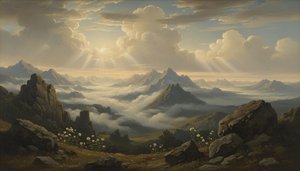 Ethereal Eminence: The Dawn of the Sublime
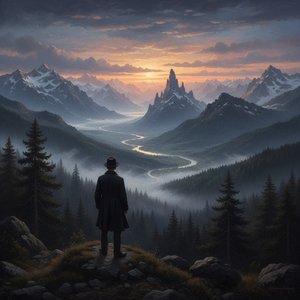
A Vision of Sublime Grandeur Ethereal Eminence: The Dawn of the Sublime is a breathtaking homage to the Romanticist tradition, breathing modern life into the evocative aesthetics of Caspar David Friedrich. This panoramic masterpiece captures a moment...
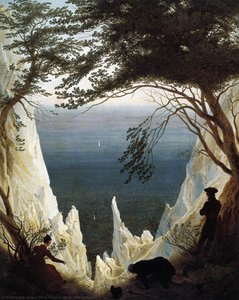
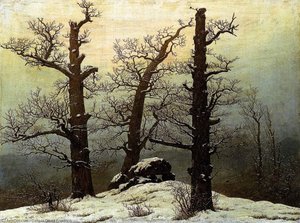
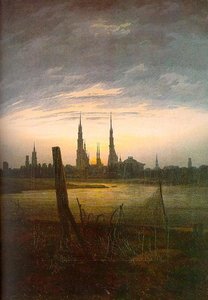
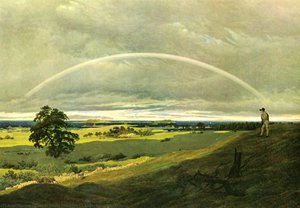
The execution of such profound concepts required a mastery of atmosphere that few artists in history have ever matched. Caspar David Friedrich stands as perhaps the most iconic figure of this era, his works often serving as windows into the spiritual void. In masterpieces like Wanderer above the Sea of Fog, we see the quintessential Romantic motif: a solitary figure positioned against a landscape of rugged, jagged peaks piercing through a sea of low-lying mist. Friedrich utilized dramatic crepuscular rays and a high-contrast interplay between dark, weathered foreground textures and ethereal, pale gold glows to create a sense of profound atmospheric transition. His landscapes are not merely scenery; they are meditations on solitude and the divine.
In contrast to Friedrich’s more contemplative stillness, J.M.W. Turner pushed the boundaries of light and motion toward the very edge of abstraction. Turner’s work captures the elemental fury of nature—the swirling vortex of a shipwreck or the blinding brilliance of a setting sun. His technique, characterized by fluid, almost liquid brushwork, allows the viewer to feel the heat of the sun and the spray of the salt sea. Alongside these masters, other artists like Barend Cornelis Koekkoek brought a meticulous Dutch tradition to the movement, blending fine detail with the dramatic emotional resonance of the Romantic spirit. Through their varied approaches, these artists transformed the landscape into a stage for the most intense human emotions.
The Emotional Landscape: Subjectivity, Intuition, and the Individual Soul
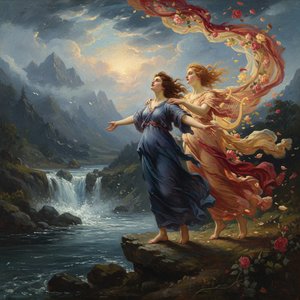 The Sublime and the Sensual: Exploring Emotion & Individuality in Romanticism's Artistic Revolution
Introduction: The Dawn of Feeling – Romanticism's Rejection of Enlightenment Reason Wikipedia: Romanticism Romanticism (also known as the Romantic movement or Romantic era) was an artistic and intellectual movement that originated in Europe towards t...
Romanticism fundamentally altered the relationship between the viewer and the canvas by elevating subjectivity above all else. The movement argued that beauty is more than an affair of form; it is something that evokes a strong, visceral emotional response. This emphasis on individualism meant that no two observers would see the same landscape; each person brought their own passions, dreams, and spiritual yearnings to the encounter. The landscape became a mirror for the internal state of the individual, where a turbulent sky might reflect a troubled mind, or a serene valley might represent a moment of profound peace.
This era celebrated the power of intuition over instruction, allowing for an art that was deeply personal and often mysterious. The fascination with the exotic, the supernatural, and the nocturnal allowed artists to explore the darker, more enigmatic corners of human existence. By prioritizing the individual’s unique perspective, Romanticism paved the way for a modern understanding of creativity—where the artist's primary duty is not to reproduce reality with photographic accuracy, but to communicate the truth of their own emotional experience. It is this very soulfulness that continues to captivate collectors and enthusiasts today, as these works offer a timeless connection to the depths of human feeling.
Curating Grandeur: Integrating Romantic Landscapes into Modern Interiors
--- title: Romanticism - The Metropolitan Museum of Art author: Kathryn Calley Galitz url: https://www.metmuseum.org/essays/romanticism hostname: metmuseum.org description: In Romantic art, nature—with its uncontrollable power, unpredictability, and ...
For the discerning collector or interior designer, integrating Romantic landscapes into a contemporary space offers an unparalleled opportunity to introduce depth, history, and narrative. These works are not merely decorations; they are architectural anchors that can transform a room from a mere living space into a sanctuary of thought. A large-scale, multi-panel reproduction of a Turner-esque seascape can serve as a breathtaking focal point for a wide wall or a grand staircase, creating a sense of movement and drama that commands attention. The rich, deep tonal ranges found in hand-painted oil reproductions provide a tactile luxury that modern prints simply cannot replicate.
When curating such pieces, one must consider the interplay of light and texture. The visible brushstrokes and the subtle use of impasto in a high-quality oil painting catch the ambient light of a room, providing a dynamic quality that changes throughout the day. For those seeking to create a cohesive aesthetic, we recommend pairing these evocative landscapes with solid wood frames in gold leaf or deep espresso to enhance their historical weight. Whether you are looking to recreate the atmospheric grandeur of a museum gallery or wish to commission a custom piece that reflects your own personal journey, the timeless power of Romanticism remains an enduring choice for those who value art as a profound emotional experience.
At ArtsDot.com, we specialize in preserving this legacy through our exquisite collection of hand-painted oil reproductions. Our master artists, many of whom hold degrees from prestigious Fine Arts academies, work meticulously to capture the soul and texture of these historical masterpieces on 100% cotton canvas. From bespoke commissions that transform your personal photos into Romantic-style treasures to large-format murals for luxury hospitality projects, we provide a full-service experience backed by a 100% satisfaction guarantee. Discover how you can bring the sublime into your home by exploring our vast library of over 465,000 paintings at ArtsDot.com.