



The Illusion of Infinity: Defining Linear Perspective
To gaze upon a truly great Renaissance masterpiece is to experience a profound sense of vertigo, a sudden realization that the flat surface of a canvas has dissolved into an endless window. This breathtaking phenomenon is not merely a trick of the light or a clever arrangement of colors; it is the result of linear perspective, one of the most significant intellectual triumphs in the history of human expression. At its core, linear perspective is a mathematical system designed to mimic how the human eye perceives the world—a method where parallel lines appear to converge as they recede into the distance, creating a structured illusion of three-dimensional space on a two-dimensional plane.
Before this discovery, much of medieval art relied upon hierarchical scaling, where the importance of a figure was dictated by their size rather than their position in space. The introduction of perspective fundamentally altered the viewer's relationship with the artwork. It invited us not just to observe a sacred scene, but to step into it. By establishing a logical framework for depth, artists could manipulate the viewer’s gaze, guiding the eye through complex landscapes and architectural marvels toward a singular, focused destination. This mastery of space transformed painting from a symbolic medium into a window onto a tangible, measurable reality.
Brunelleschi’s Breakthrough: The Mathematical Birth of Depth
The dawn of this spatial revolution can be traced back to the streets of Florence, specifically to the brilliant mind of Filippo Brunelleschi. An architect and engineer of unparalleled vision, Brunelleschi did more than just design the magnificent dome of the Florence Cathedral; he decoded the geometry of sight itself. Through a series of rigorous experiments involving mirrors and precise measurements, he demonstrated that the convergence of lines toward a single point could be calculated with mathematical certainty. This was not merely an artistic innovation but a scientific one, bridging the gap between the humanities and the empirical sciences.
Brunelleschi’s discovery provided the foundational blueprint for the Renaissance spirit, which sought to harmonize human reason with divine beauty. By applying the principles of geometry to the canvas, artists were suddenly equipped with a tool that could render the physical world with unprecedented accuracy. This breakthrough allowed for the creation of believable environments where light, shadow, and distance worked in concert. The architect’s precision became the painter’s greatest ally, turning the act of composition into an exercise in structural engineering, ensuring that every element within a frame occupied its rightful place in a coherent, measurable universe.
Geometric Precision: Analyzing Paolo Uccello’s Perspective Studies
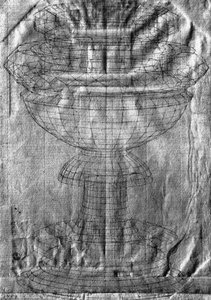
While Brunelleschi provided the theory, artists like Paolo Uccello became the obsessive practitioners of its application. For Uccello, perspective was not merely a tool for realism but a profound fascination with the beauty of pure geometry. His works, such as the Perspective Study of a Chalice and his explorations of the Mazzocchio, reveal an artist captivated by the way complex, curved surfaces interact with linear receding lines. In these studies, we see a departure from narrative storytelling in favor of a rigorous investigation into form and volume.
In Uccello’s hands, the canvas becomes a laboratory. His Perspective Study showcases an almost hypnotic level of precision, where every edge and shadow is calculated to reinforce the illusion of depth. He pushed the boundaries of what was possible, using geometric shapes to construct a world that felt both mathematically perfect and strangely otherworldly. To study his work is to witness the Renaissance obsession with order; he treated the vanishing point not just as a technical requirement, of a compositional necessity, but as a sacred intersection where mathematics meets the infinite.
The Vanishing Point: How Renaissance Masters Controlled the Viewer's Eye
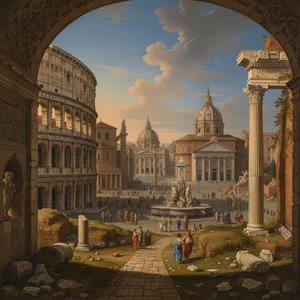
The true magic of linear perspective lies in the concept of the vanishing point—that singular, invisible location on the horizon line where all parallel lines seem to disappear. This point acts as the psychological anchor of a painting. By strategically placing this point, Renaissance masters could exert total control over the viewer's emotional and visual journey. A vanishing point placed low on the horizon might evoke a sense of overwhelming grandeur, making the viewer feel small beneath towering arches, while a central placement can create a sense of divine stability and balance.
This technique allowed for a sophisticated layering of meaning. An artist could lead the eye through a foreground filled with tactile, detailed objects—perhaps a fallen fruit or a draped cloth—through a middle ground of human drama, and finally toward a distant, luminous horizon. This progression creates a narrative rhythm, ensuring that the viewer does not simply see the painting but "reads" it from front to back. The vanishing point serves as the silent conductor of this visual orchestra, orchestrating the movement of light and attention to ensure that the most critical symbolic elements are never lost in the depth of the composition.
Beyond the Canvas: The Lasting Legacy of Spatial Innovation in Art History
The ripples of the Renaissance perspective revolution continue to move through the currents of art history, influencing everything from the dramatic chiaroscuro of the Baroque period to the structured compositions of modern realism. The ability to manipulate space fundamentally changed our understanding of what art could achieve; it turned the canvas into a stage for the human experience, capable of hosting both the intimate and the epic. This legacy is not confined to museums; it lives on in our very way of perceiving the world around us.
Today, as we look back upon these masterworks, we recognize that the power of perspective lies in its ability to marry the tangible with the transcendent. It taught us that through the rigorous application of logic and observation, we can capture the essence of reality and present it in a way that feels eternal. The mastery of depth remains one of the most profound legacies of the Old Masters, reminding us that within the boundaries of a frame, there exists an infinite capacity for discovery, wonder, and the pursuit of truth.
At ArtsDot.com, we celebrate this enduring legacy of human creativity. Our mission is to bring the profound depth and tactile beauty of these historical masterpieces into the modern home. Whether through our meticulously handcrafted oil reproductions, which capture every intentional brushstroke and layer of texture, or our high-fidelity Giclée prints, we strive to preserve the spirit of the Renaissance for a new generation of collectors. We invite you to explore our vast library of art history and find a piece that brings the mathematical elegance and emotional resonance of the masters into your own space.